Deprecated: Accessing static trait property MatthiasWeb\RealMediaLibrary\Vendor\MatthiasWeb\Utils\Localization::$PACKAGE_INFO_BACKEND is deprecated, it should only be accessed on a class using the trait in /var/www/html/public_html/wp-content/plugins/real-media-library/vendor/devowl-wp/utils/src/PackageLocalization.php on line 37
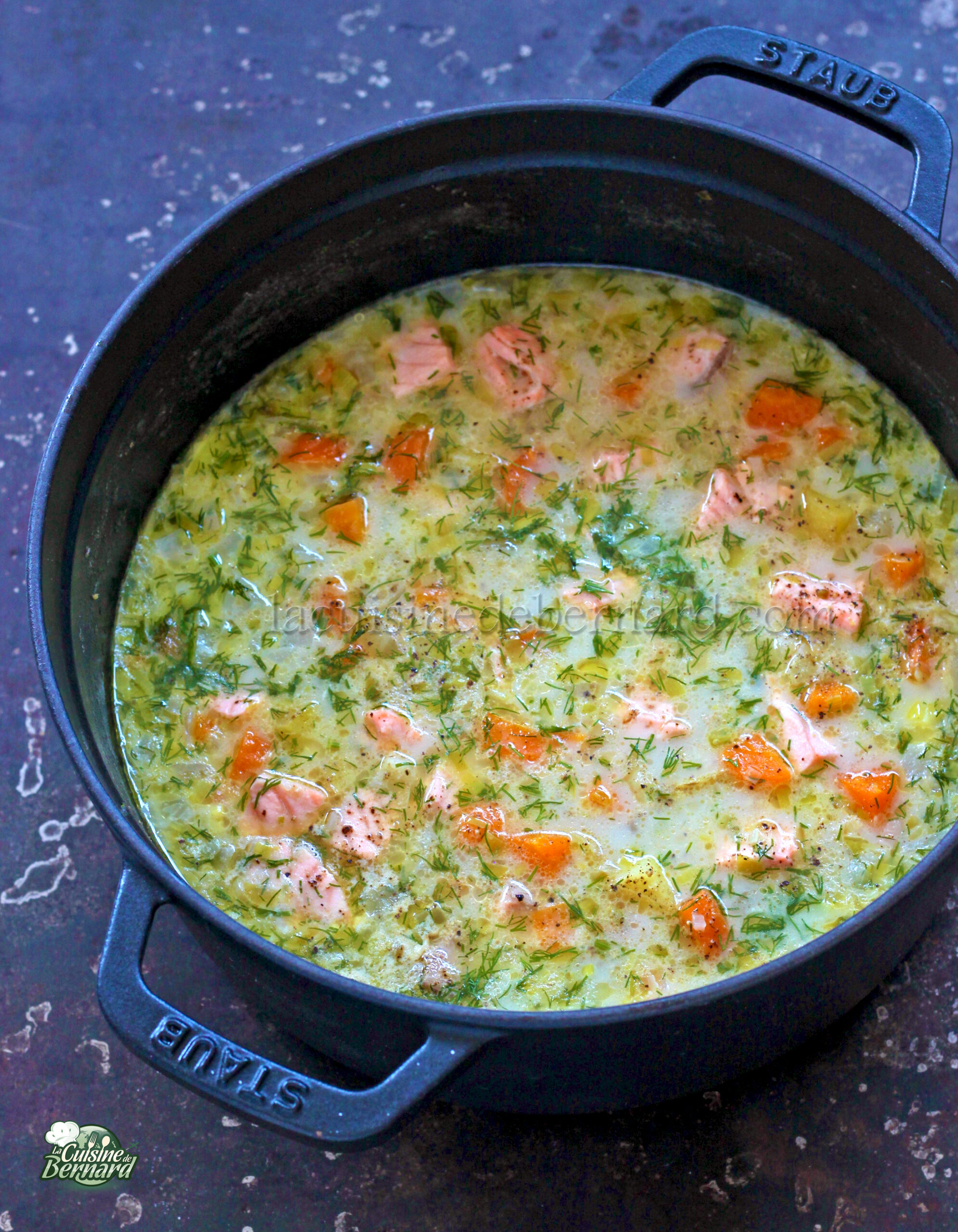
A deliciously comforting, nourishing and balanced soup! If you’re new to this Finnish dish, now’s the time to get started, because it’s not only very easy to make, but also very, very good! The soup is quick to prepare and the salmon is cooked at the last minute, just before dinner. I just added a small piece of fennel to this traditional dish, as seen once in Helsinki. And just writing the recipe makes me salivate all over again!
Lohikeitto for 4 people:
- 1 small leek
- 1 small fennel
- 50g semi-salted butter
- 400-500g small potatoes
- 3-4 carrots
- 1.25 liters of fish stock (I use 3 teaspoons of stock powder for 1.25 liters of water).
- 10 sprigs fresh dill
- 15cl heavy cream
- 400g skinless, boneless salmon fillet
- salt pepper
Préparation :
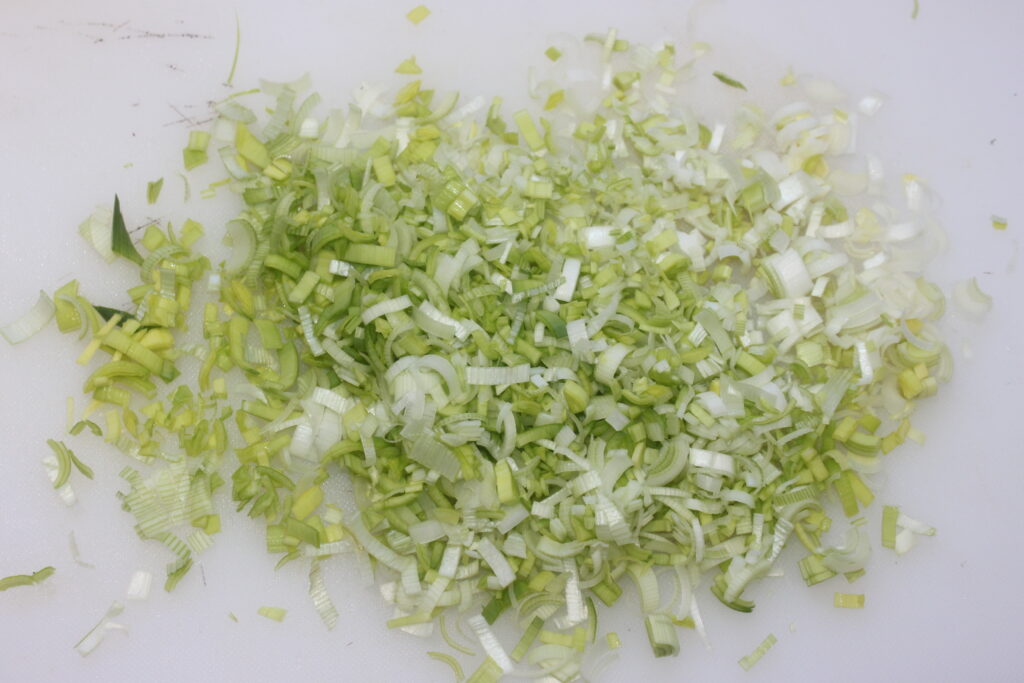
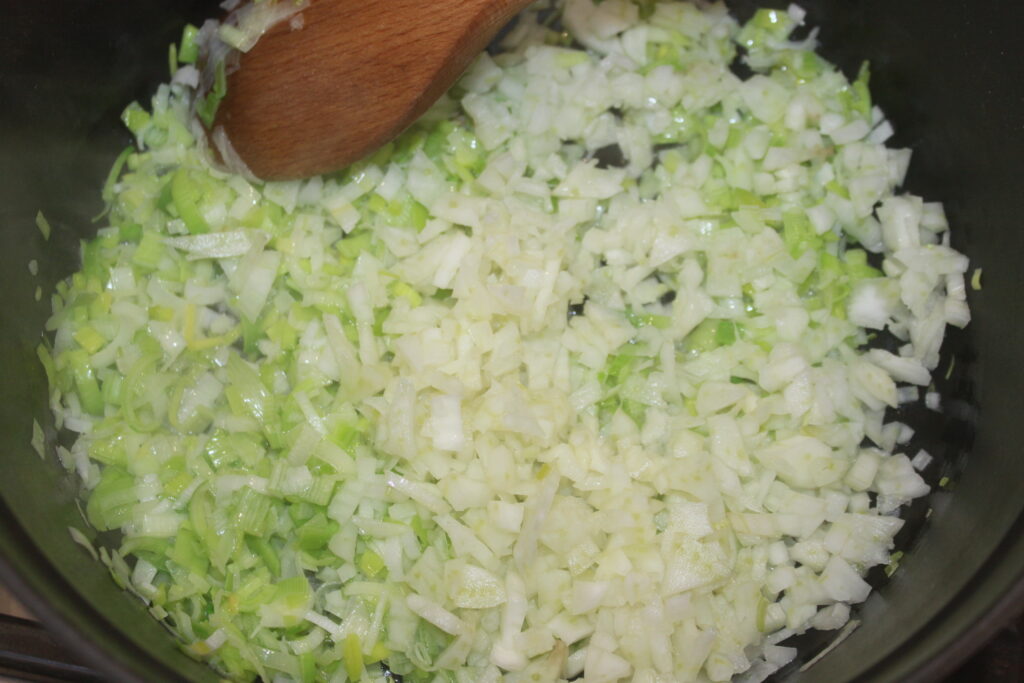
Start by cleaning and cutting the leek and fennel into very small pieces.
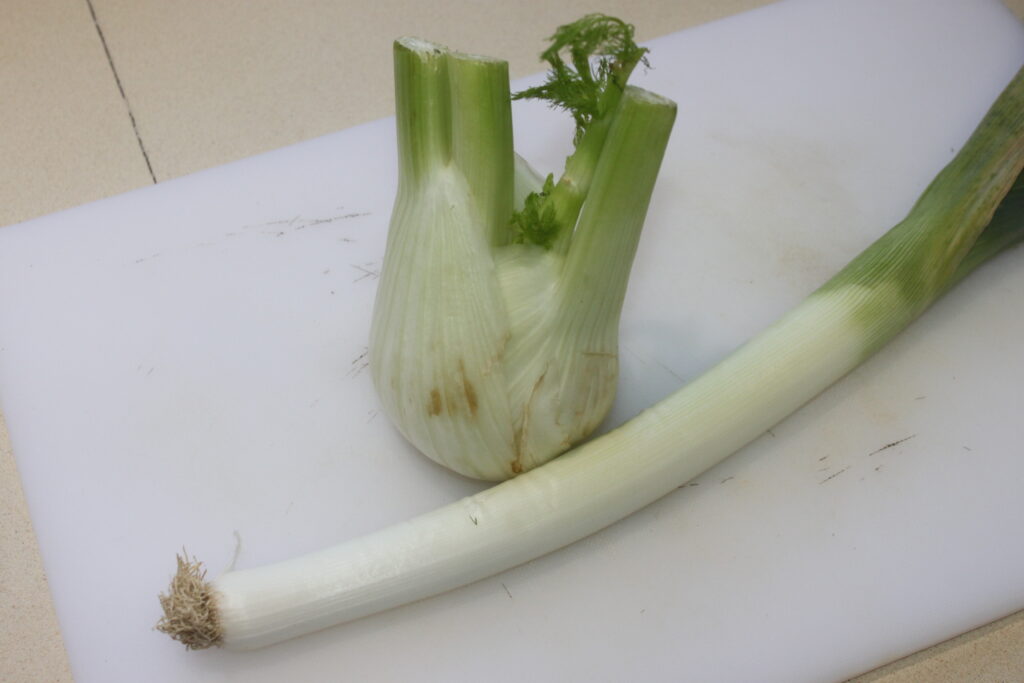
To do this, remove the leafy part of the leek and its roots. Strain the top of the leaves to get rid of any soil, then chop.
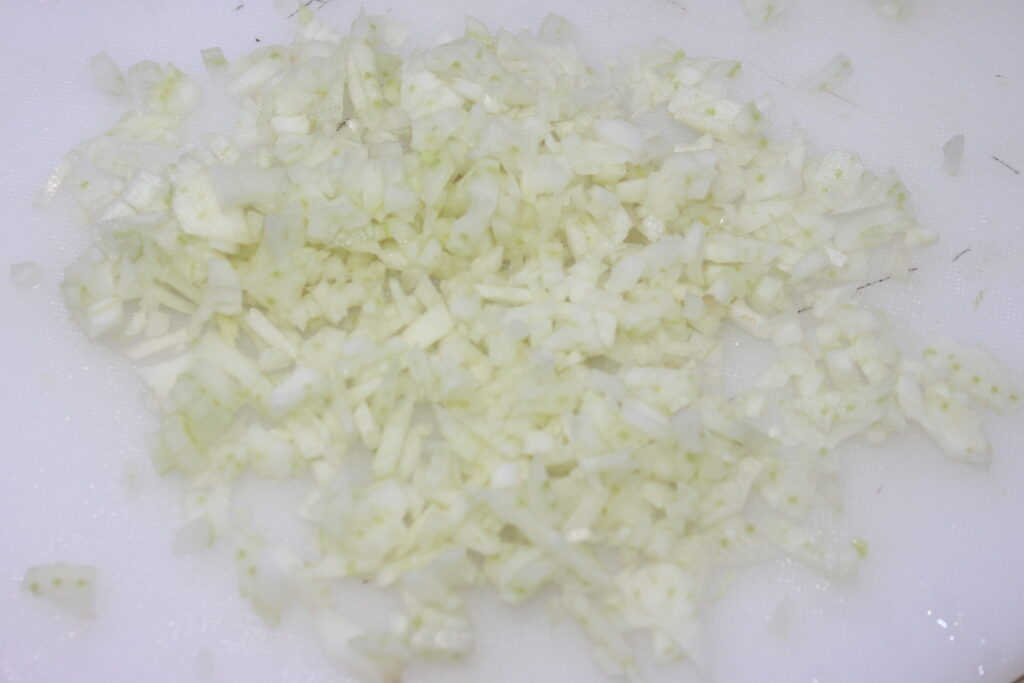
Cut the fennel in the same way.
Cuisson :
Place the butter in a large saucepan or casserole dish.
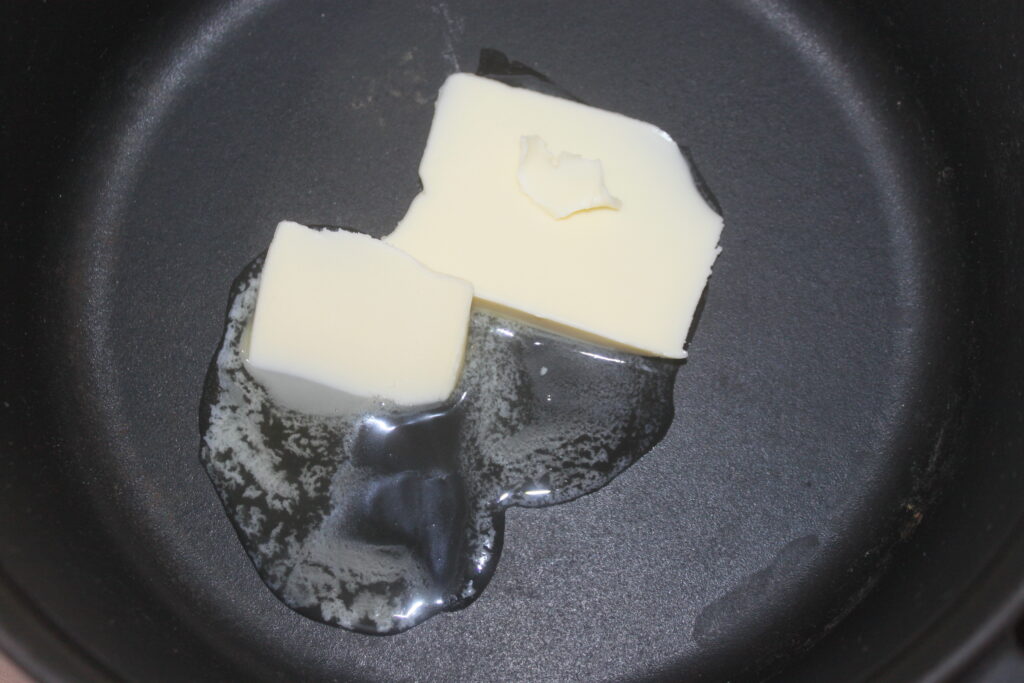
Heat over moderate heat with the leek and fennel. Cook for 7 to 8 minutes.
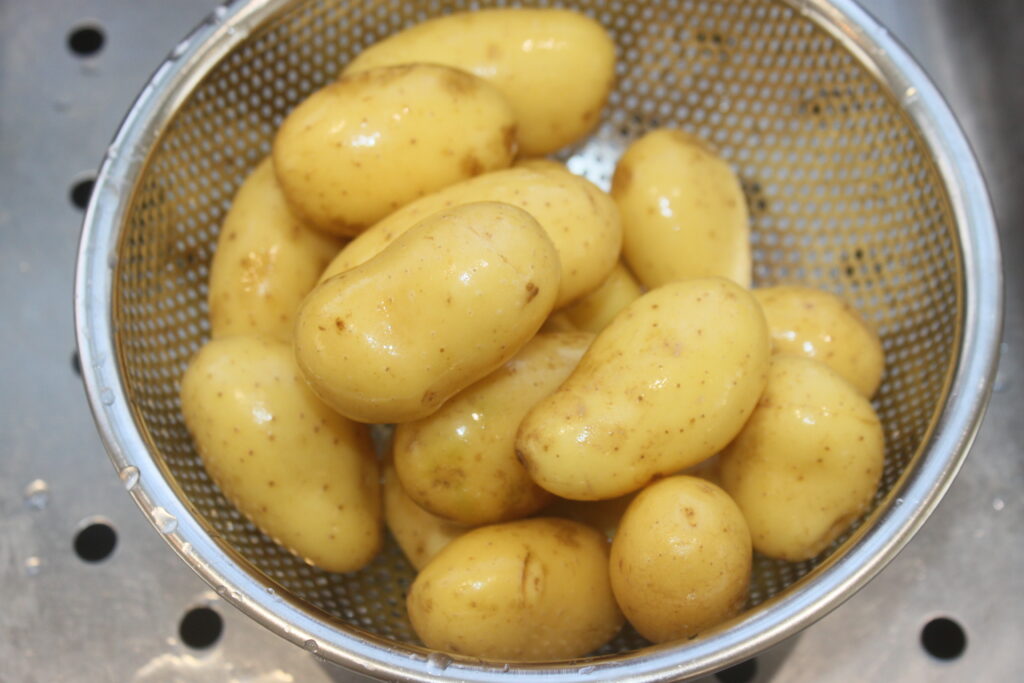
I used small potatoes for this recipe.
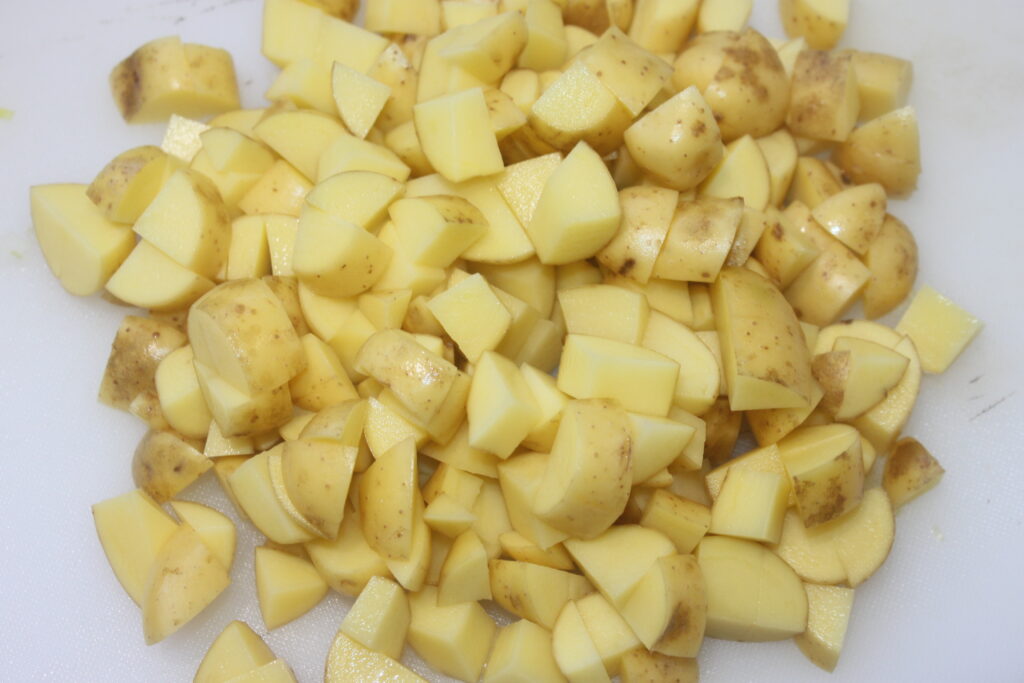
Cut them into pieces. I keep the skin on, but you’re free to peel them.
Peel and chop the carrots.
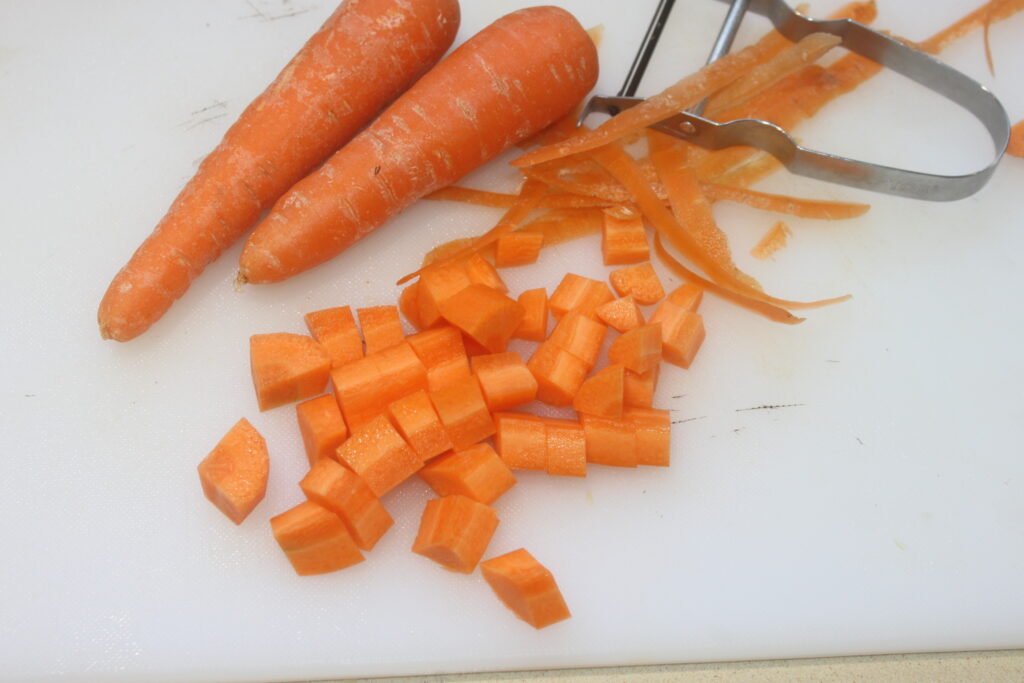
Pour into the casserole dish.
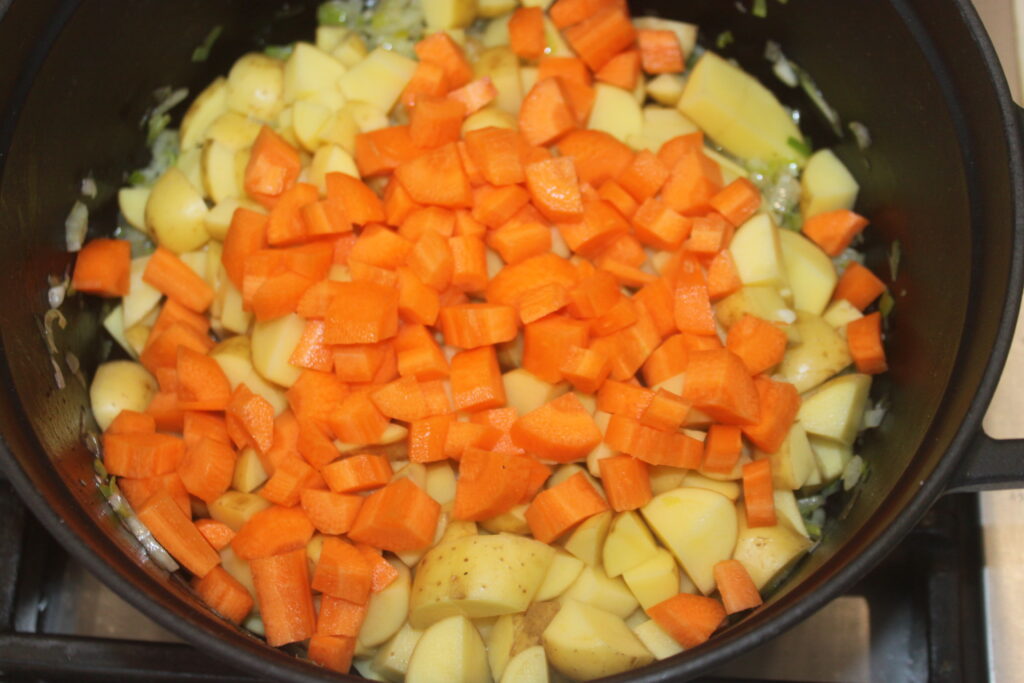
Pour in 1.25 liters of water. I simply added 3 teaspoons of powdered fish stock, no more!
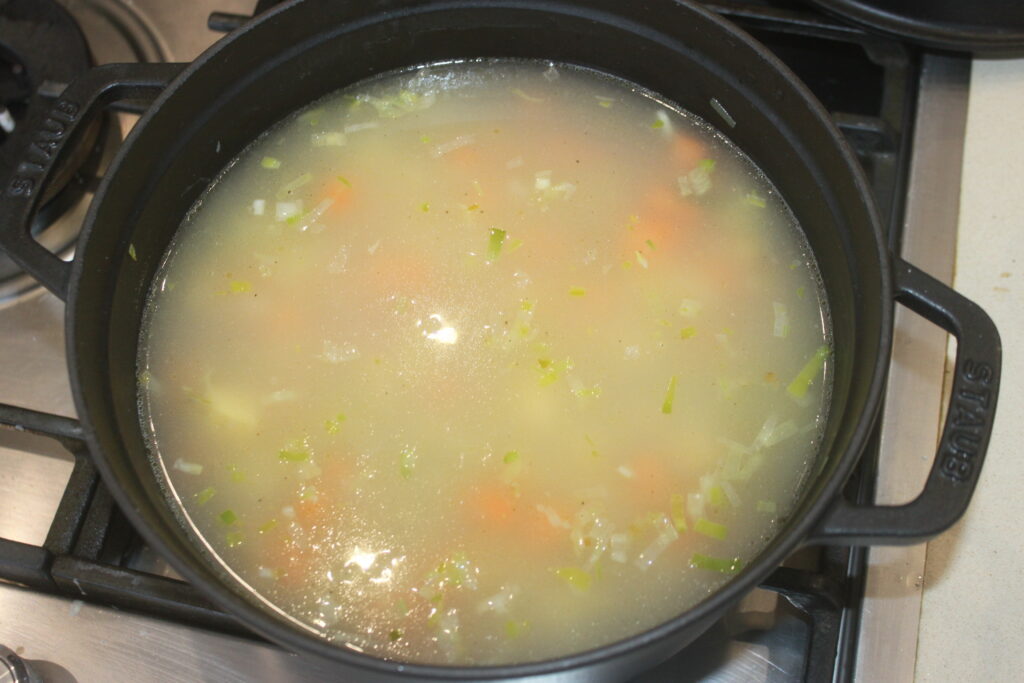
Bake for 20 minutes until potatoes are tender. Then pour in the cream.
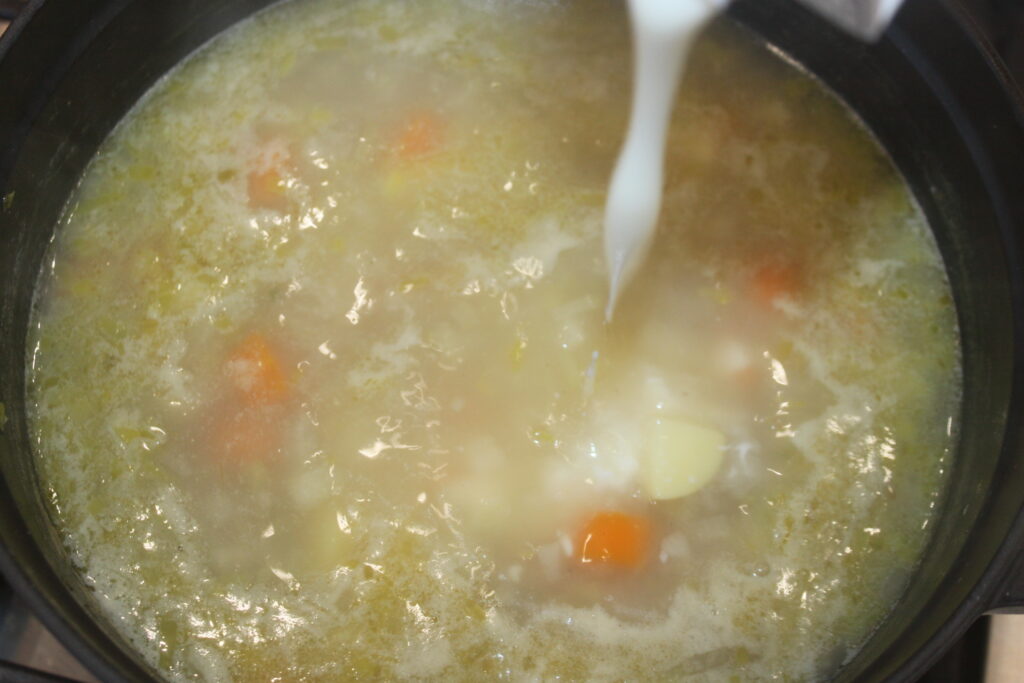
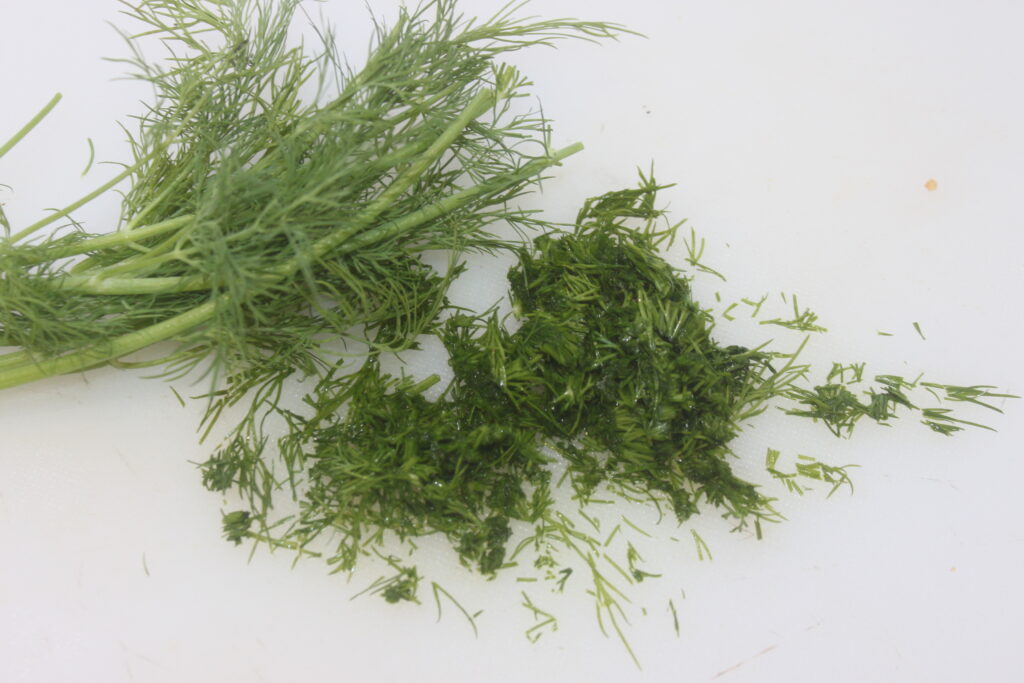
Finely chop the dill and add it to the casserole.

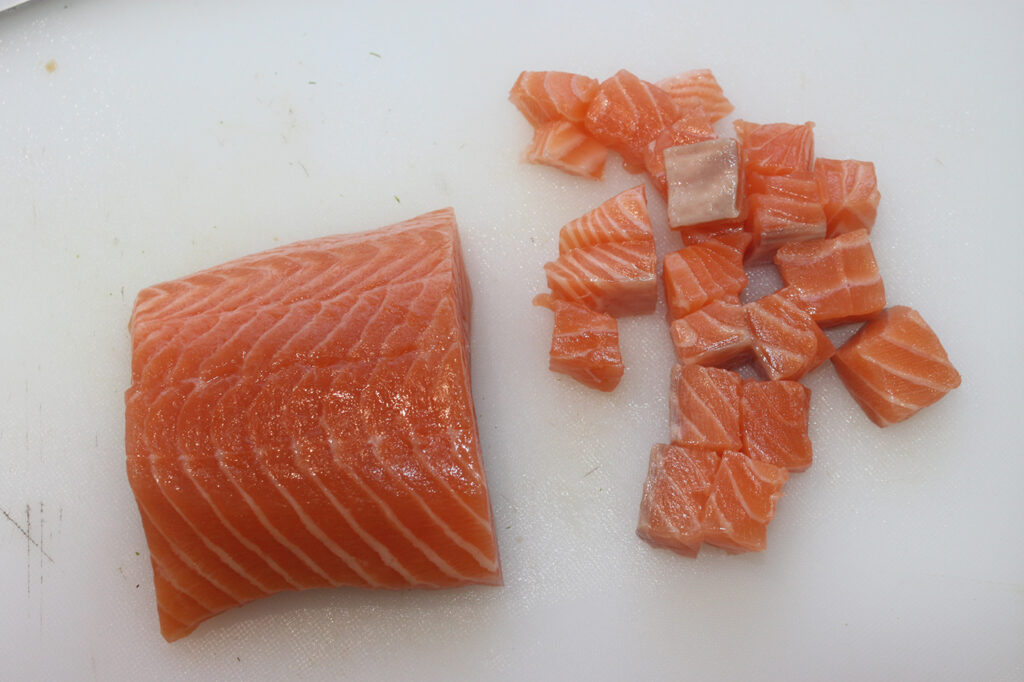
Cut the salmon into cubes.
Add the salmon 3 minutes before serving. You can therefore prepare the soup in advance without the salmon, then reheat it at the last minute by cooking the fish just before serving.
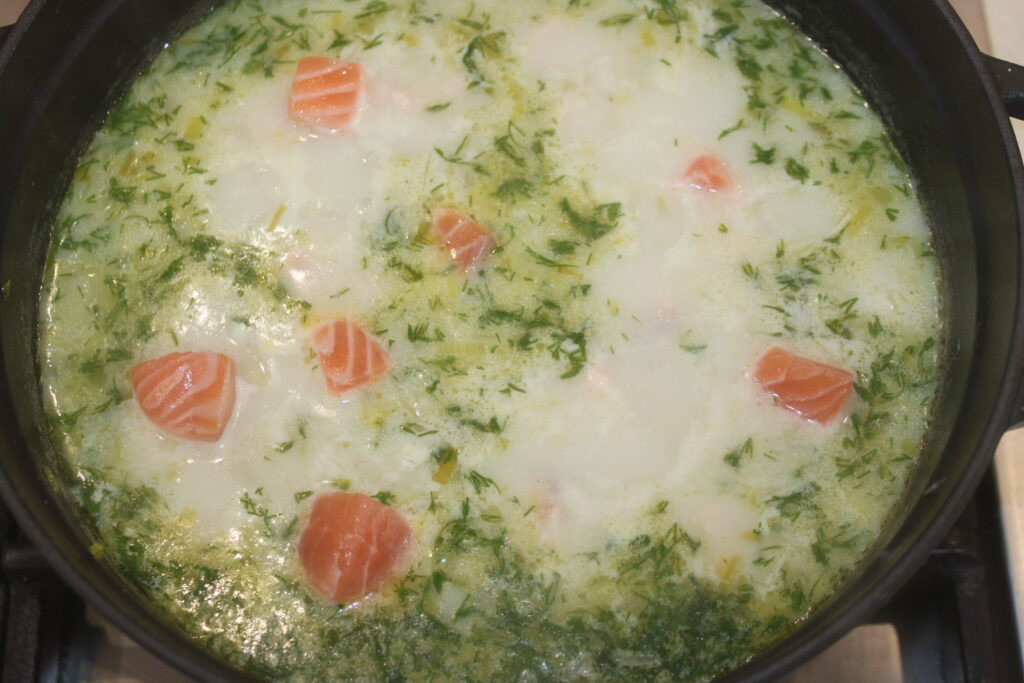
Simmer the salmon for 3 minutes, then serve immediately! Add salt and pepper to taste.
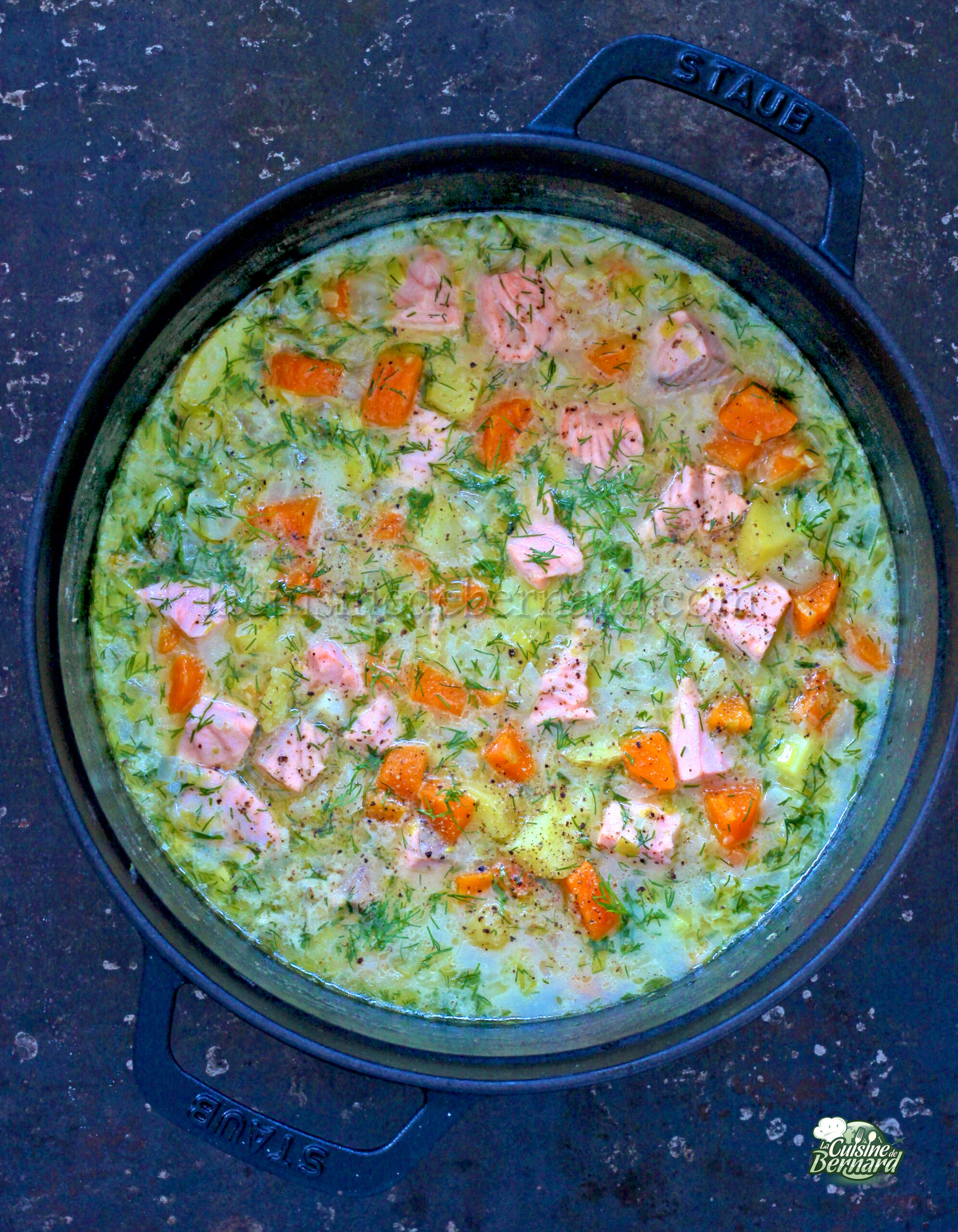
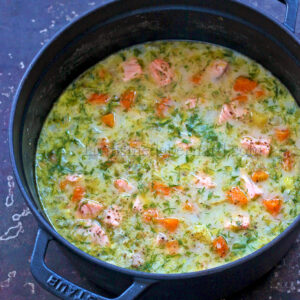
LohiKeitto (soupe de saumon finlandaise)
Ingredients
- 1 petit poireau
- 1 petit fenouil
- 50 g beurre demi-sel
- 400 g pommes de terre type grenail
- 4 carottes
- 1,25 l fumet de poisson
- 10 branches d'aneth
- 15 cl crème fraiche épaisse
- 400 g saumon cru
- sel, poivre
Instructions
- Commencez par nettoyer et couper en très petits morceaux le poireau et le fenouil.
- Enlevez pour cela la partie trop feuillue du poireau et ses racines. Passez bien le haut des feuilles pour vous débarrasser de la terre éventuelle, puis hachez-le. Coupez le fenouil de la même façon.
- Placez le beurre dans une grande casserole ou une cocotte.
- Faites chauffer sur feu modéré avec le poireau et le fenouil. Faites cuire le tout 7 à 8 minutes.
- J’ai pris pour cette recette, des petites pommes de terre.
- Coupez-les en morceaux. Je garde la peau, mais libre à vous de les éplucher.
- Épluchez et coupez les carottes en morceaux.
- Versez le tout dans la cocotte.
- Versez 1,25 litre d’eau. J’ai simplement ajouté 3 cuillerées à café de fumet de poisson en poudre, pas plus !
- Faites cuire 20 minutes jusqu’à ce que les pommes de terre soient tendres. Versez alors la crème.
- Hachez finement l’aneth que vous ajouterez dans la cocotte.
- Coupez le saumon en cubes.
- Ajoutez-le 3 minutes avant de servir la soupe. Vous pourrez donc préparer la soupe en avance sans le saumon, puis la réchauffer au dernier moment en faisant cuire le poisson juste avant de passer à table.
- Laissez mijoter le saumon 3 minutes puis servez sans attendre ! Salez et poivrez à votre convenance.
Nutrition
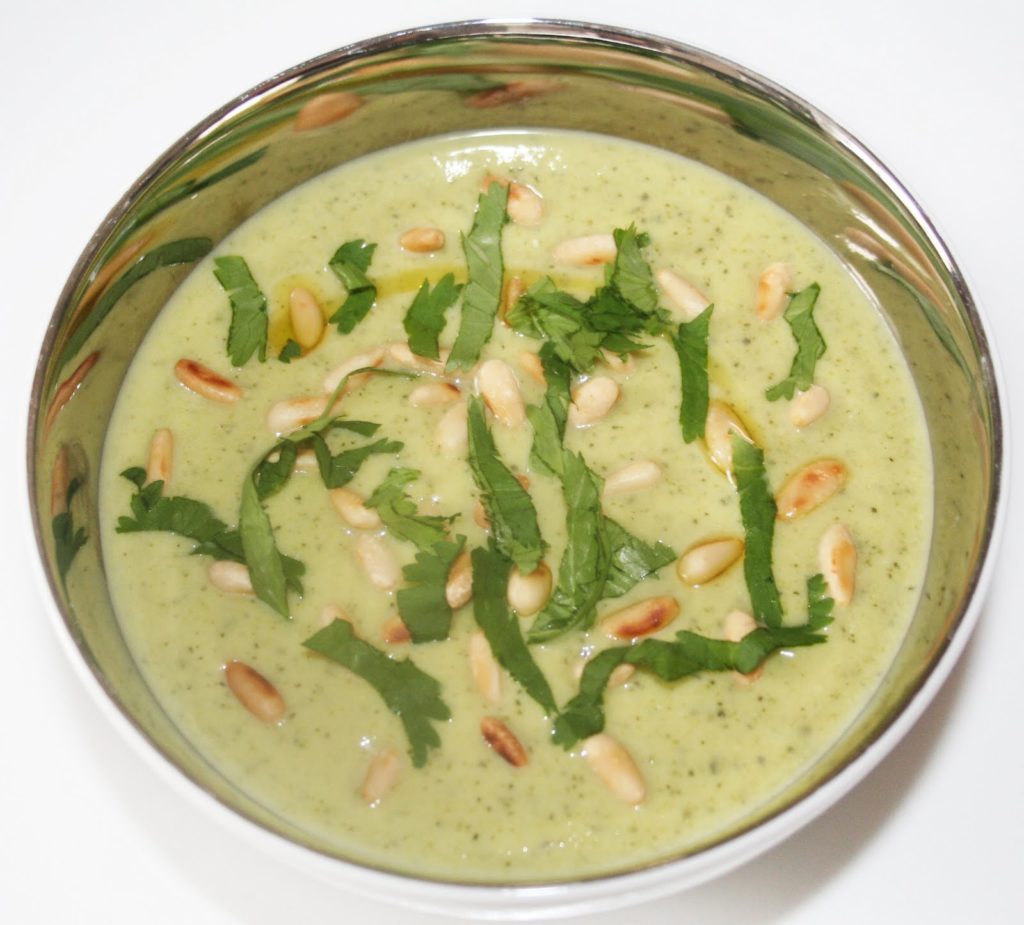
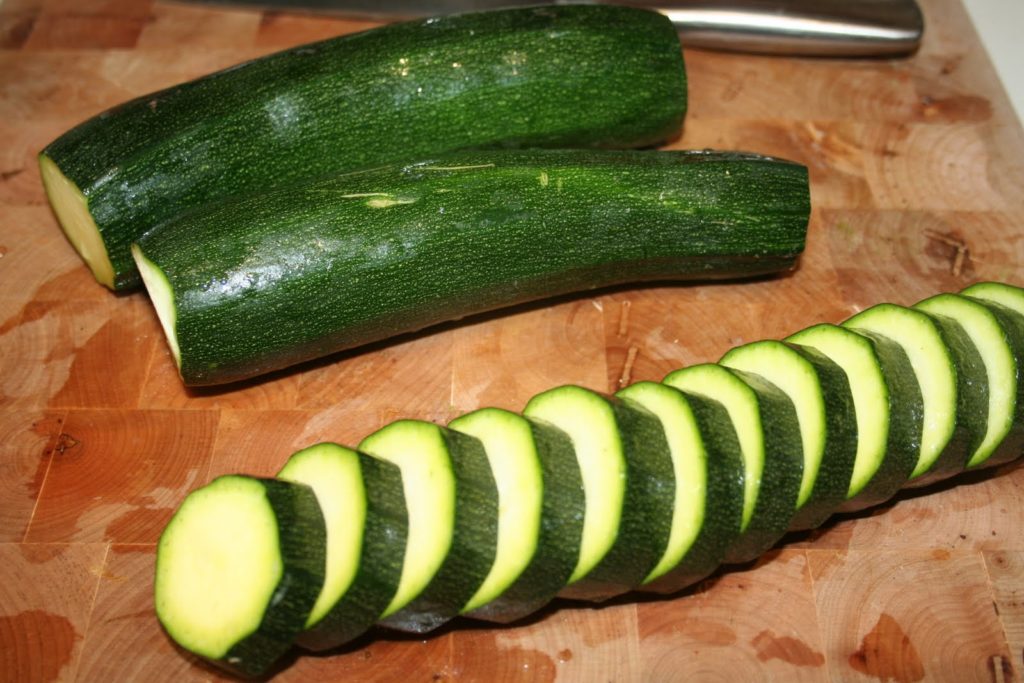
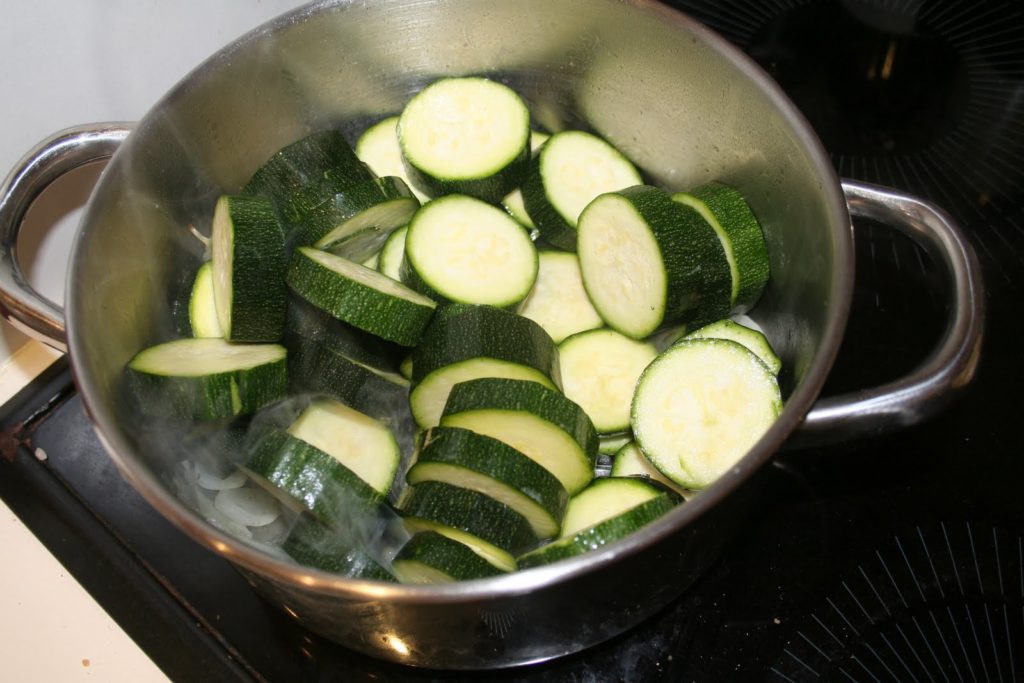
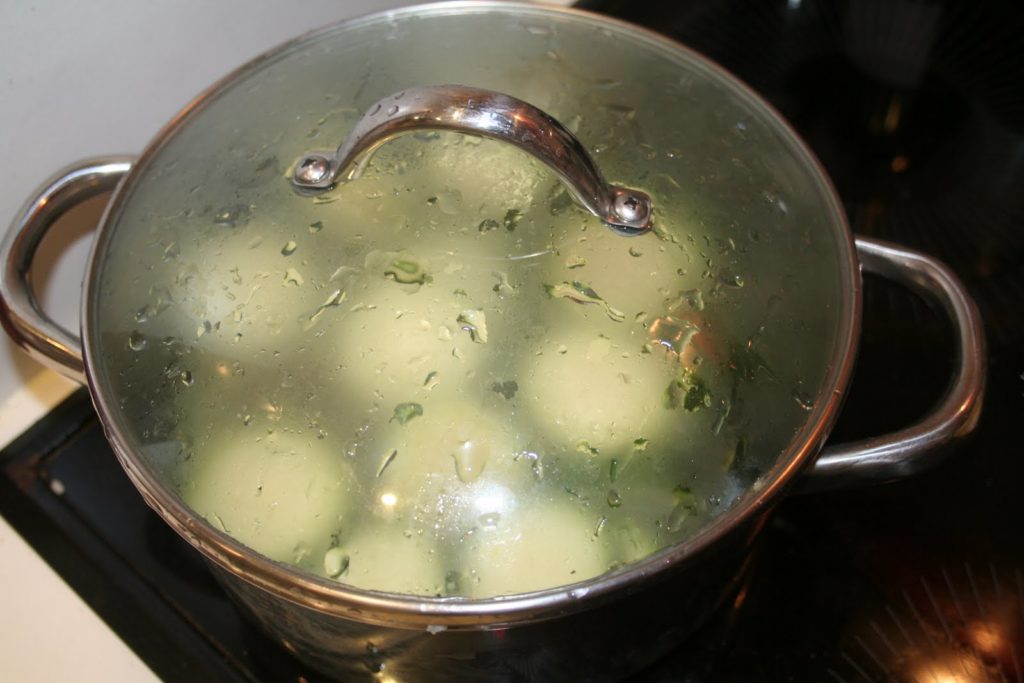
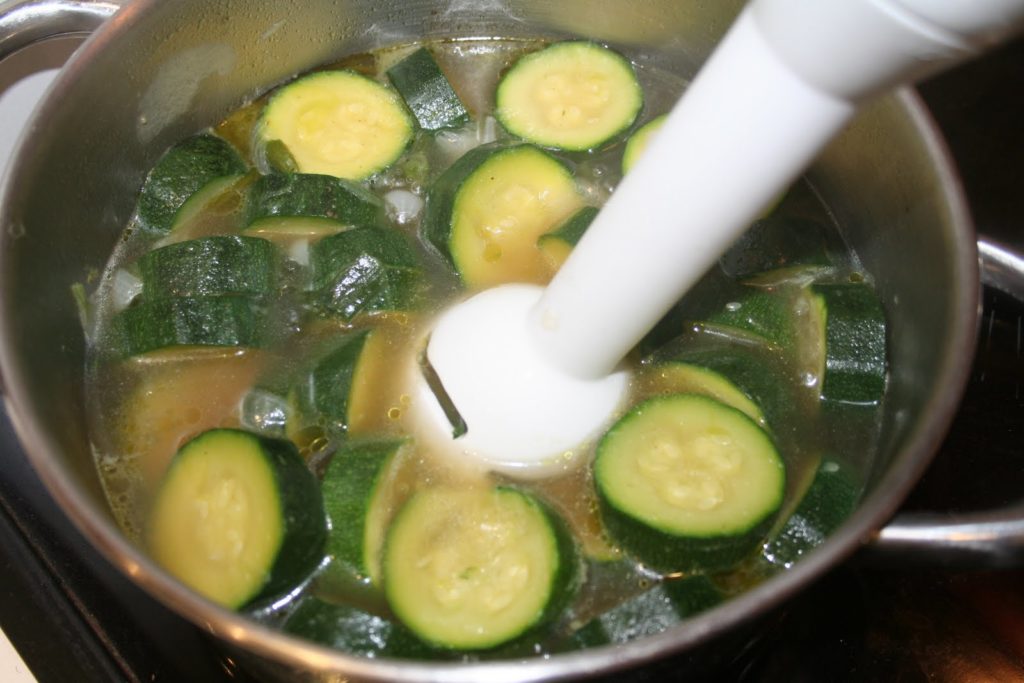
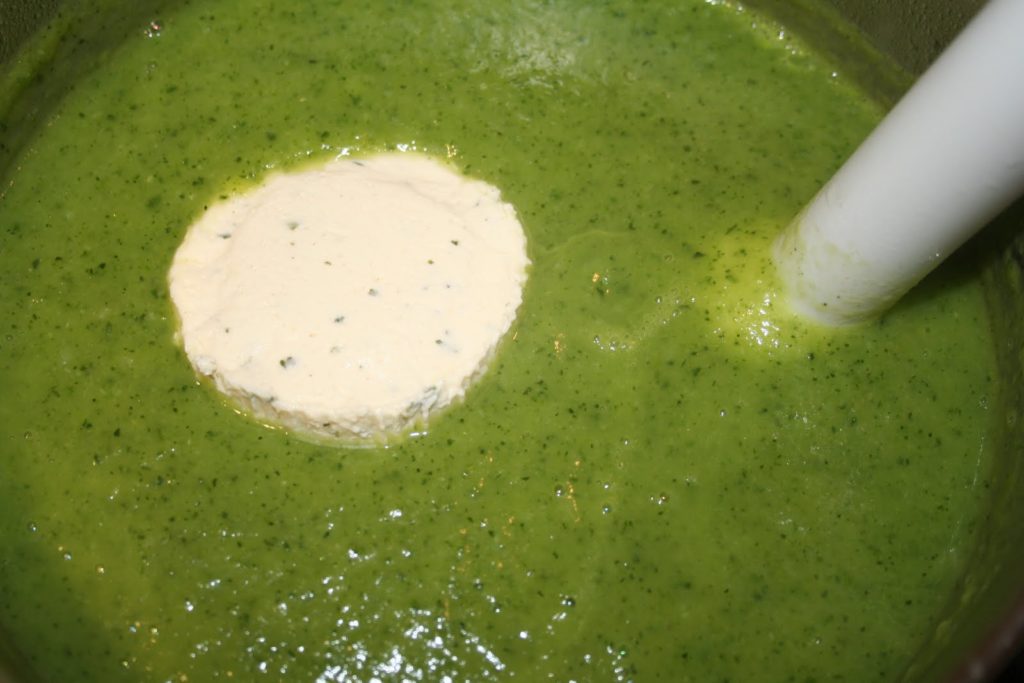
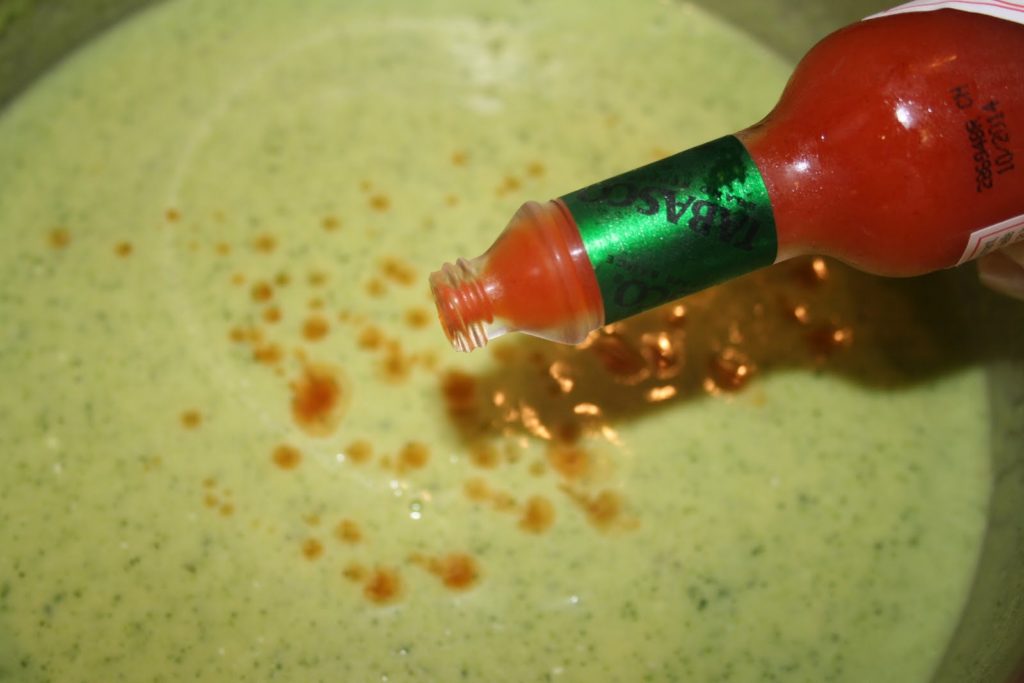
Recipe for “cold zucchini soup”:
-3 medium zucchini
-3 white onions
-3 tablespoons of olive oil
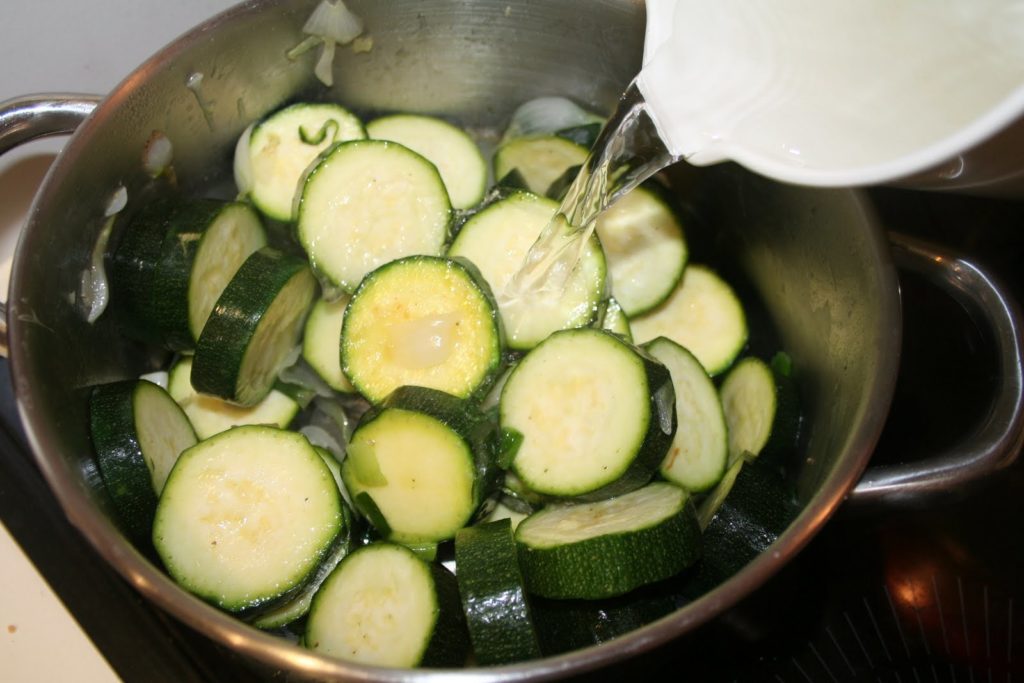
-500g of water (a little more if the zucchini are huge!)
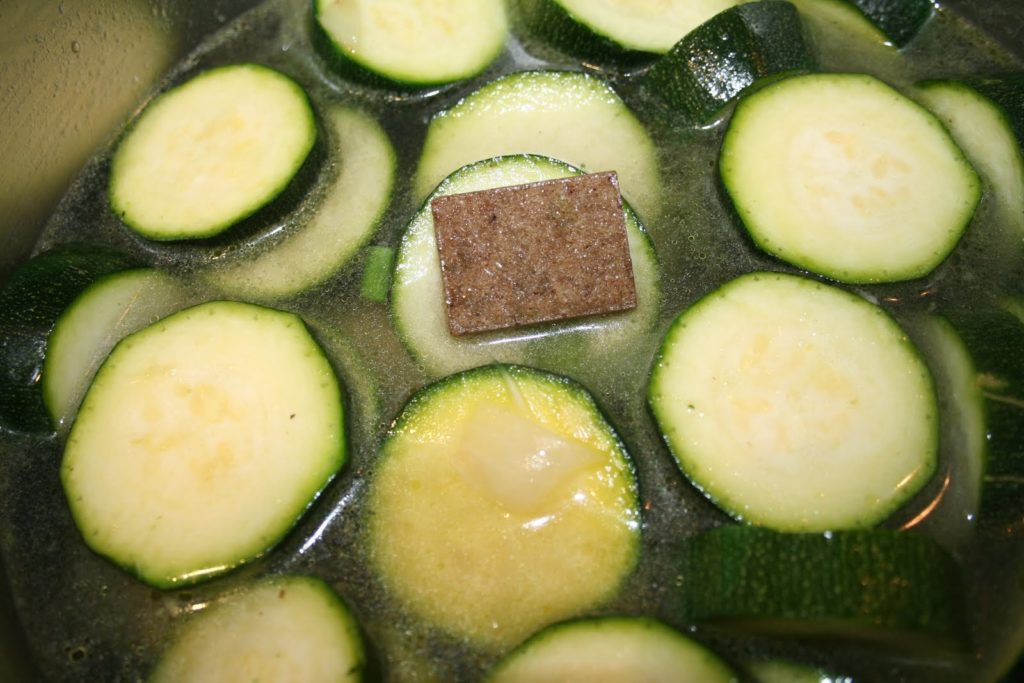
-1 bouillon cube
-100g of “boursin ail et fines herbes
-salt, pepper, tabasco
-fresh cilantro
-pine nuts


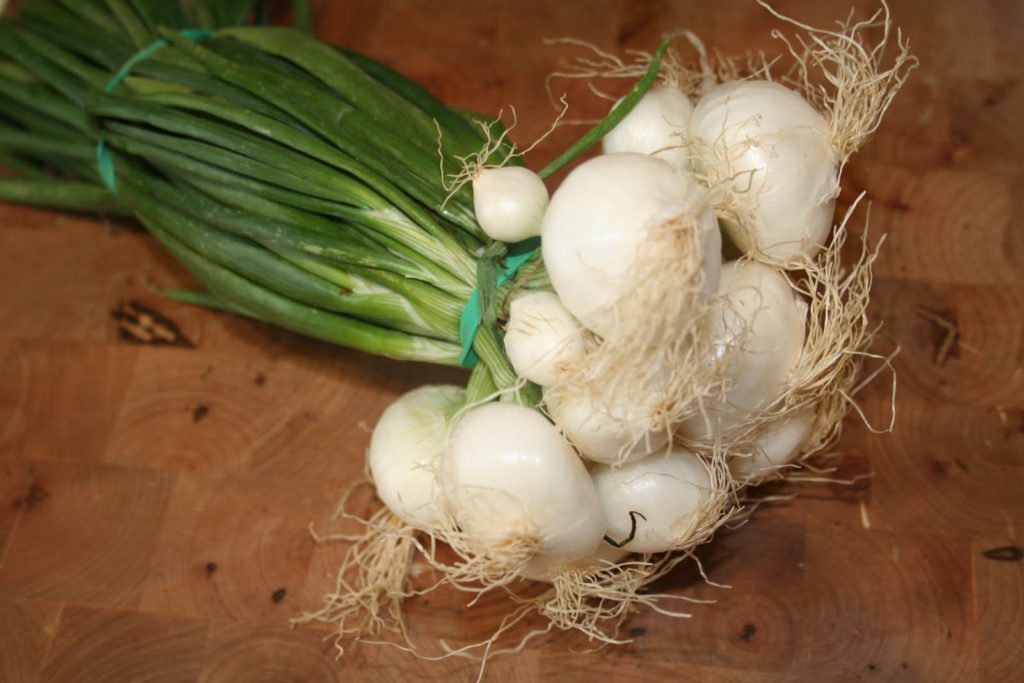
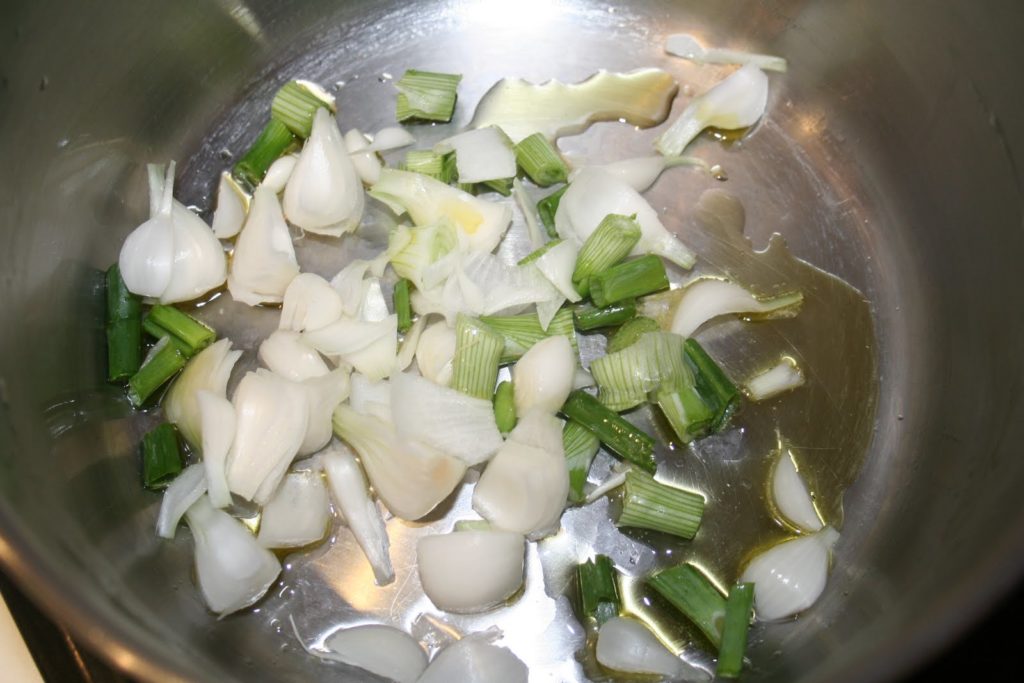
Start by washing and cleaning three white onions.




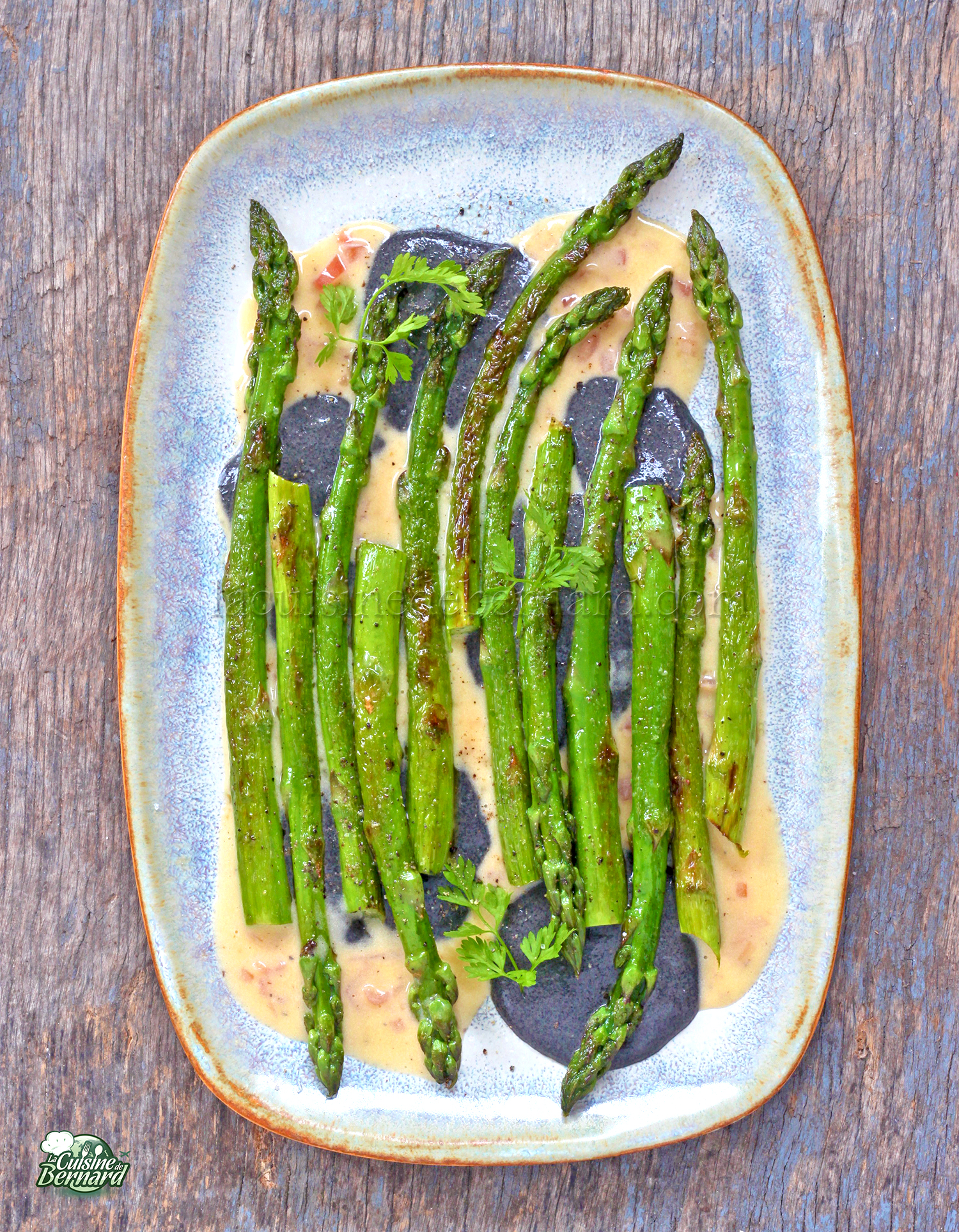
A surprising and totally addictive mix. I love asparagus, green or white. I took this photo with green asparagus because it cooks in two or three minutes in a pan, but you can do the same with white asparagus. They should then be peeled and steamed for about 20 minutes. The combination of beurre blanc, in which I keep the shallots, and the black tahini sauce is incredibly good and delicate. You’ll certainly need some fresh bread to clean your plate!
Pour 4 personnes:
- 20 green asparagus spears
- Olive oil, salt, pepper
White butter :
- 2 shallots
- 150ml dry white wine
- 125g of salted butter
- 1 tablespoon full cream
- Salt and pepper
Black tahini sauce :
- 100g black sesame cream
- 25g white vinegar
- 25g olive oil
- 60g water
- 10g honey
- 1 clove garlic, peeled and minced
- Salt and pepper
- 20 asperges vertes
- 2 c. à soupe huile d'olive
- sel, poivre
- 2 échalotes
- 150 ml vin blanc sec
- 125 g beurre salé
- 1 c. à soupe crème liquide entière
- sel, poivre
- 100 g crème de sésame noir
- 25 g vinaigre blanc
- 25 g huile d'olive
- 60 g eau
- 10 g miel
- 1 gousse d'ail épluchée et finement hachée
- sel, poivre
- Pour le tahiné noir :J’ai acheté ce tahiné de sésame noir dans une boutique bio à côté de chez moi. Il faut bien vérifier qu’il n’y a que du sésame, car il existe aussi (mais plutôt en rayon asatique) de la crème sucrée de sésame noir à tartiner, et ce n’est pas du tout le même produit !
- Placez la crème de sésame noir et un peu d’eau (que vous pesez avant de cuisiner) dans un récipient.
- Au départ, le tahiné se solidifie légèrement, puis se redétend en ajoutant l’eau au fur et à mesure, tout en mélangeant.
- Ajoutez le reste des ingrédients et mélangez soigneusement. Laissez de côté.
- Pour le beurre blanc :Épluchez et hachez finement les échalotes. Placez-les dans une petite casserole.Versez les 150ml de vin blanc sec. Poivrez et laissez bouillir jusqu’à n’avoir presque plus de liquide, juste un léger fond. Cela prend 15 minutes environ.
- Ajoutez alors le beurre salé en 4 ou 5 fois, sur feu doux en mélangeant en permanence. Le premier morceau doit bien fondre avant d’ajouter la suite. Je garde ici les échalotes, je trouve dommage de les enlever comme dans beaucoup de beurre blanc.
- Mélangez constamment toujours sur feu doux. Le beurre garde sa texture crémeuse et ne tranche pas.
- Quand tout le beurre est ajouté, versez une cuillerée à soupe de crème liquide entière pour bloquer la sauce et l’empêcher de trancher, c’est prêt.
- Faites griller les asperges vertes lavées et séchées dans une poêle avec un peu d’huile d’olive, pendant 2 minutes sur feu assez fort. Salez et poivrez à vote goût.
- Versez un peu des deux sauces dans les assiettes puis disposez les asperges sur le dessus. Dégustez sans attendre avec un bon pain frais.
Comment choisir ses asperges ?
Privilégiez les asperges fraîches, bien fermes, avec des tiges sans taches. Pour cette recette, les asperges vertes sont idéales, mais les blanches peuvent aussi être utilisées après épluchage et cuisson à la vapeur.
Peut-on préparer les sauces à l’avance ?
Oui, vous pouvez préparer le beurre blanc et la sauce tahiné noir à l’avance. Conservez-les au réfrigérateur et réchauffez doucement avant de servir.
Quel type de vin utiliser pour le beurre blanc ?
Un vin blanc sec comme un Sauvignon Blanc ou un Chardonnay fonctionne très bien. Évitez les vins sucrés.
Où trouver du tahiné noir ?
Le tahiné noir se trouve dans les boutiques bio ou les rayons spécialisés des grandes surfaces. Assurez-vous qu’il s’agit de pur sésame noir et non d’une version sucrée.
Astuces pour la cuisson des asperges
Pour des asperges vertes, une cuisson rapide à la poêle avec un peu d’huile d’olive donne une texture croquante. Si vous utilisez des asperges blanches, épluchez-les et cuisez-les à la vapeur pendant environ 20 minutes.
Comment empêcher la sauce beurre blanc de trancher ?
Ajoutez une cuillerée de crème liquide entière à la fin de la préparation. Cela stabilise la sauce et empêche qu’elle ne se sépare.
Pour le tahiné noir :
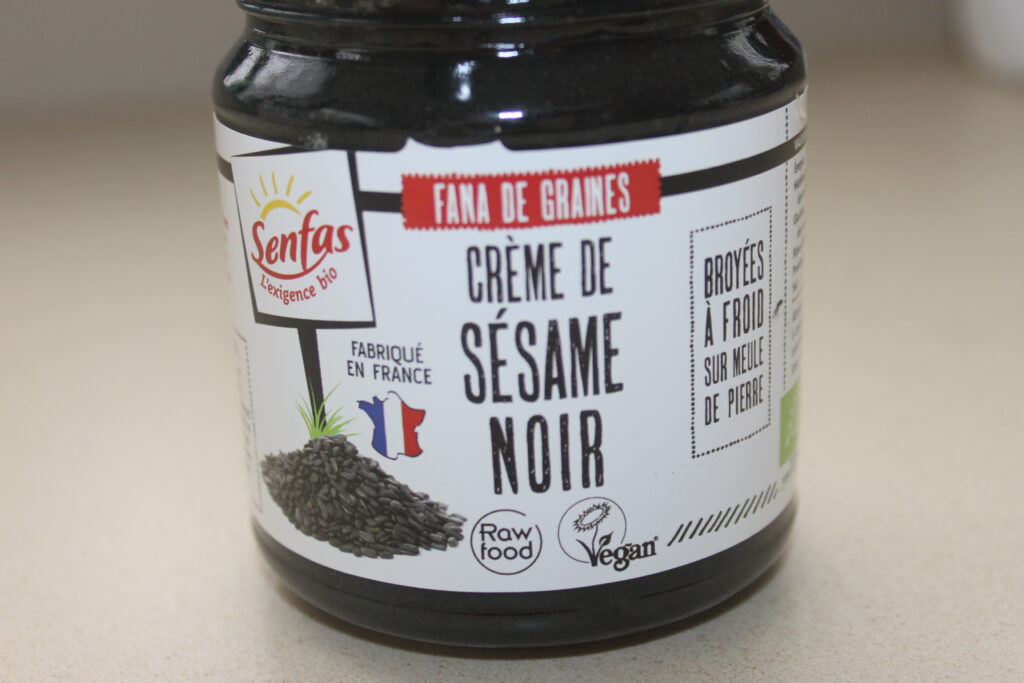
I bought this black sesame tahini at an organic store near my home. It’s important to check that it only contains sesame, because there’s also a sweetened black sesame cream spread (available in the dairy section), and it’s not the same product at all!
Place the black sesame cream and a little water (which you weigh before cooking) in a container.
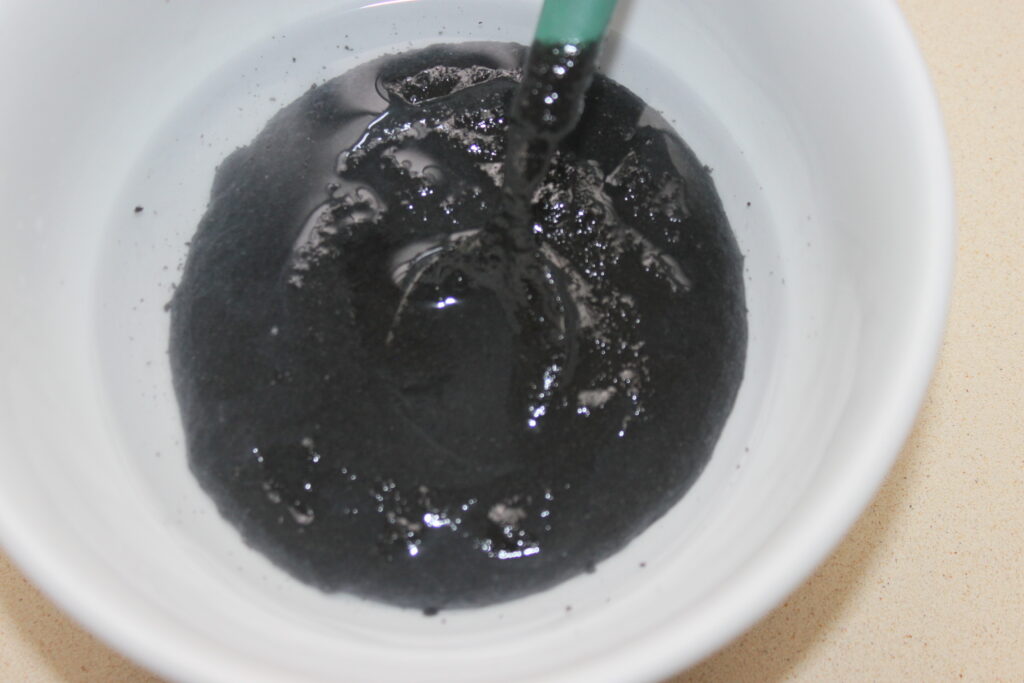
Initially, the tehena solidifies slightly, then is re-spread by adding water gradually, while stirring.
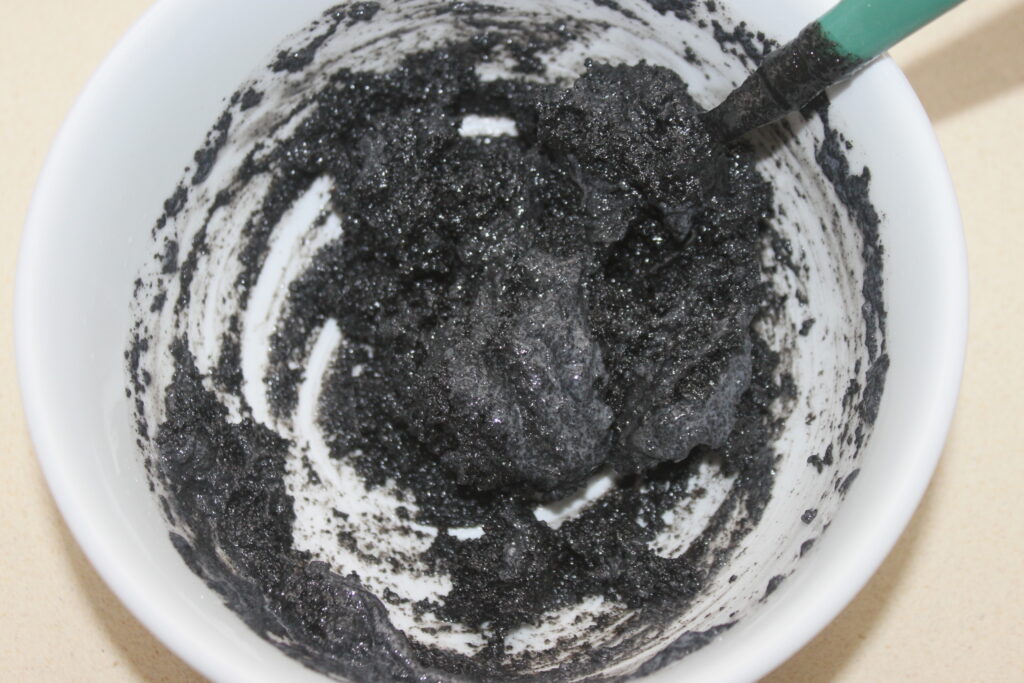
Add the remaining ingredients and mix thoroughly. Leave it out.
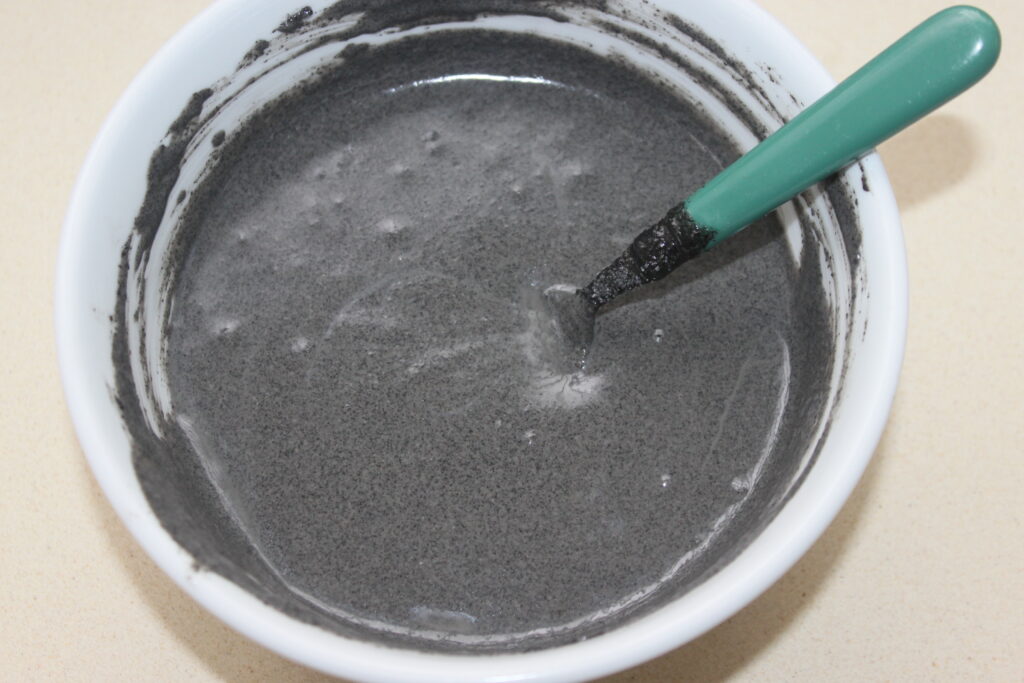
Pour le beurre blanc :
Peel and finely chop the shallots. Place them in a small saucepan.
Pour the 150ml of dry white wine. Add pepper and boil until almost no liquid remains, just a slight melt. This takes about 15 minutes.
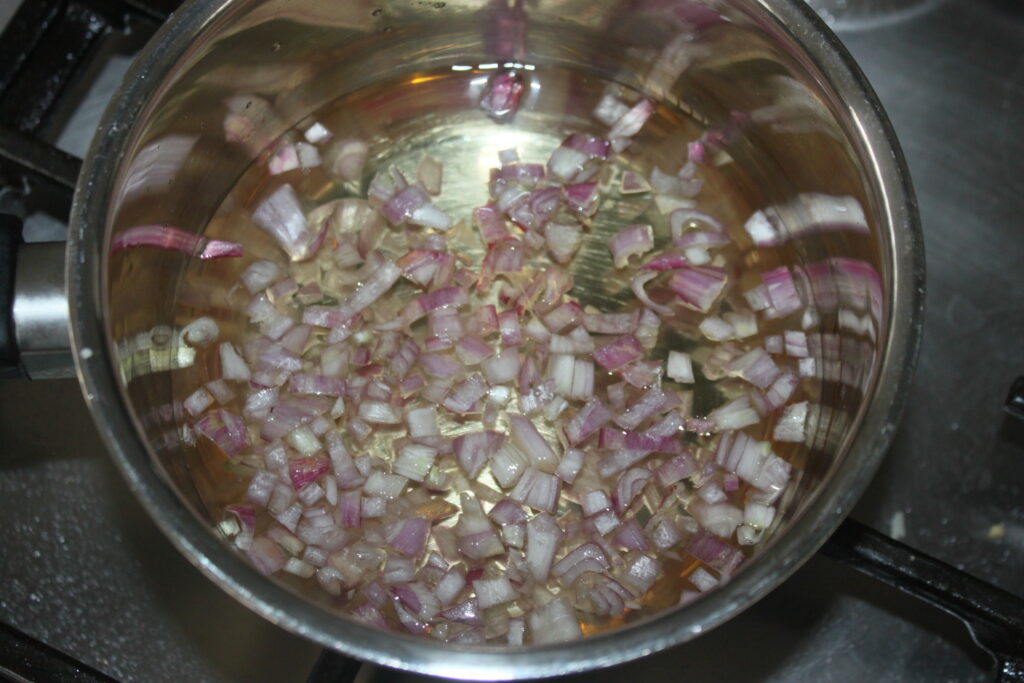
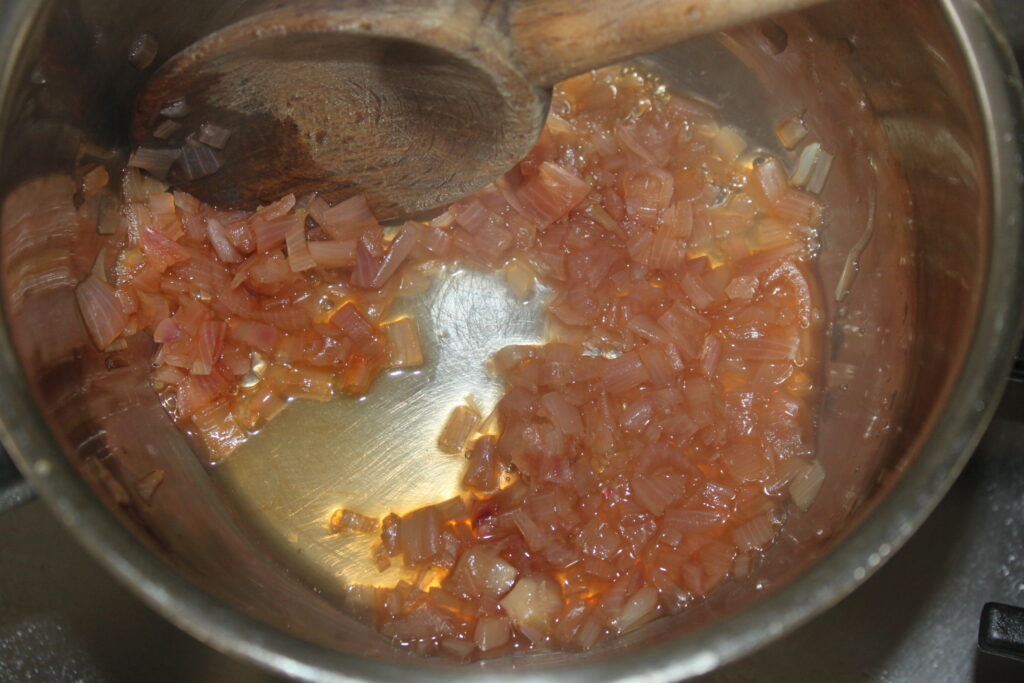
Add the salted butter in 4 or 5 additions over low heat, stirring constantly. The first piece should melt well before adding the next. I keep the shallots here, I think it’s a shame to remove them like in many beurre blanc.
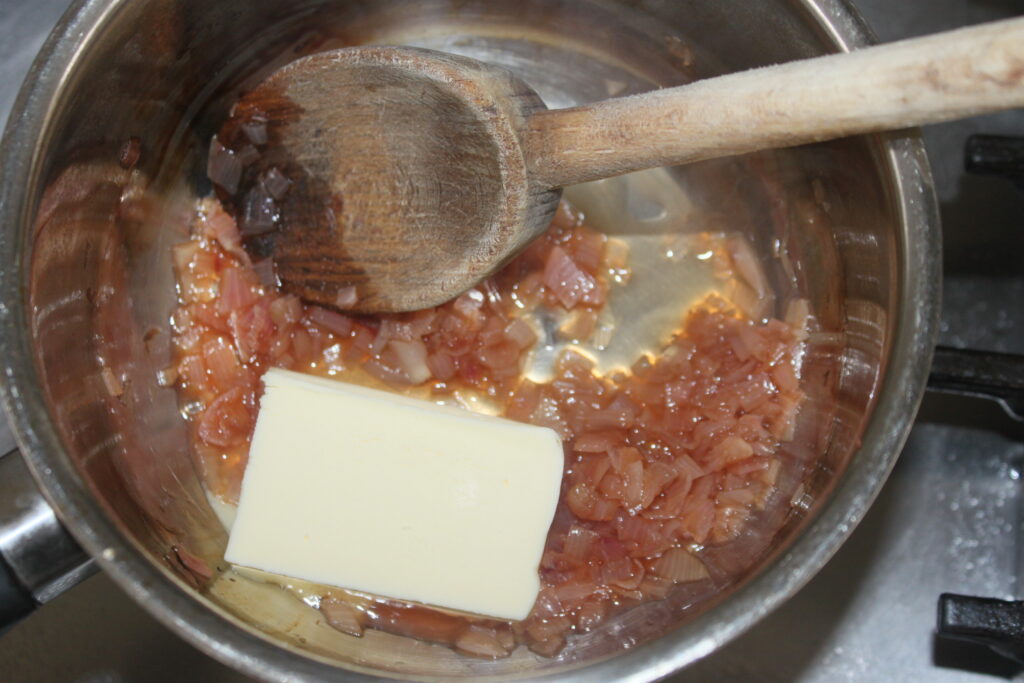
Stir constantly over low heat. The butter keeps its creamy texture and does not slice.
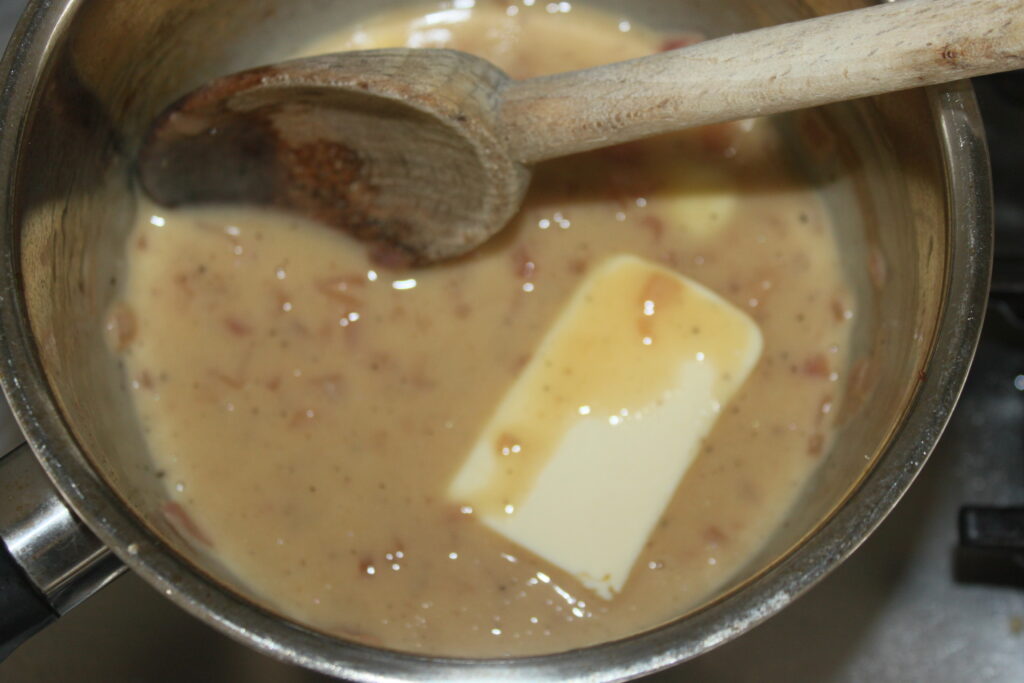
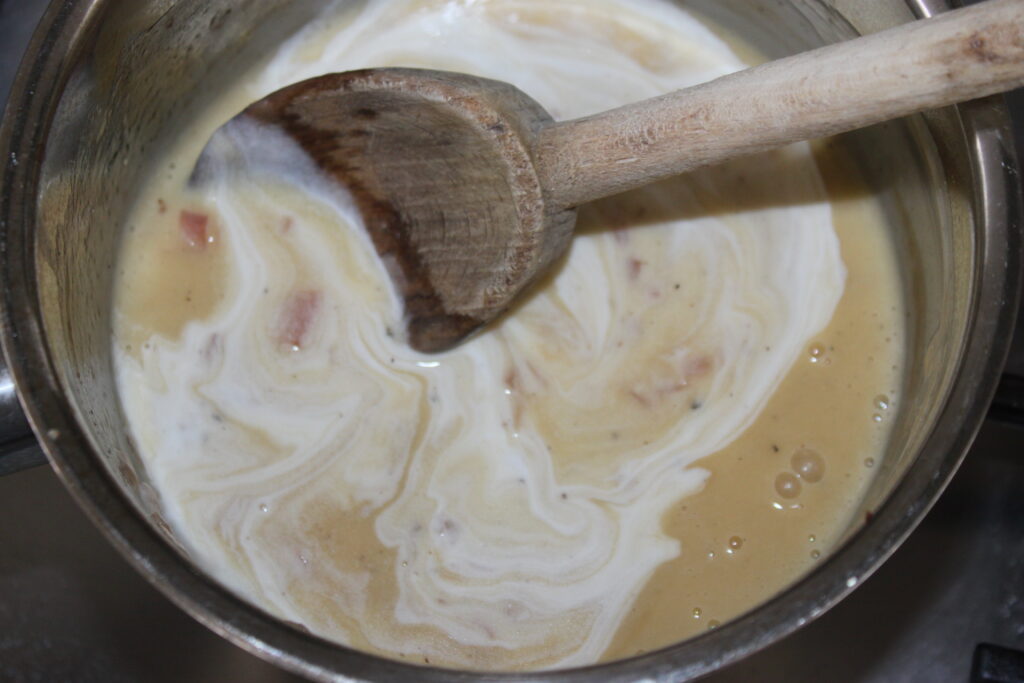
When all the butter has been added, pour in a tablespoon of whole cream to block the sauce from slicing, and you’re ready to go.
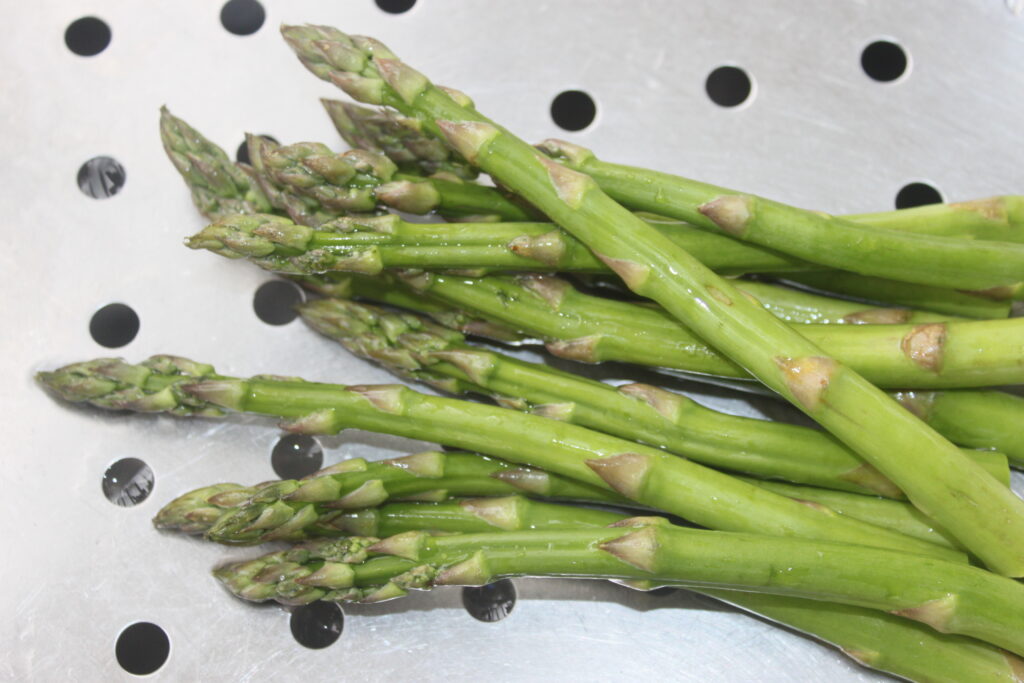
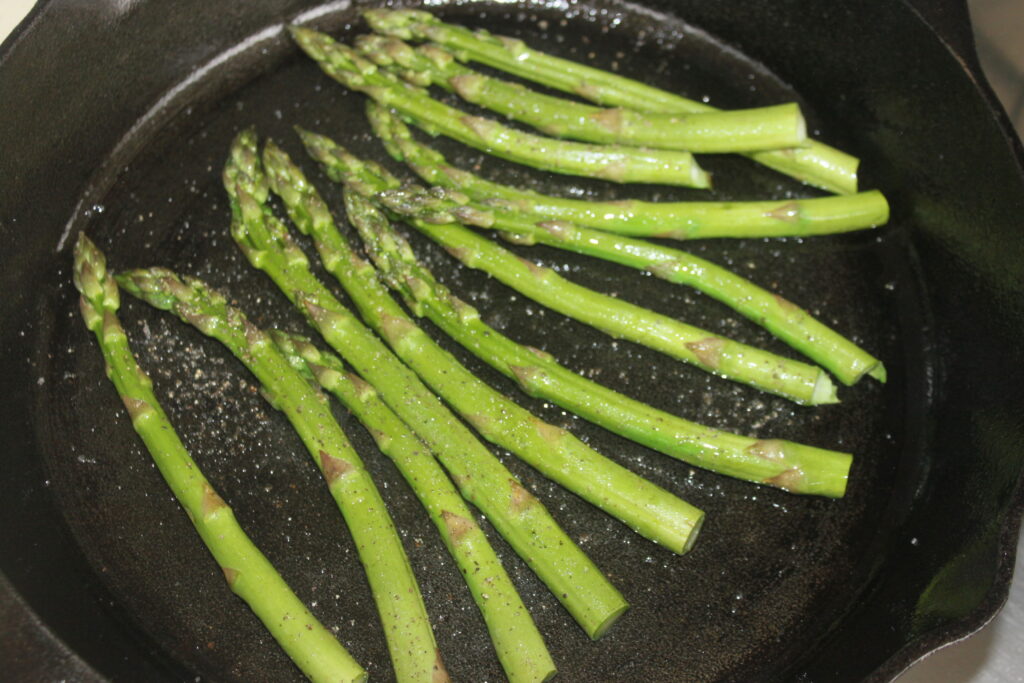
Grill the washed and dried green asparagus in a frying pan with a little olive oil for 2 minutes over fairly high heat. Add salt and pepper to taste.
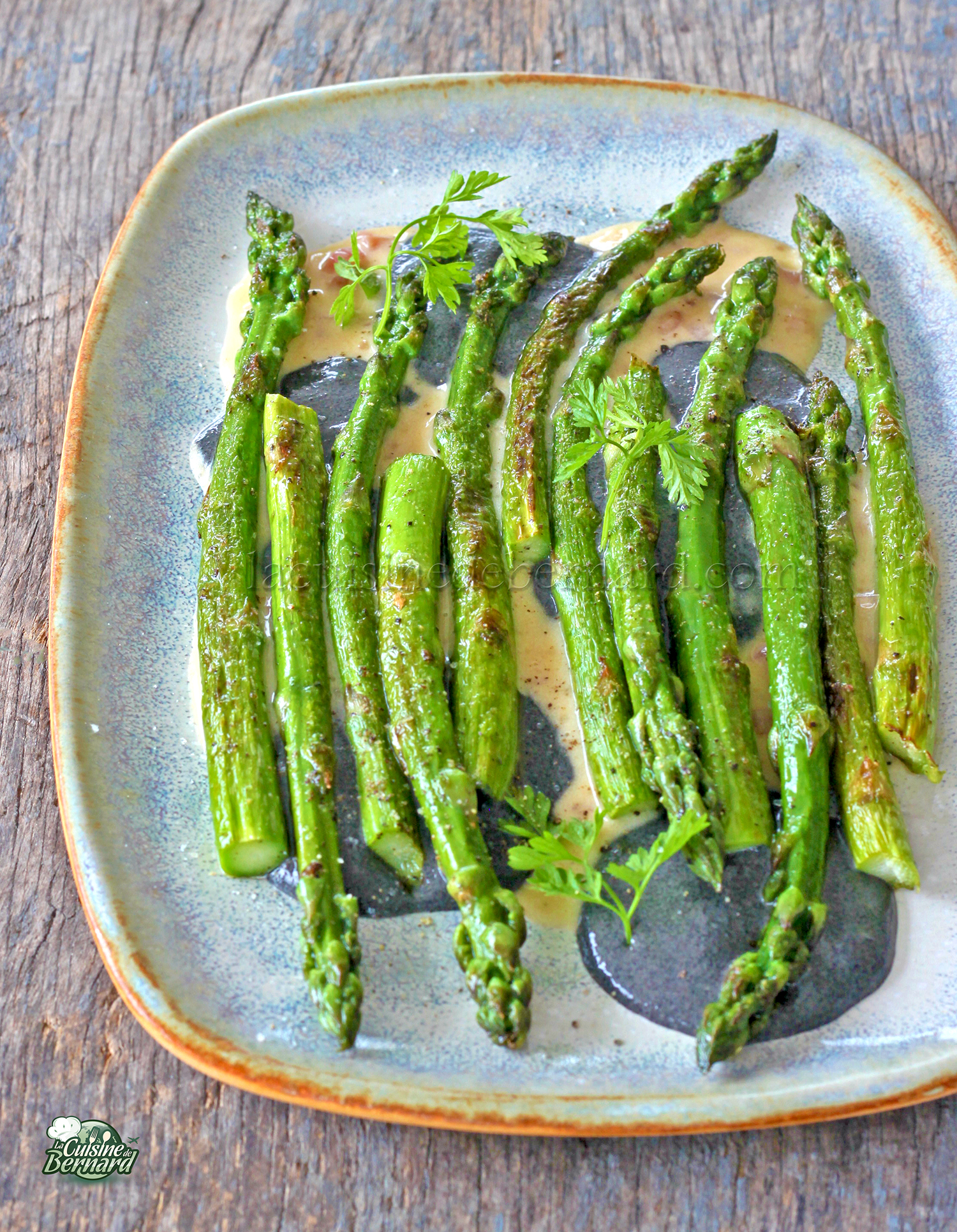
Pour a little of both sauces onto the plates, then arrange the asparagus on top. Enjoy with freshly baked bread.
Asperges sauce beurre blanc, tahiné noir
Ingredients
Beurre blanc :
Sauce tahiné noir :
Instructions
Nutrition
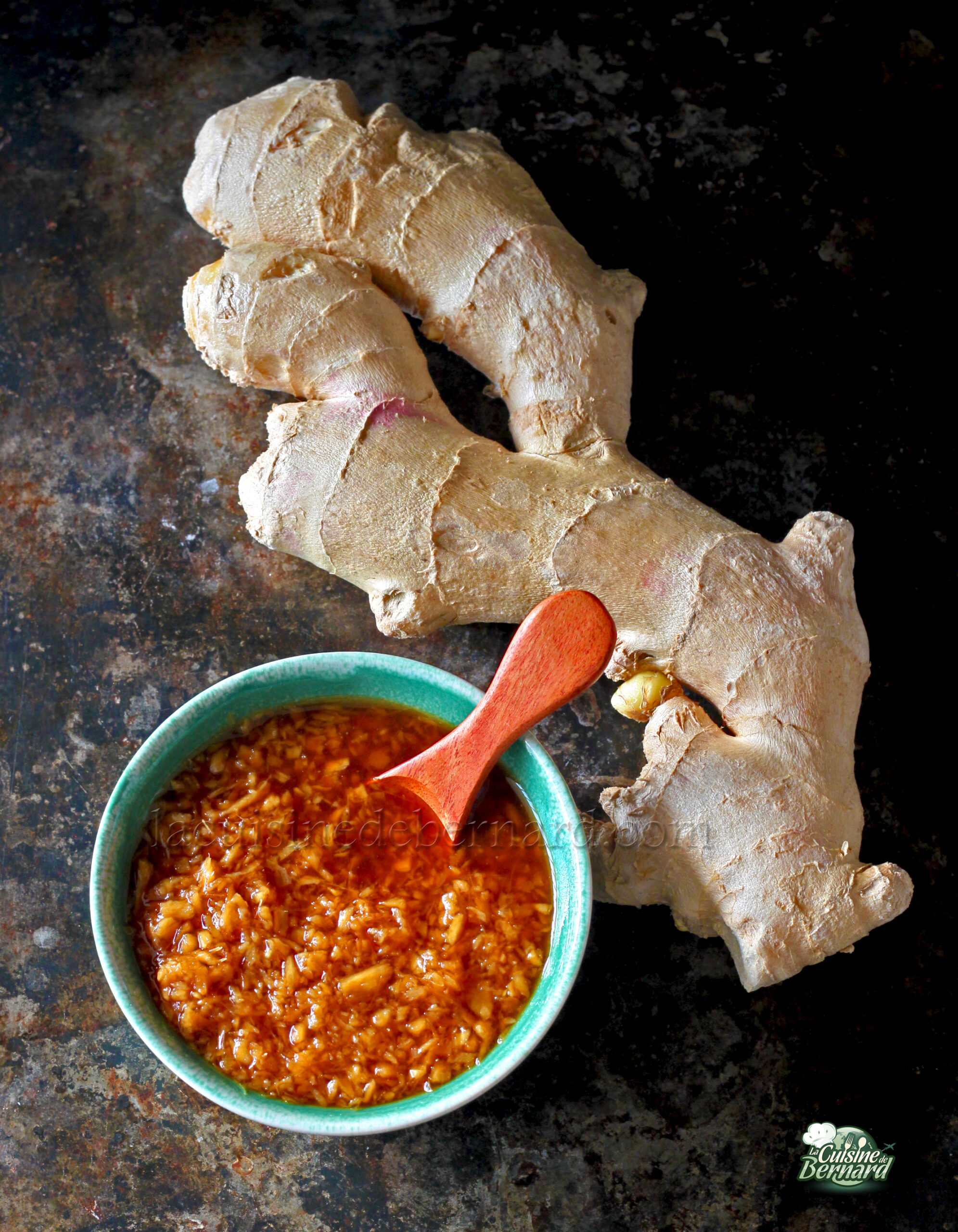
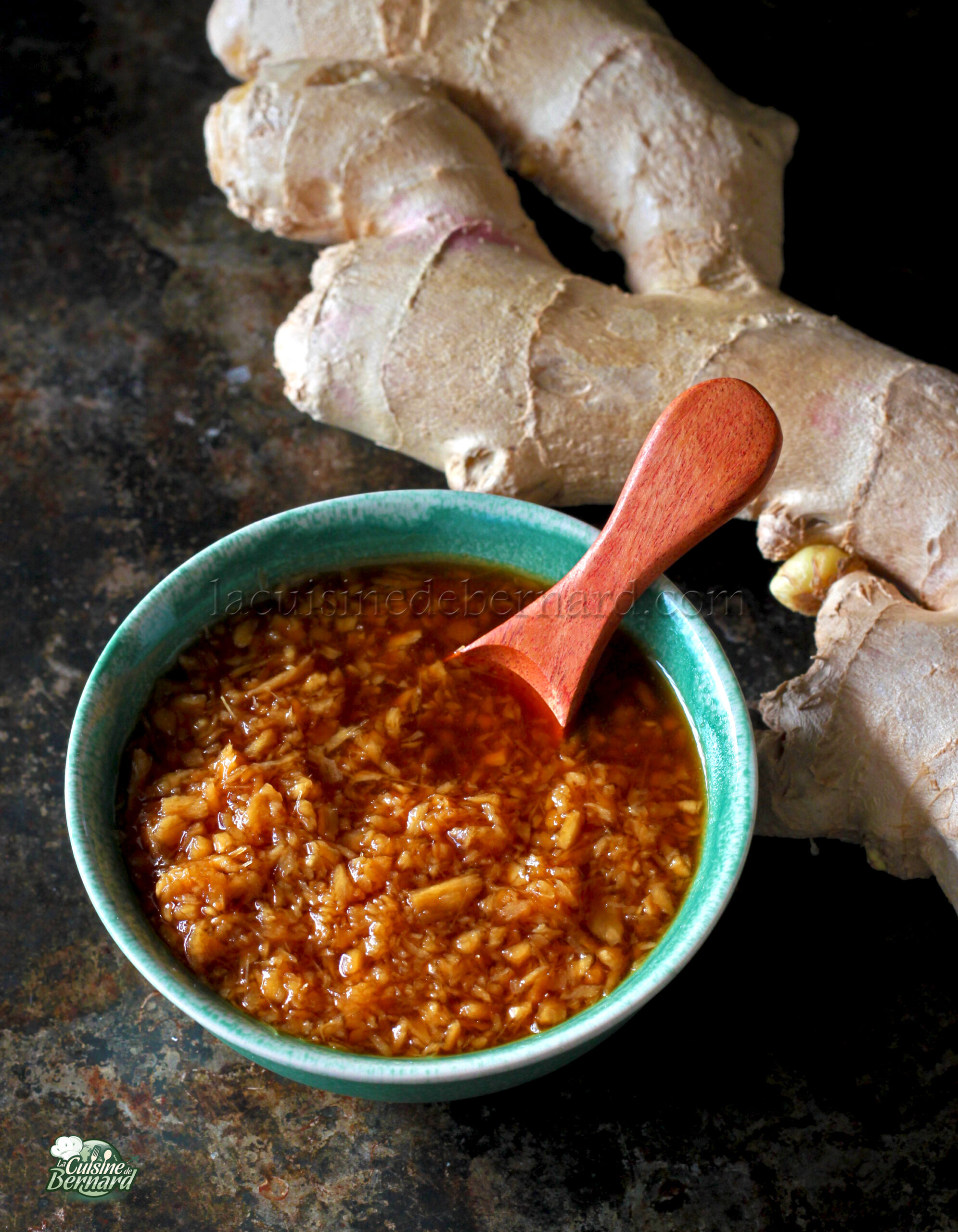
A delicious, versatile sauce that goes well with anything you like. Meat, fish, vegetables, rice, vegetable cakes, etc. An absolute delight, and very easy to make at home. It should be prepared at least a day in advance, to give the ginger time to marinate. I had bought a jar of the equivalent of this sauce in Tokyo and immediately thought that I would have to make it again and offer it on my cooking site! It contains no fat. Store in an airtight container for at least 10 days in a cool place.
Les questions :
- Peut-on préparer la sauce à l’avance ?
- Oui, la sauce gingembre peut être préparée à l’avance et se conserve bien au réfrigérateur dans un récipient hermétique pendant au moins 10 jours.
- Comment obtenir une texture bien homogène ?
- Mixez le gingembre finement mais sans en faire une pâte. Mélangez ensuite soigneusement tous les ingrédients pour une texture lisse.
- Peut-on congeler la sauce gingembre ?
- Il est déconseillé de congeler cette sauce car la texture pourrait être altérée. Elle se conserve bien au réfrigérateur.
- Quelles variantes peut-on essayer ?
- Vous pouvez ajouter des zestes de citron vert pour une touche d’acidité, ou remplacer le sucre par du miel, du sirop d’érable ou du sirop de riz (ou tout autre sucre à votre goût ! ) pour une saveur différente.
- Comment ajuster la sauce selon les saisons ?
- En été, ajoutez du concombre râpé pour une sauce rafraîchissante. En hiver, ajoutez une pincée de piment pour réchauffer les plats. Utilisez des produits locaux de saison pour enrichir la saveur.
Recette pour 550g de sauce au gingembre :
- 300g fresh peeled ginger (peeled weight)
- 20g miso paste
- 135g light soy sauce (the classic)
- 55g white vinegar
- 40g of sugar
La préparation :
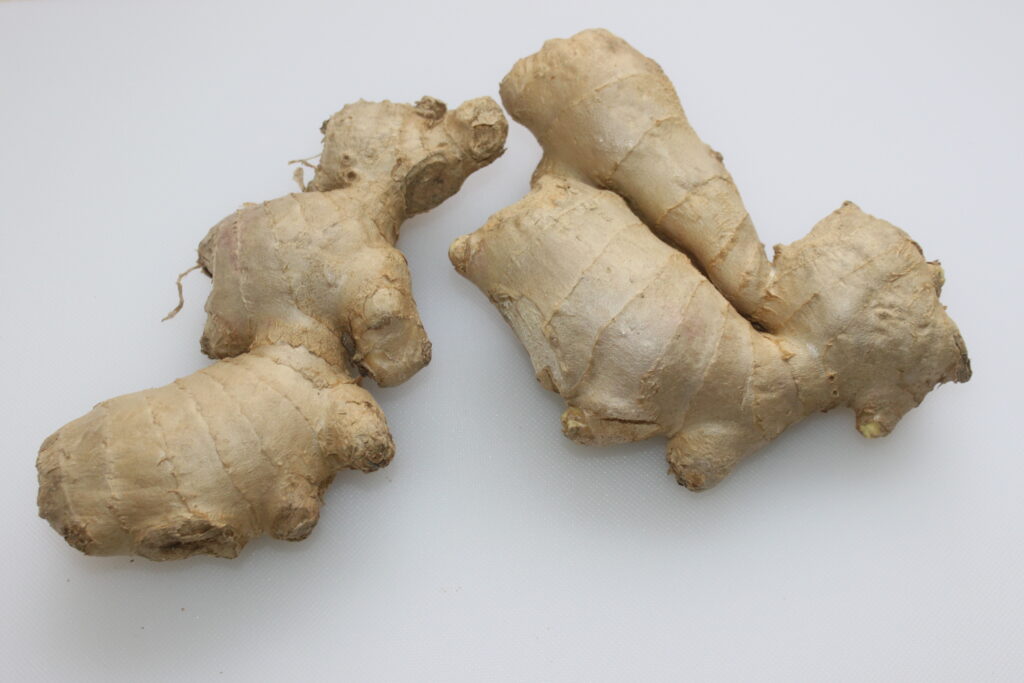
To obtain 300g of peeled ginger, take 400g of fresh ginger. Choose a plump one!
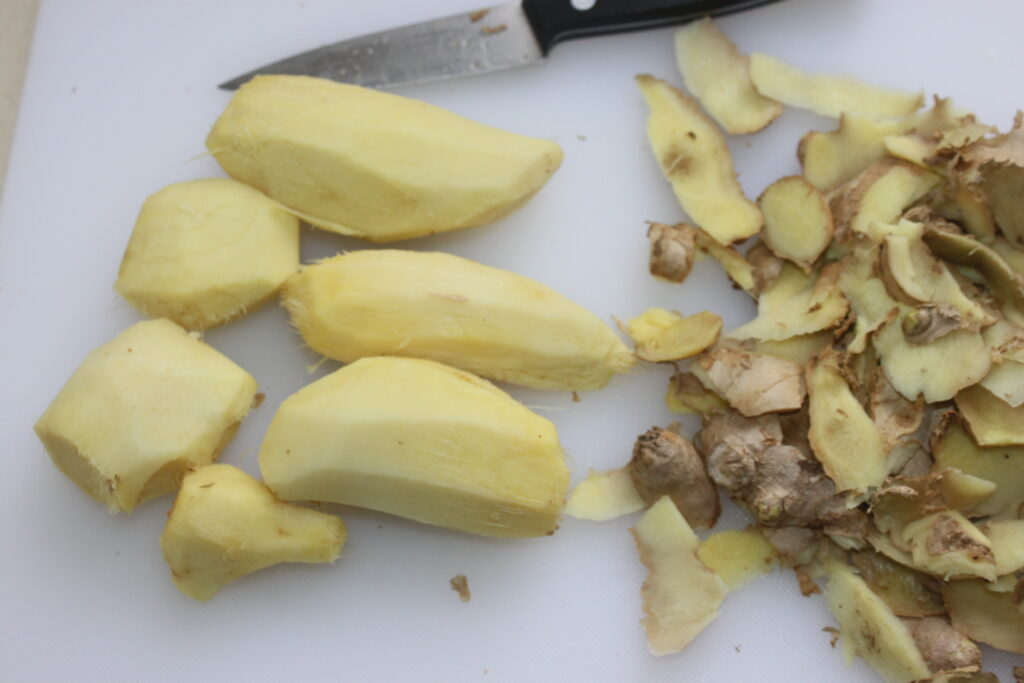
Peel it like an apple, it’s as simple as that. A good knife will do the trick.
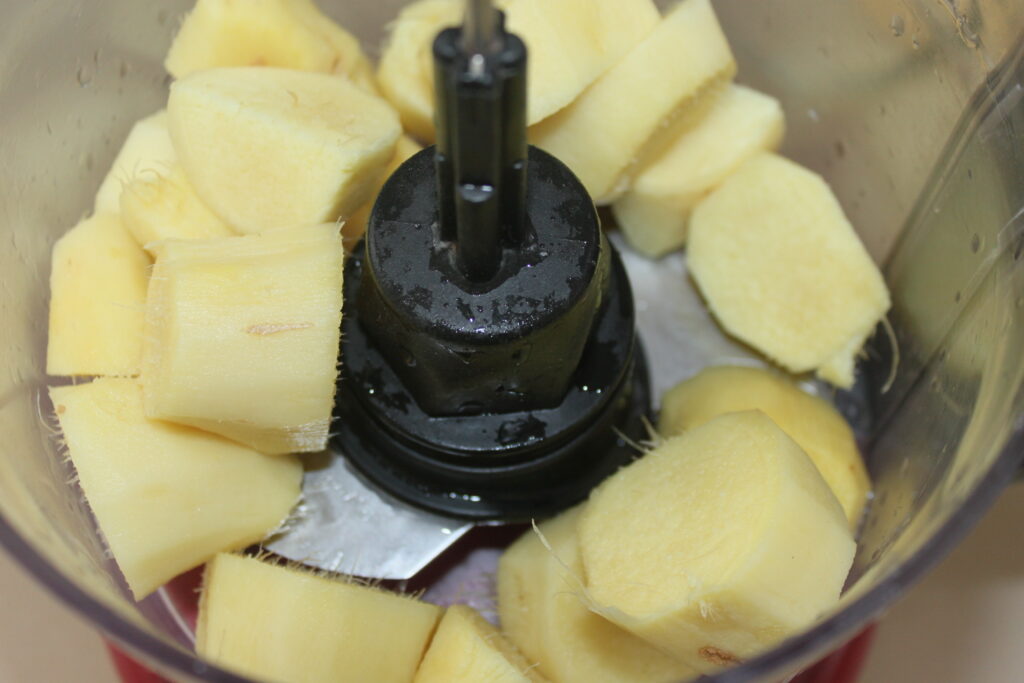
Cut into pieces and place in a small blender.
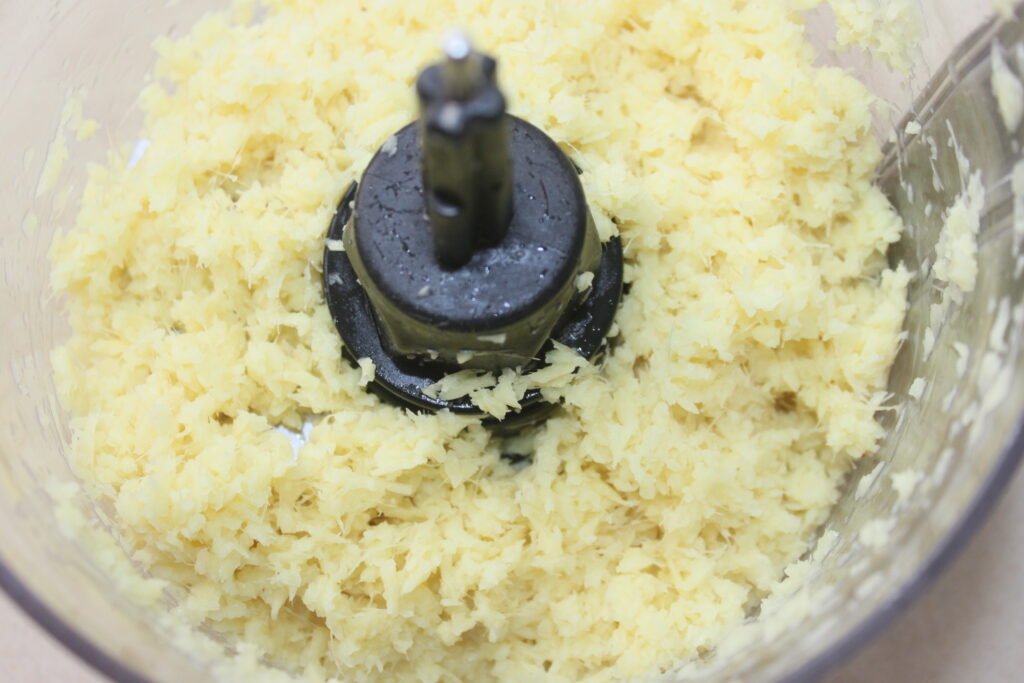
Blend it fairly finely, but without turning it into a paste.
Le mélange :
Pour into a container, then simply add the remaining ingredients. I used a brown miso paste, but any miso paste will do.
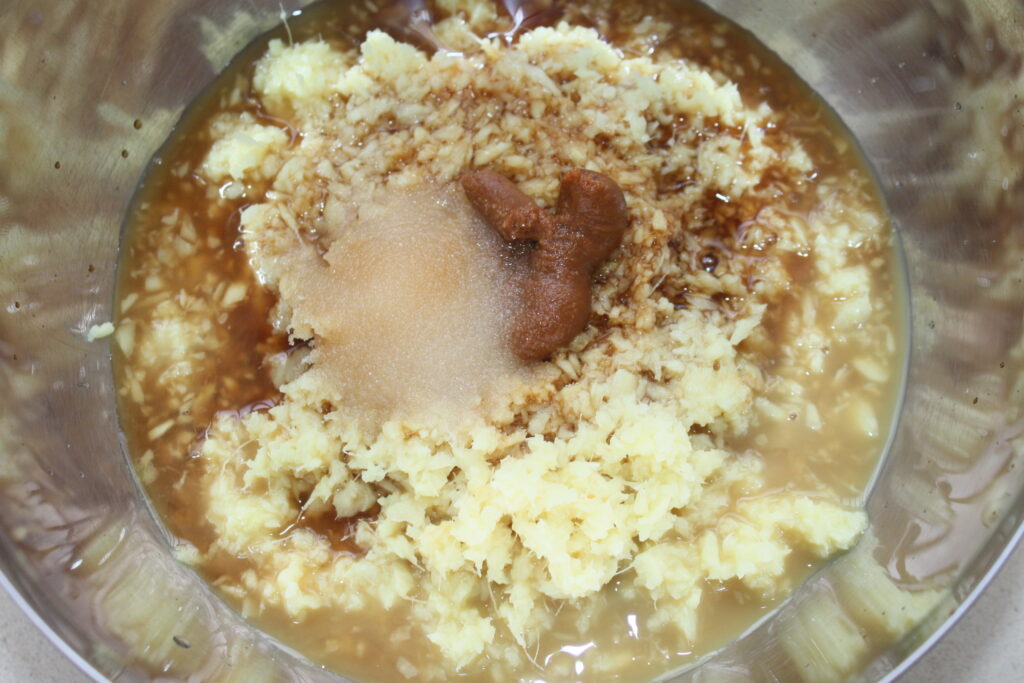
Mix thoroughly, then cover with cling film. Place in a cool place overnight to ensure that the flavours blend as perfectly as possible and the ginger has time to marinate.
L’utilisation :
The sauce is perfect with anything you like. Grilled meat, vegetables, vegetable patties, on white rice… It’s totally addictive and ultra-savory!
Bernard’s advice:
- For a more intense taste, marinate the sauce for at least 24 hours before eating.
- Serve this sauce with grilled meats, sautéed vegetables or rice for an Asian touch to your dishes.
- If the sauce is too strong, sweeten it with a little honey or maple syrup.
Sauce Gingembre
Ingredients
- 300 g gingembre frais et épluché
- 20 g pâte miso
- 135 g sauce soja claire
- 55 g vinaigre blanc
- 40 g sucre
Instructions
- Pour obtenir 300g de gingembre épluché, prenez 400g de gingembre frais. Choisissez-le bien dodu !
- Épluchez-le comment une pomme, c’est aussi simple que cela. Avec un bon couteau ça fait très bien l’affaire.
- Coupez-le en morceaux, puis placez-le dans un petit mixeur.
- Mixez-le assez finement, sans pour autant en faire une pâte.
- Versez le tout dans un récipient puis ajoutez simplement le reste des ingrédients. J’ai pris une pâte miso brune, mais toute pâte miso fera l’affaire.
- Mélangez soigneusement le tout, puis couvrez d’un film étirable. Placez au frais la nuit pour que le mélange des saveurs soit le plus parfait possible et que le gingembre ait le temps de bien mariner.
- La sauce sera parfaite avec tout ce que vous aimez. Une viande grillée, des légumes, des galettes végétales, sur un riz blanc… Elle est totalement addictive et ultra-savoureuse !

Here’s a recipe idea for an aperitif or starter with friends. These breaded mozzarella balls are delicious, especially with the colourful sauce! You have to like wasabi, and you can of course use another sauce to serve these crispy balls! Make sure you prepare them in advance if necessary, and fry them at the last minute for maximum crispiness.
Recette pour 4 à 6 personnes :
- 300g mozzarella balls
- 50g of flour
- 200g fermented milk
- 100g roasted peanuts
- 100g panko (or breadcrumbs)
- salt, pepper, oil for frying
For the wasabi mayonnaise :
- 100g of mayonnaise
- 20g wasabi
- 10g white vinegar
- 1 – Can the mozzarella balls be prepared in advance?
Yes, it’s perfectly possible to prepare your mozzarella balls in advance. Freeze them raw to preserve their freshness and texture. Simply fry them at the last minute for an incomparable crispness.
- How do you prevent the breadcrumbs from separating?
For breadcrumbs that adhere perfectly, make sure your mozzarella balls are well drained and perfectly dried before coating them. Residual moisture could compromise the breading’s adhesion.
- Can I use a sauce other than wasabi mayonnaise?
Absolutely! Vary your taste buds by opting for a pesto sauce, a lighter spiced fromage blanc sauce, or even a homemade paprika mayonnaise. All these options will add a unique touch to your mozzarella balls.
- How do you get crispy breadcrumbs?
For a light, crispy breading, panko is your best ally. Make sure the frying oil is at the right temperature, ideally 180°C, for the perfect texture.
- Can I use other types of dried fruit?
Of course, feel free to experiment with cashews or roasted almonds instead of peanuts. These alternatives bring different flavors that are just as delicious.
Bernard’s advice:
- Use fermented milk: For an even tastier, crunchier breading, soak your logs in fermented milk before coating them with breading.
- Coating technique: For a perfect coating, follow this technique: first dip the balls in the flour, then in the fermented milk, and finally in the peanut/panko mixture.
- Optimum service: Serve your mozzarella balls immediately after frying for the ultimate crispy experience.
La recette :
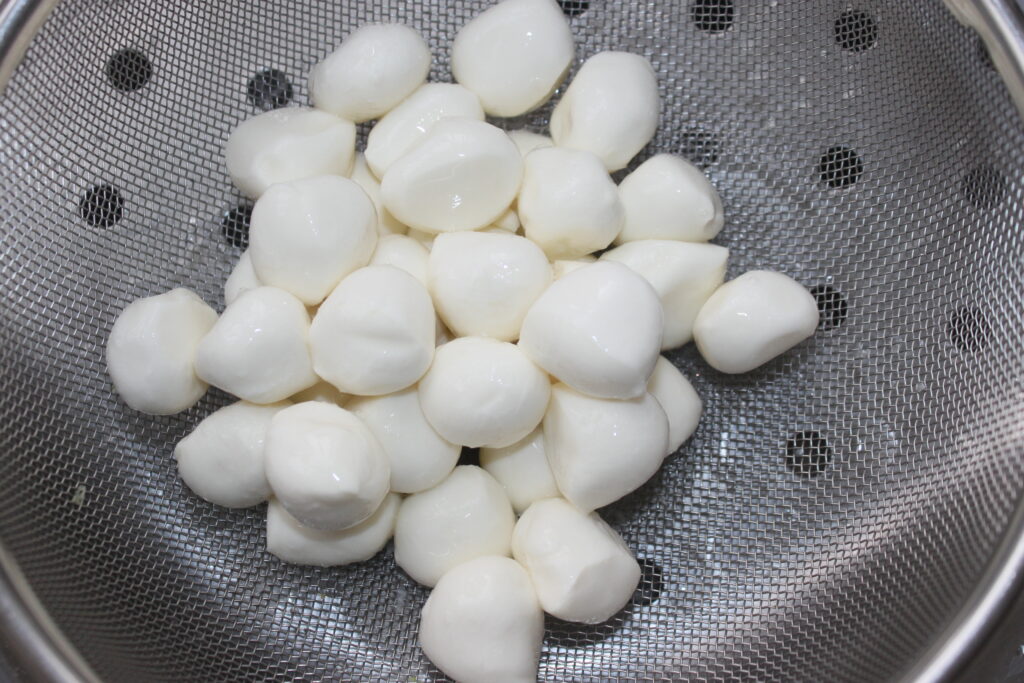
Here are the mozarella balls. Take them out of the packet and drain.
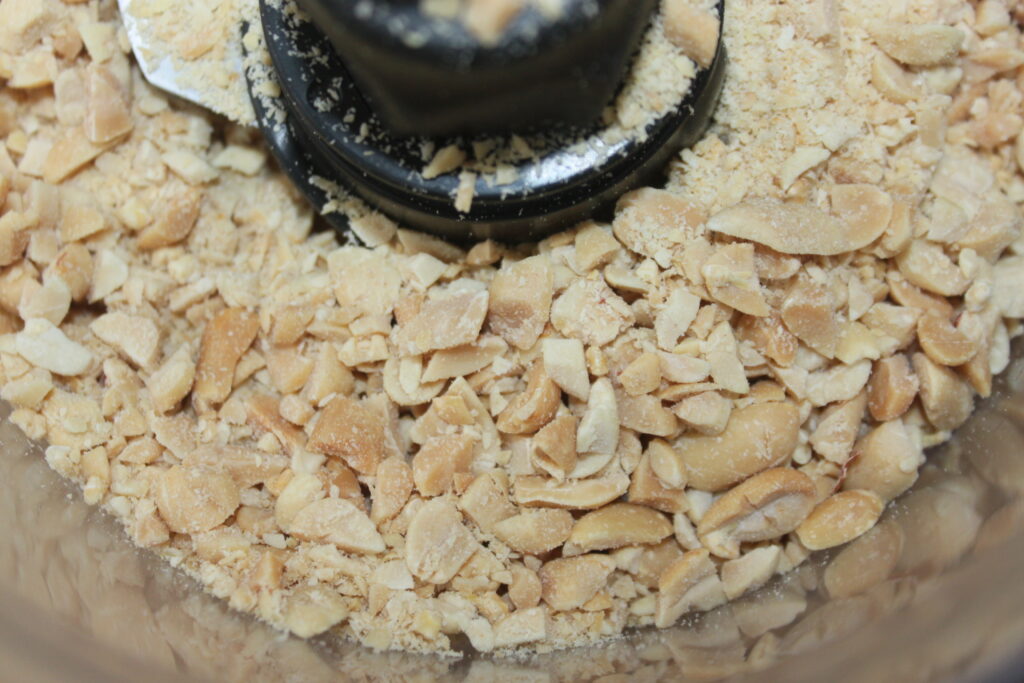
Place the roasted peanuts in a small blender and grind to a powder.
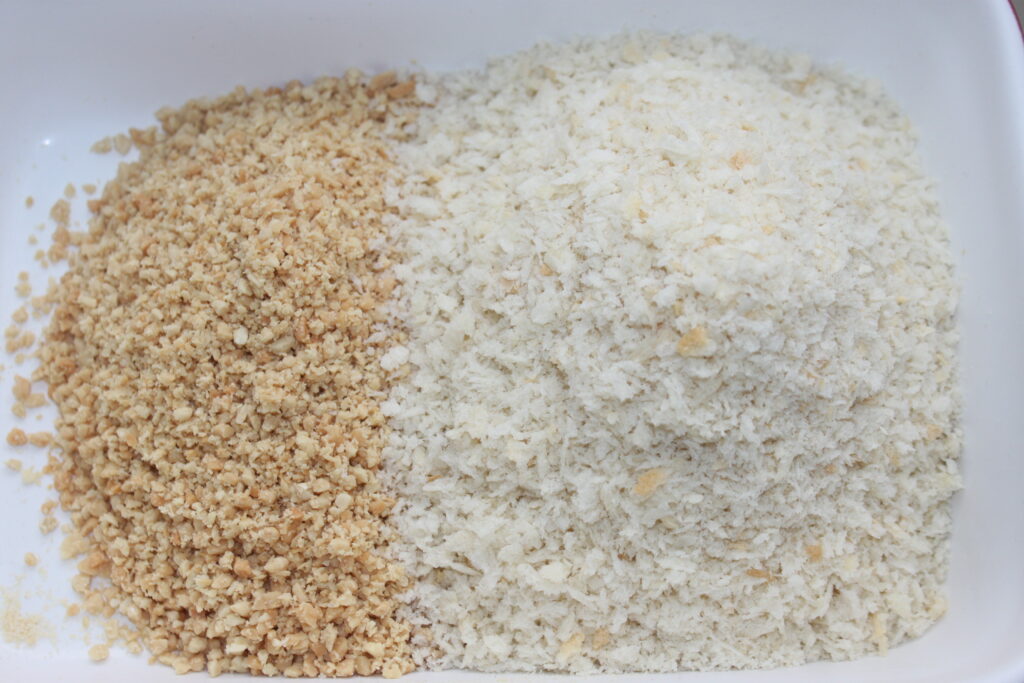
Pour into a dish with the panko (or breadcrumbs).
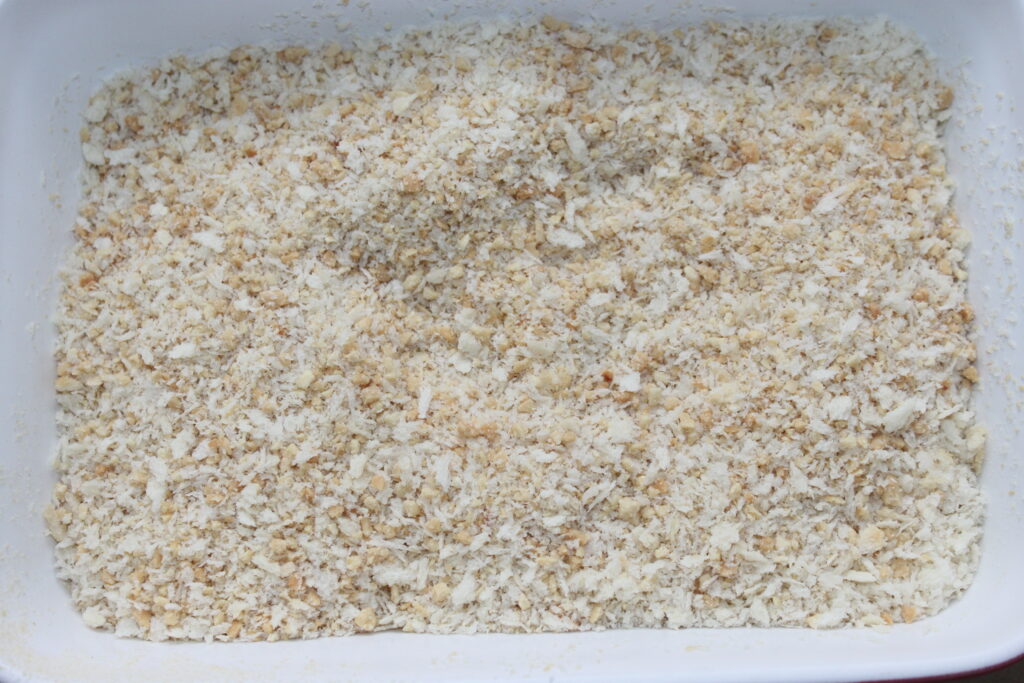
Mix well.
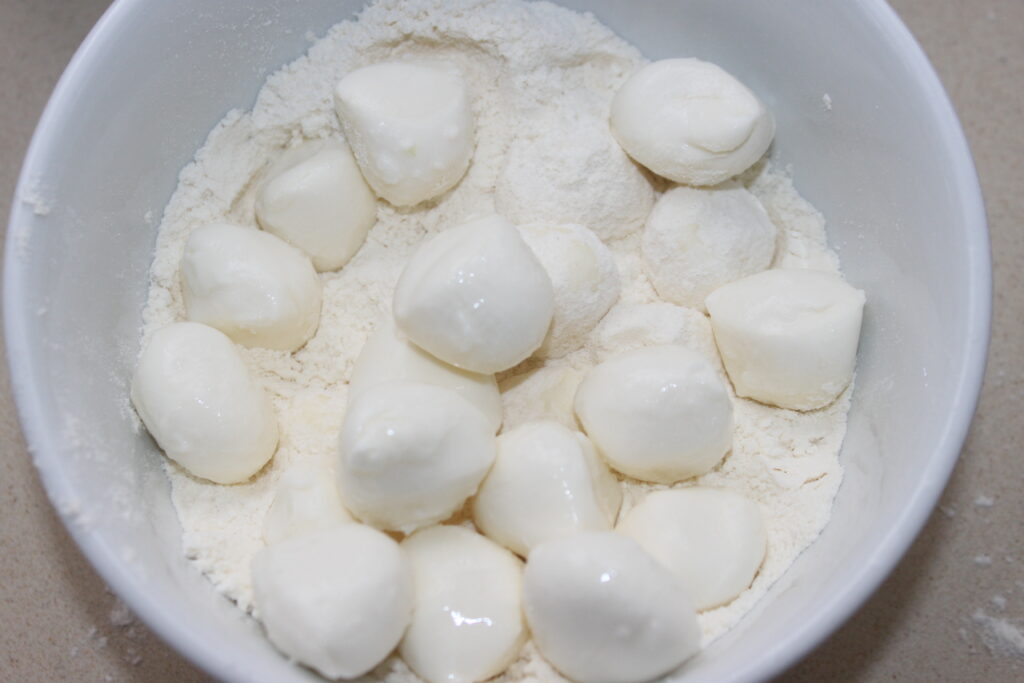
First, dip the balls in flour.
Then dip them in fermented milk (or beaten egg, which also works).

Then roll them in the peanut/panko mixture.
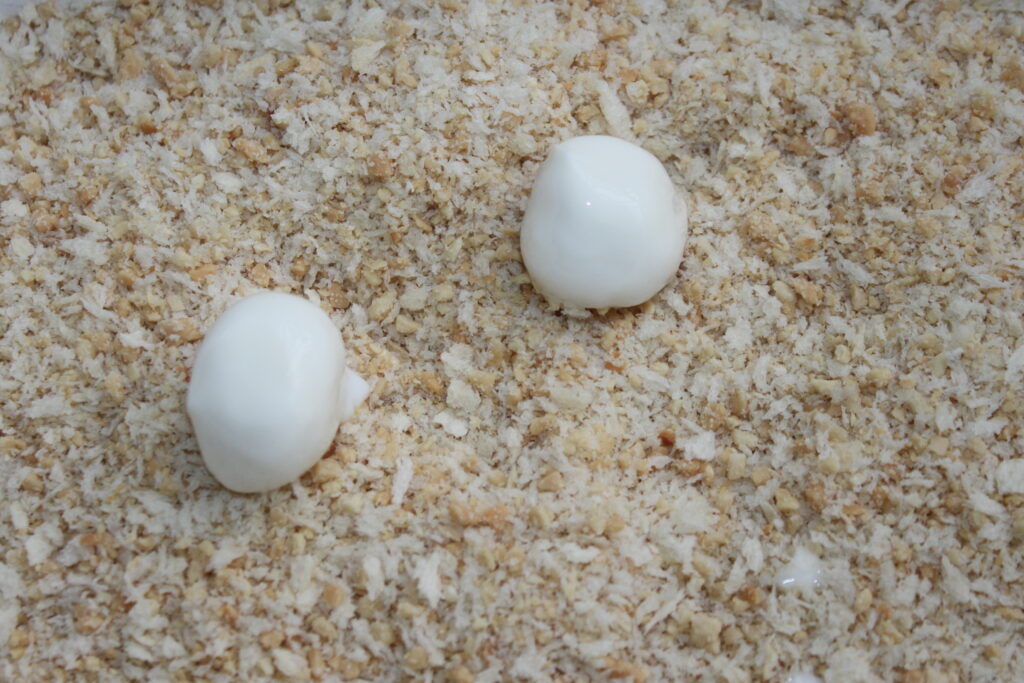
Set aside as you go along.
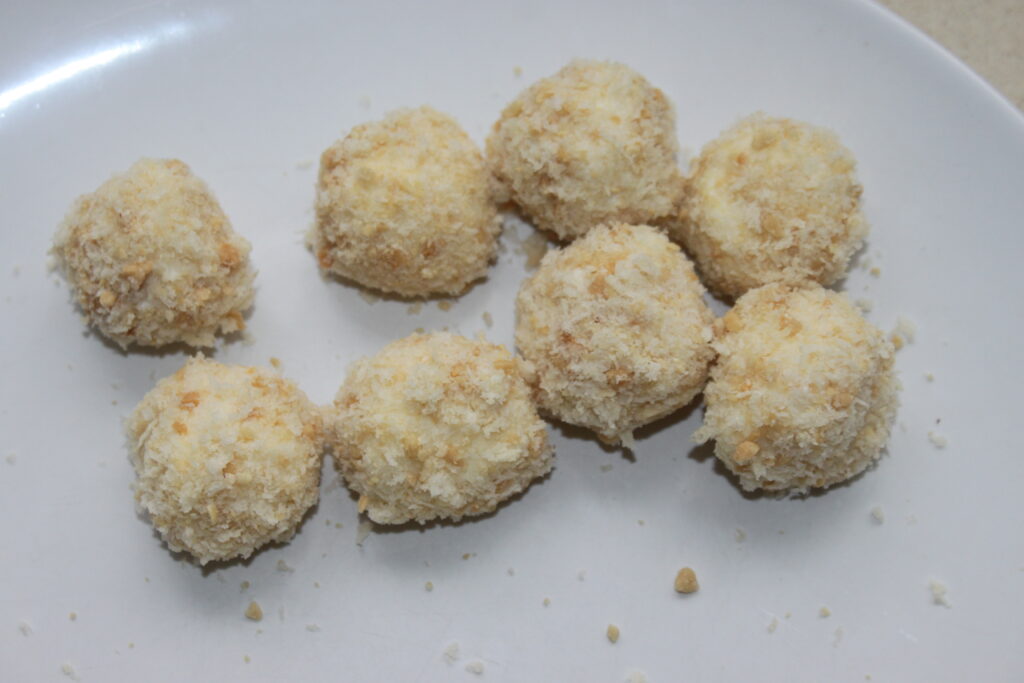
La cuisson :
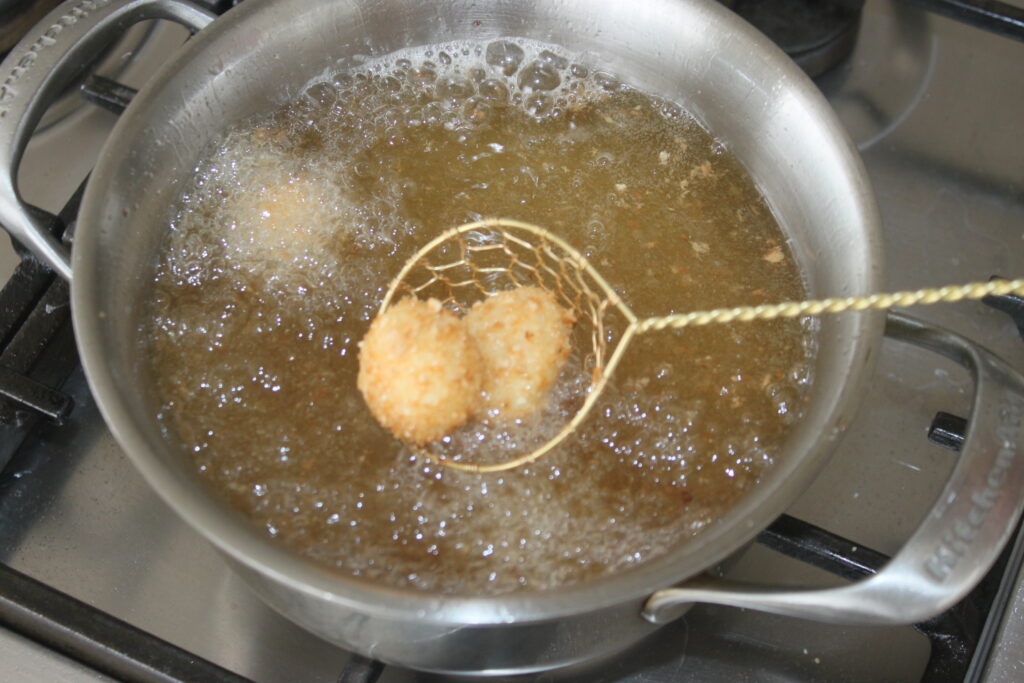
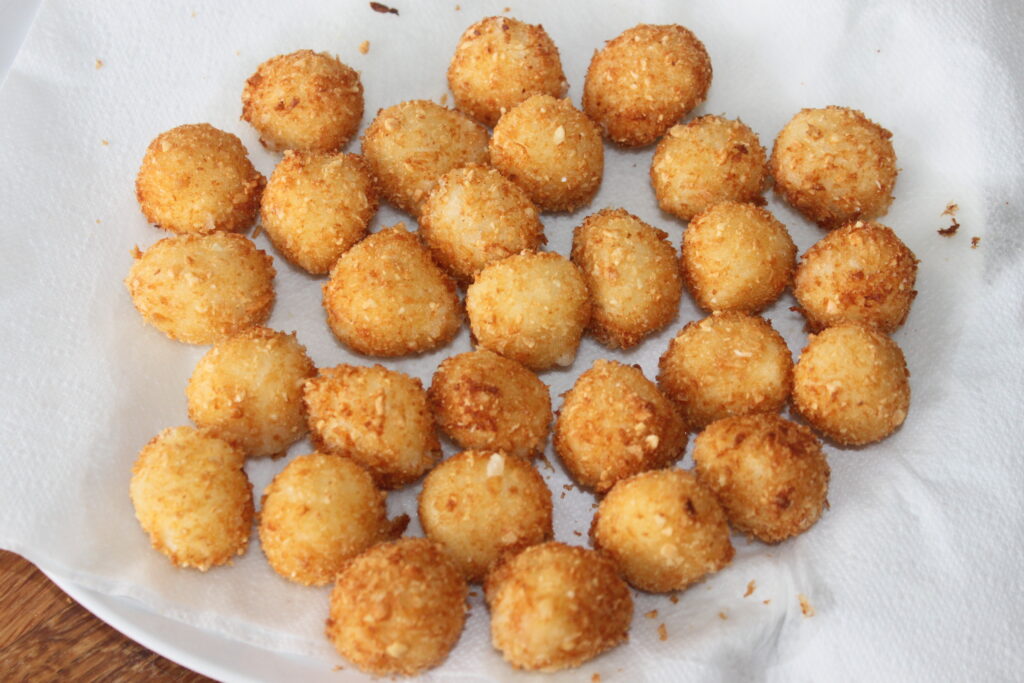
Heat a small pan of oil to 180°C. Dip in the breaded marbles. Cooking will be quick. When they’re golden brown, they’re good. You can also hear the sound of frying changing, as the mozzarella will release liquid at some point, indicating that they need to be removed from their oil bath.
Place on absorbent paper.
The sauce:
For the sauce, mix all the ingredients together. Watch out for the action! For this recipe, a good quality industrial mayonnaise will do, although of course I make my mayonnaise at home most of the time.
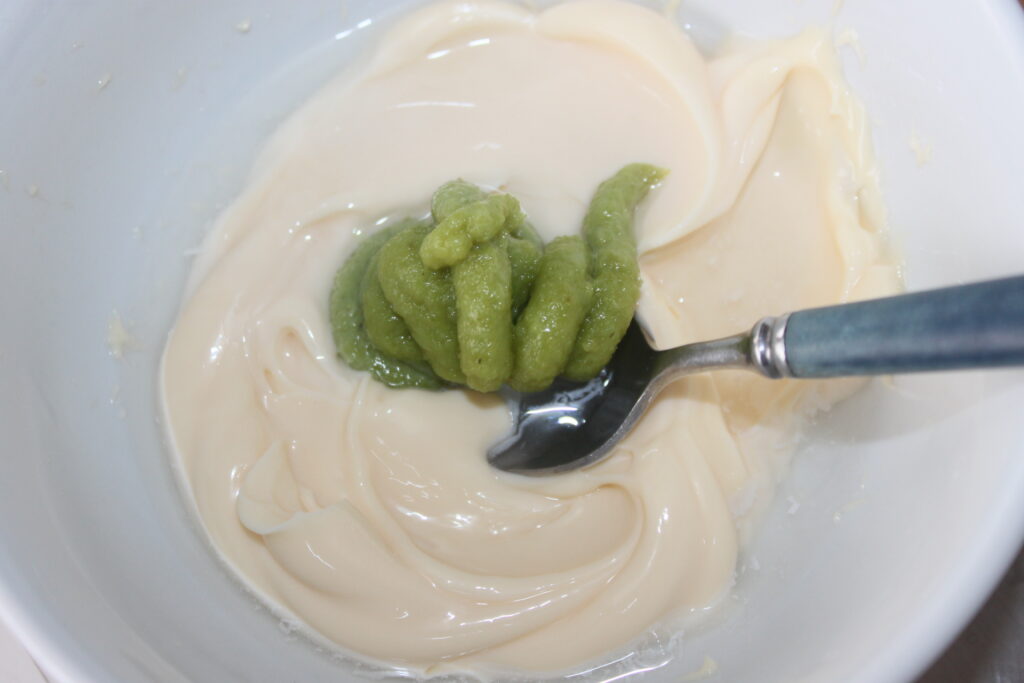
Serve the breaded balls while they’re still hot, and enjoy them with the sauce right away!
Note de Bernard :
Warning: unfortunately, they’re only good when they come out of the fryer. If you reheat them in the oven afterwards, the cheese will melt as it spreads out in the dish! It’s best to prepare them in advance, bearing in mind that they can be frozen raw and fried at the last minute.


Mozza balls, mayonnaise au wasabi
Instructions
- La recette :Voici les billes de mozarella. Sortez-les du paquet et égouttez-les.
- Mettez dans un petit mixeur, les cacahuètes grillées et réduisez-les en poudre.
- Versez dans un plat avec le panko (ou la chapelure). Mélangez bien.
- Passez tout d’abord les billes dans de la farine.
- Plongez-les ensuite dans le lait fermenté (ou de l’œuf battu, cela fonctionnera aussi).
- Puis roulez-les dans le mélange cacahuète/panko.
- Mettez de côté au fur et à mesure.
- La cuisson : Faites chauffer une petite casserole d’huile à 180°C. Plongez les billes panées. La cuisson va être rapide. Quand elles sont bien dorées, c’est que c’est bon. On entend aussi le bruit de la friture qui change, car la mozzarella va relâcher du liquide à un moment donné, c’est signe qu’il faut les sortir de leur bain d’huile. Mettez sur un papier absorbant.
- La suace : Pour la sauce, mélangez tout les éléments ensemble. Attention, ça dépote ! Pour cette recette, une mayonnaise industrielle de bonne qualité fera l’affaire, même si évidemment je fais ma mayonnaise maison la plupart du temps.
- Servez les billes panées encore très chaudes et dégustez avec la sauce sans attendre !
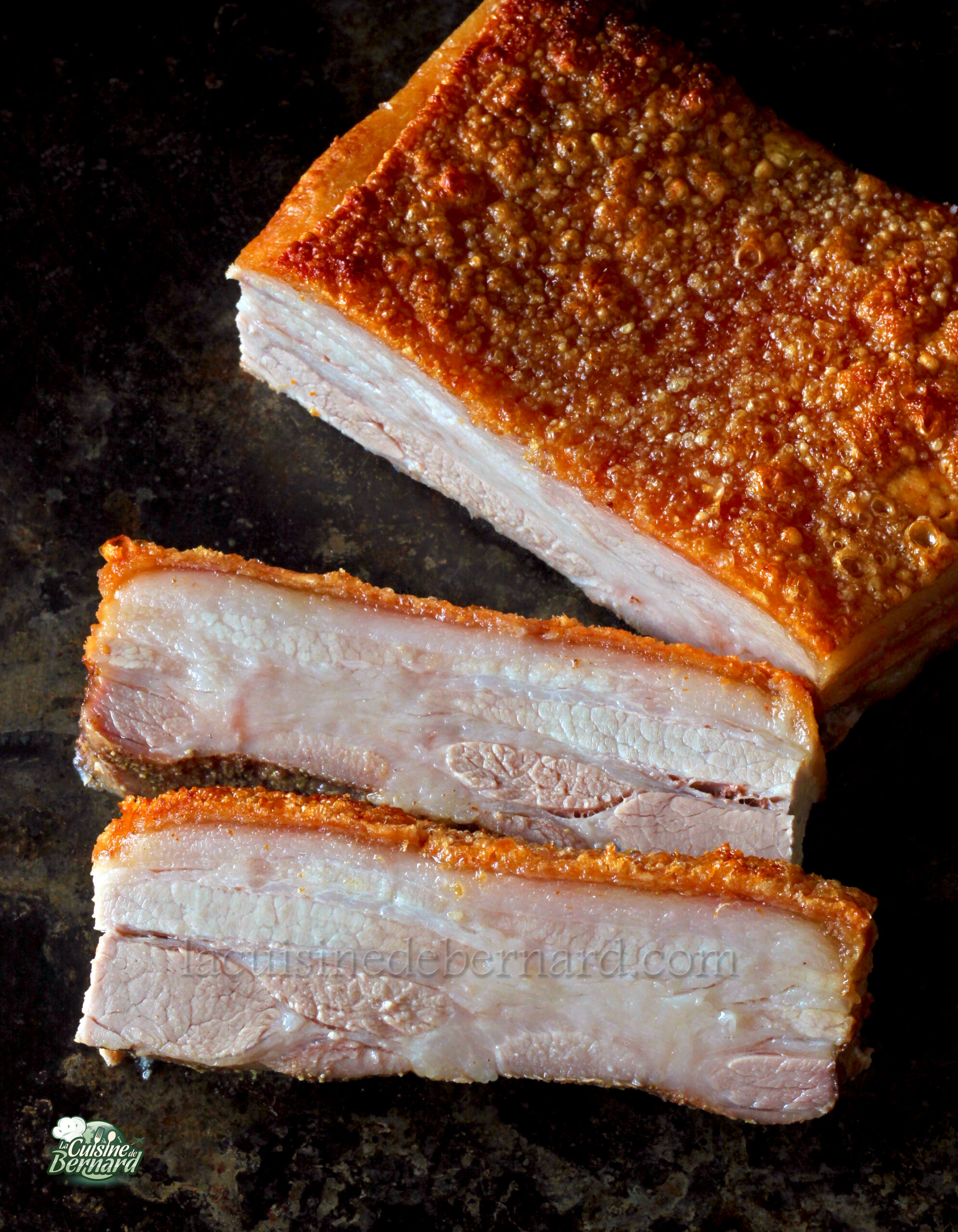
Pork with extra-crispy skin is often seen in Asian rotisseries. I’ll give you the recipe for a delicious result at home: pork cooked just right, juicy and richly flavored, with a super-crispy skin for those who love it.
You’ll need pork belly, and of course you can remove the fat as you like once it’s on the plate. Delicious with rice and a few vegetables, just to clear your conscience!
La recette pour un carré de poitrine de porc :
- 1 pork belly with skin, size of your choice
- 5 flavors” spices
- Chinese wine
- salt
- white pepper
- crystal white vinegar
- 300g coarse salt (adapt to size of meat)
Les questions sur cette recette :
- Can this recipe be prepared in advance?
- Yes, you can prepare the pork belly in advance and reheat it in the oven to keep it crisp.
- How do you get really crispy skin?
- Prick the skin without touching the flesh and apply a layer of vinegar, followed by a generous layer of coarse salt to ensure ultra-crisp skin.
- Can I use other spices?
- Of course! You can experiment with different spices such as smoked paprika or herbes de Provence to vary the flavours.
- What accompaniments go well with this dish?
- Serve pork belly with plain rice, green vegetables or a salad for an (almost!) balanced meal.
- How to prevent meat from becoming too fatty?
- You can remove the fat after cooking to suit your taste, without losing the flavor and crispy texture.
La préparation :
For this recipe, choose the size of meat you prefer. Just ask for the pork belly, with skin.
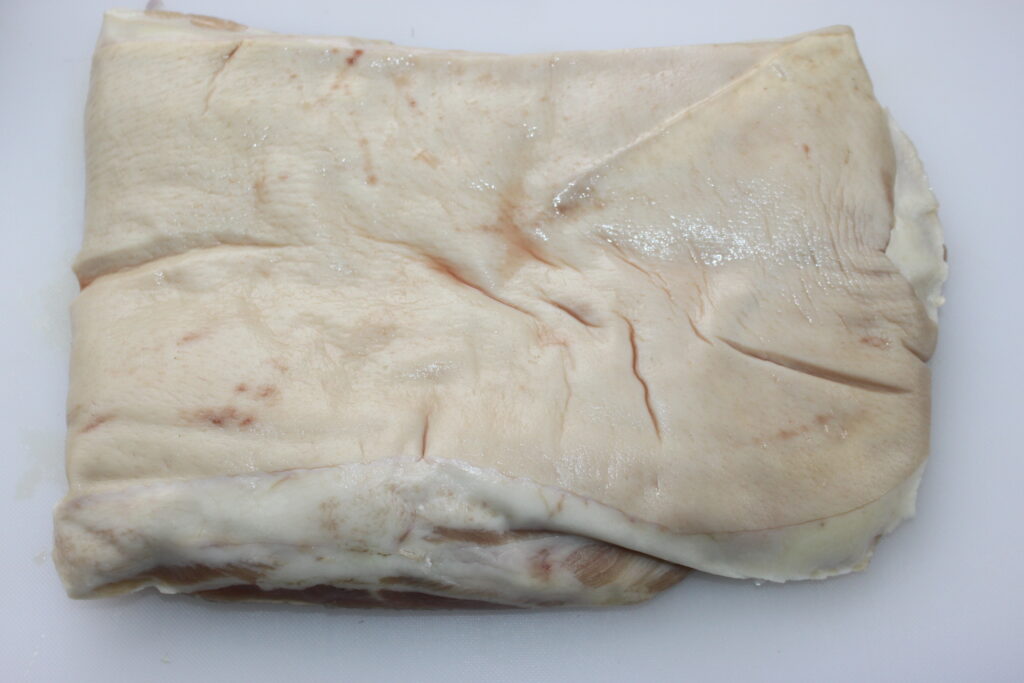
This is the Chinese wine I use for this recipe. This is not a drinking wine, but a cooking wine.

For the “5 flavors” or “5 spices” blend, you’ll find it in Asian grocery stores. Not to be confused with “4 spices” for gingerbread!

Turn the breast over onto a board, flesh side down. Drizzle Chinese wine over the entire surface (not the skin). Sprinkle with 5-flavour spices, salt and white pepper. Once again, only on the flesh side.
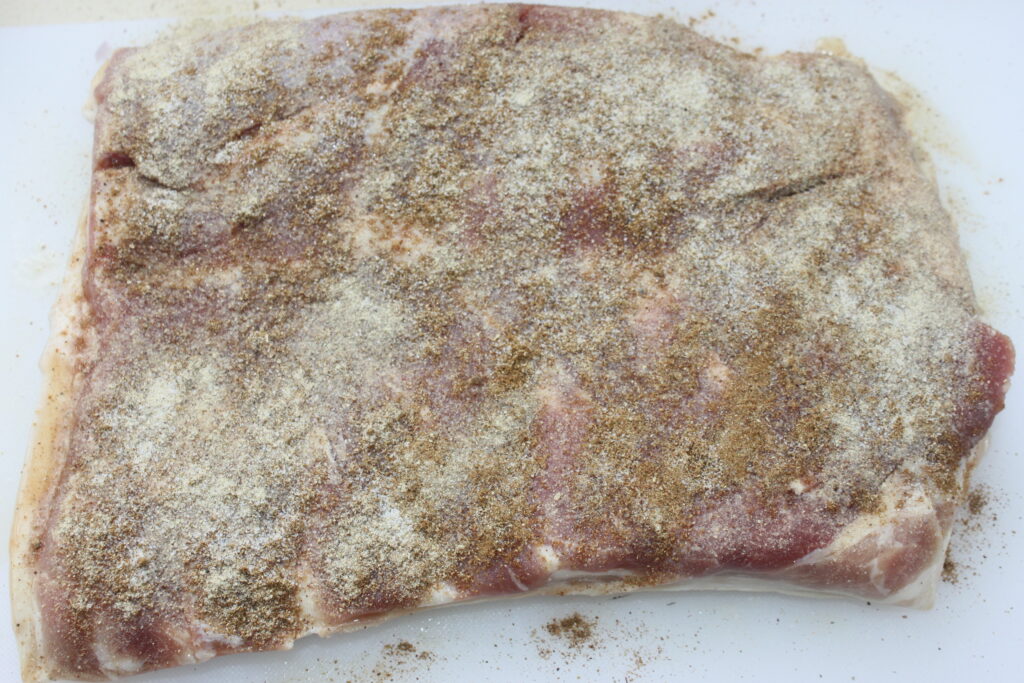
Turn the meat over onto a piece of aluminum foil (or 2 overlapping pieces if the piece of meat is too large).
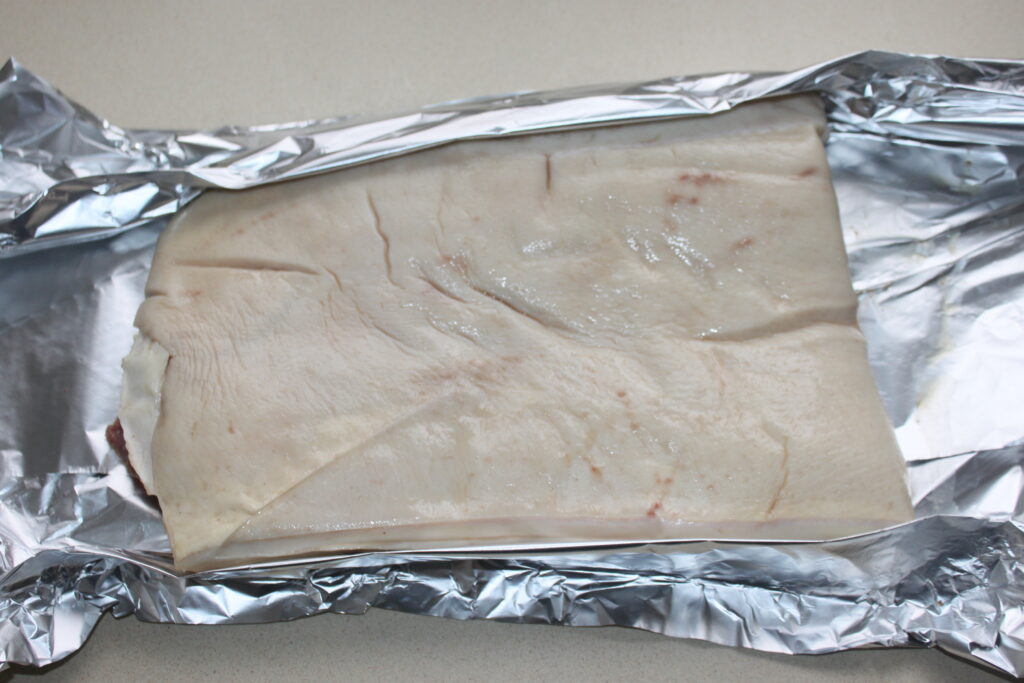
Close the foil around the meat, leaving only the skin visible.
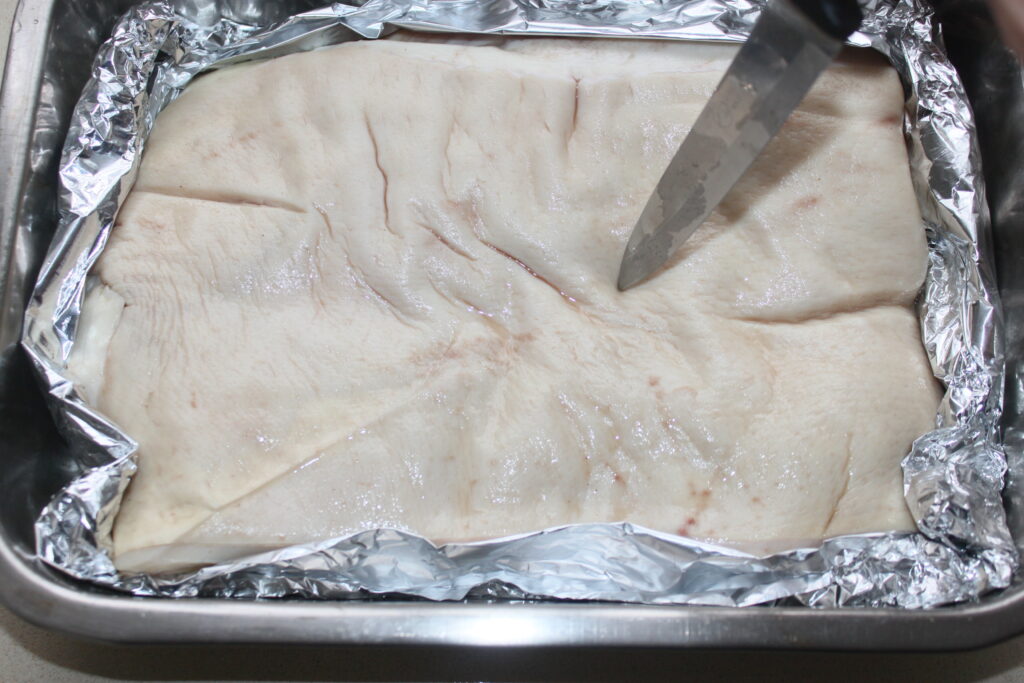
Prick the skin with the tip of a knife, or a metal skewer. Only prick the skin, not the flesh. Otherwise, the meat will release juices and prevent the skin from becoming crispy afterwards. You have to prick everywhere, which is a bit tiring. I made holes every 5mm or so.
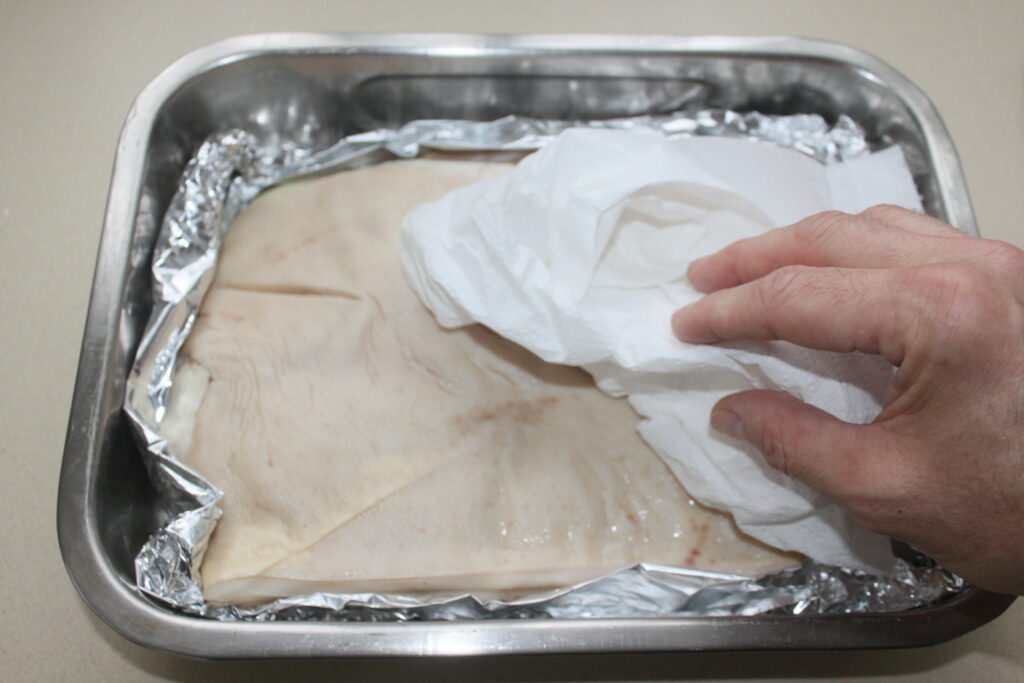
Wipe the skin with absorbent paper.
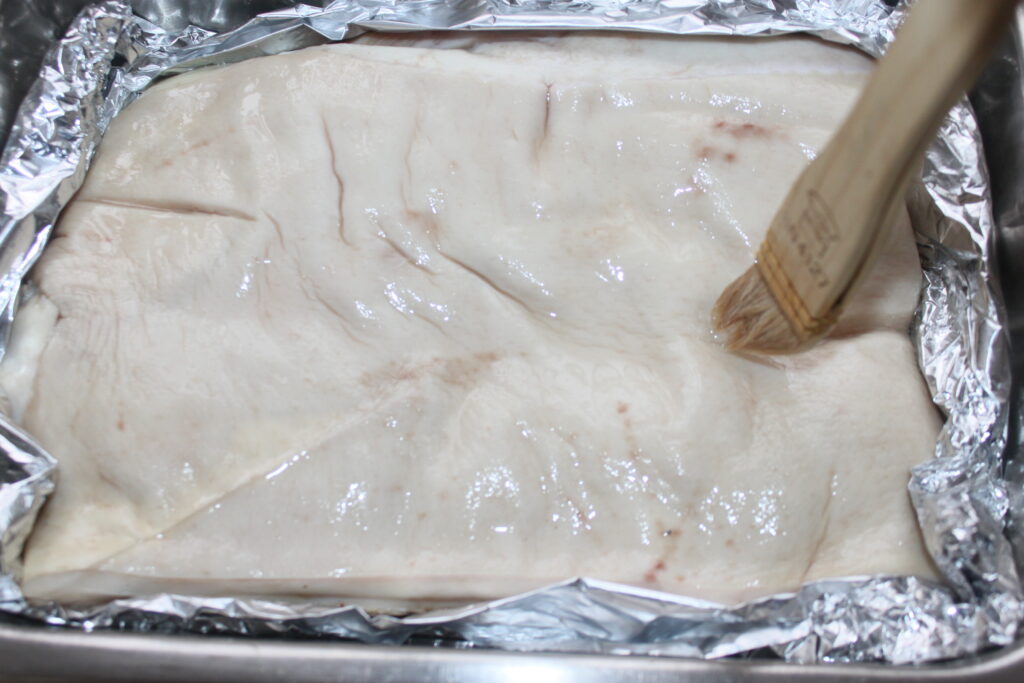
Then brush white spirit vinegar all over the skin.
Then pour coarse salt over the entire surface of the skin, to a good thickness. I used about 250g of coarse salt for the piece I had.
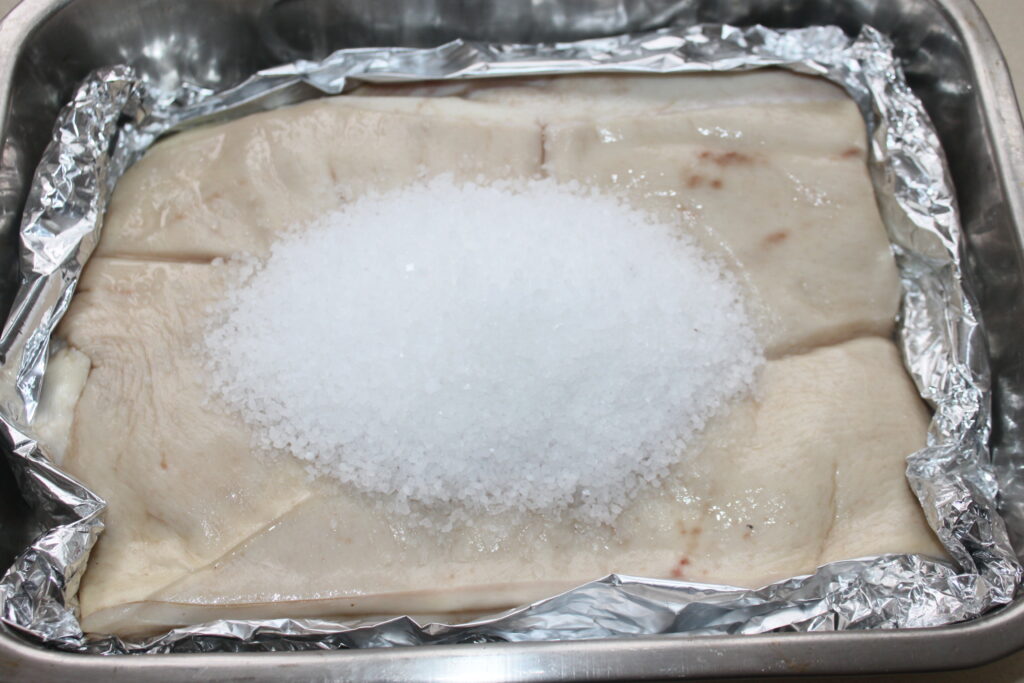
A generous crust of coarse salt is essential.
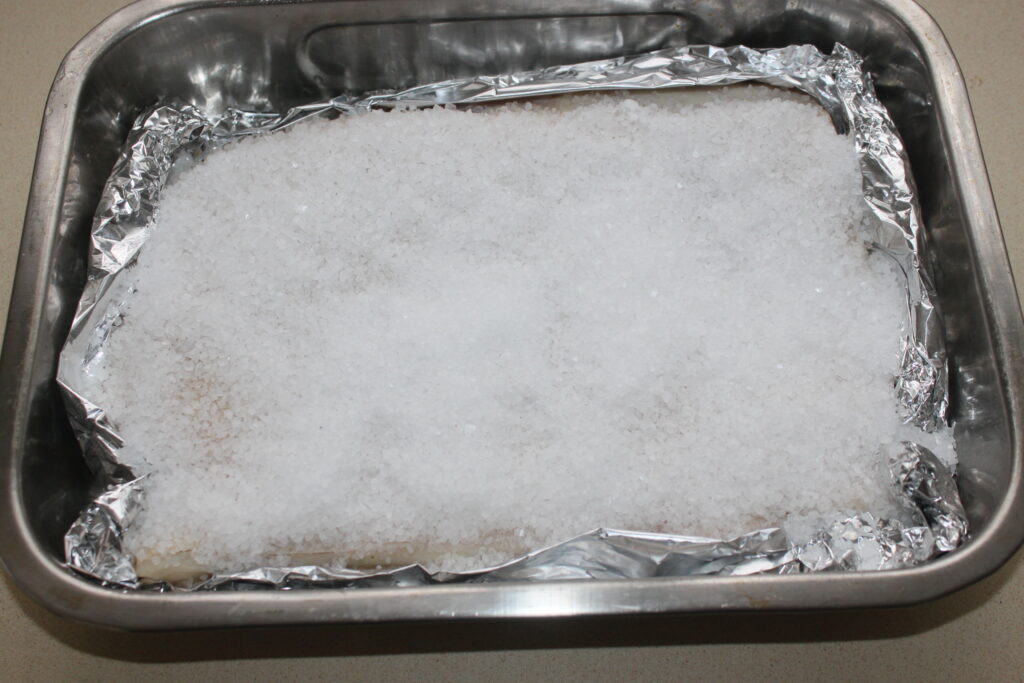
La cuisson
Then bake for 1 hour at 180°C.
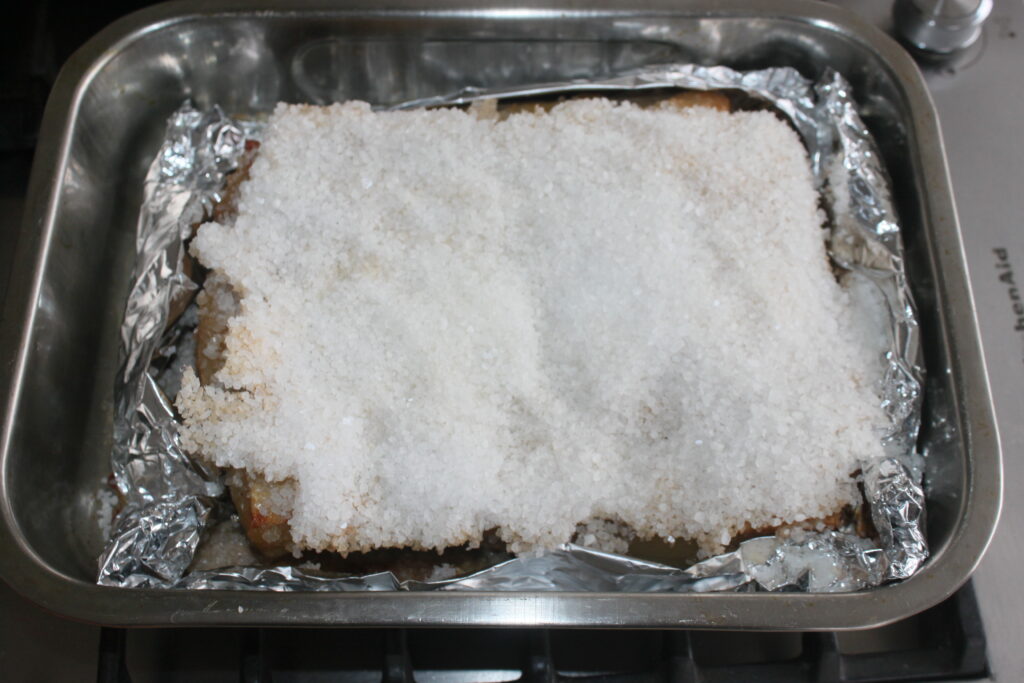
Let the meat cool, then remove all the salt – without rinsing! Scrape with a knife as much as possible. Return the meat, skin side up, to the pan without the foil.
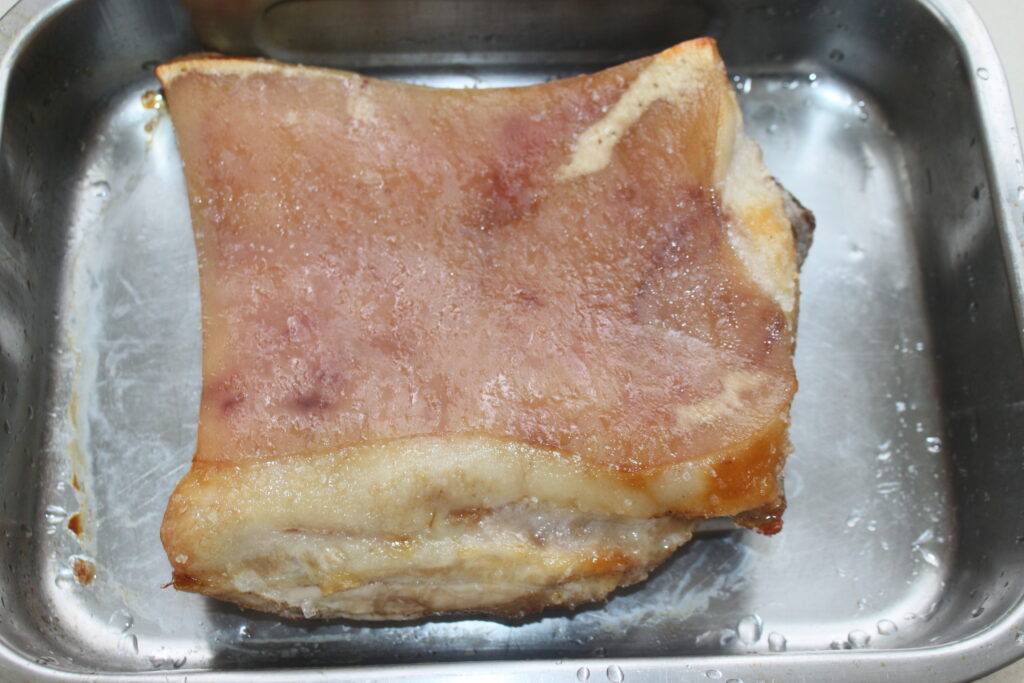
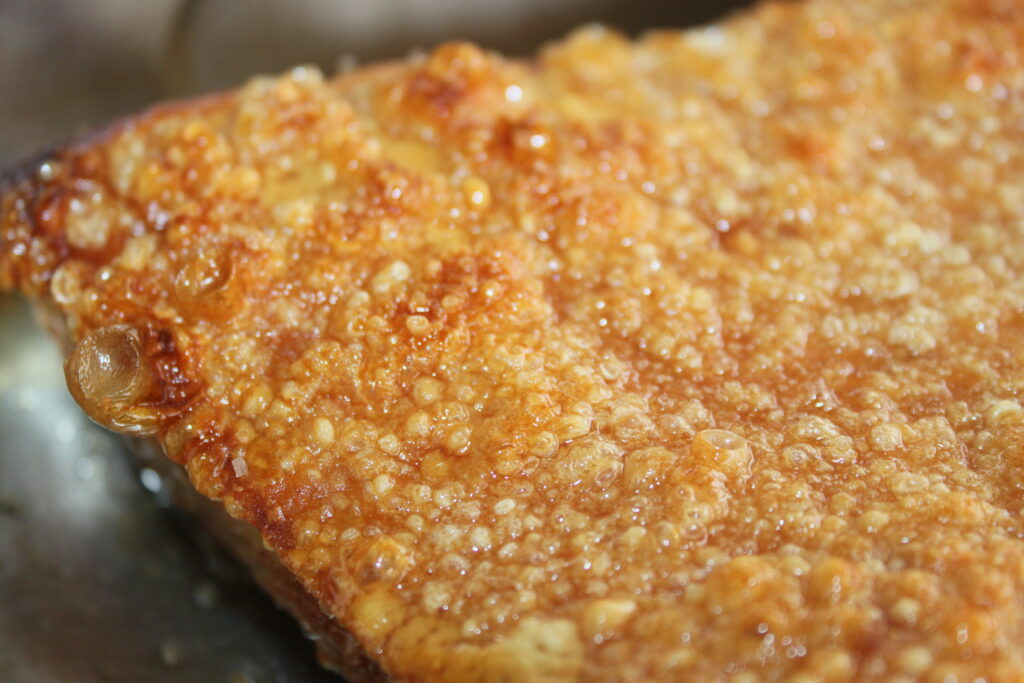
Set the oven to the “grill” function only. Do not place the dish too close to the heating elements, but approximately in the first third of the bottom of the oven. Grill for about 30 minutes, depending on your oven and the meat, which must not burn. The skin will “blow” and become extra-crispy.
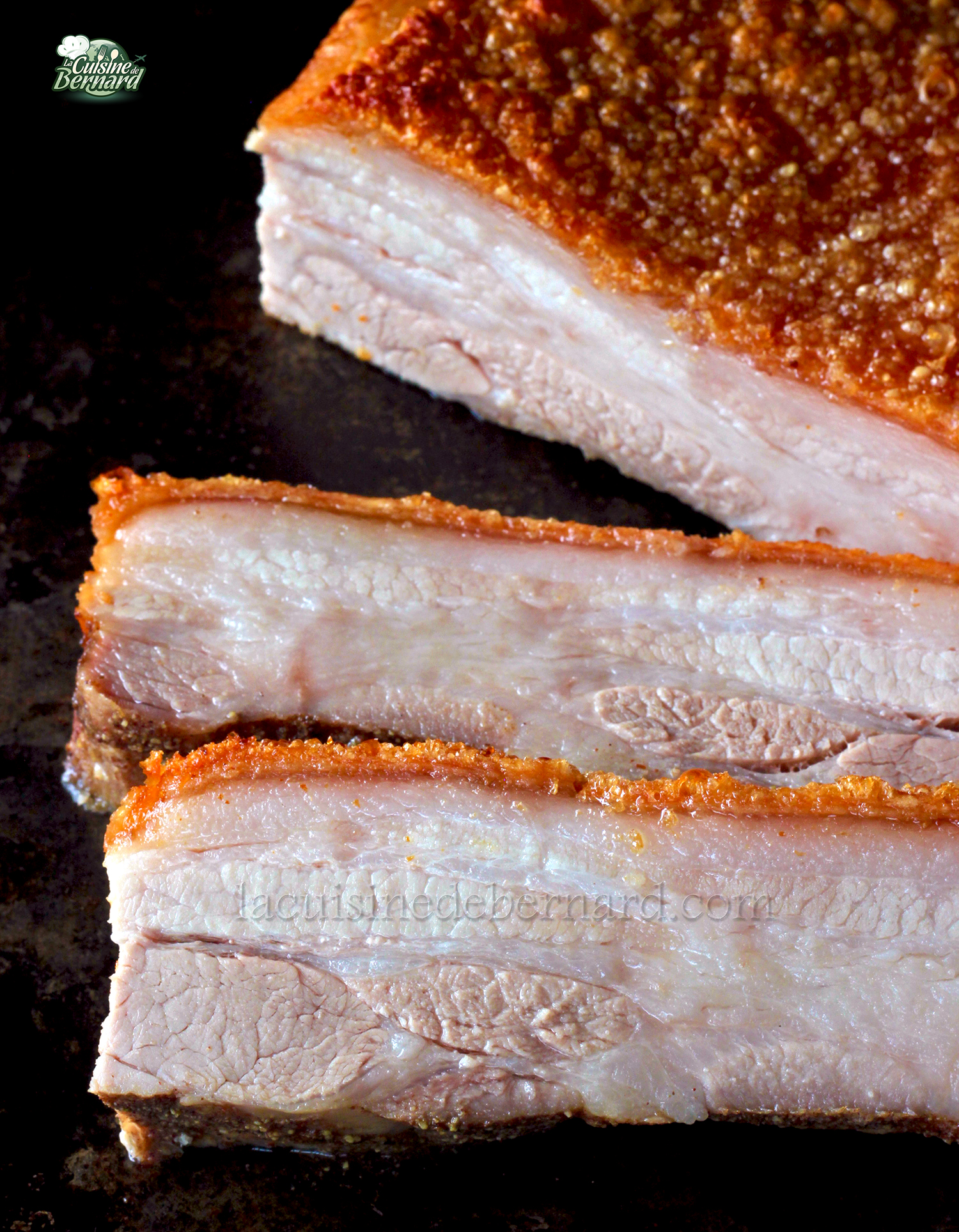
Take out the meat and cut the skin with a saw, then the flesh underneath with a knife.
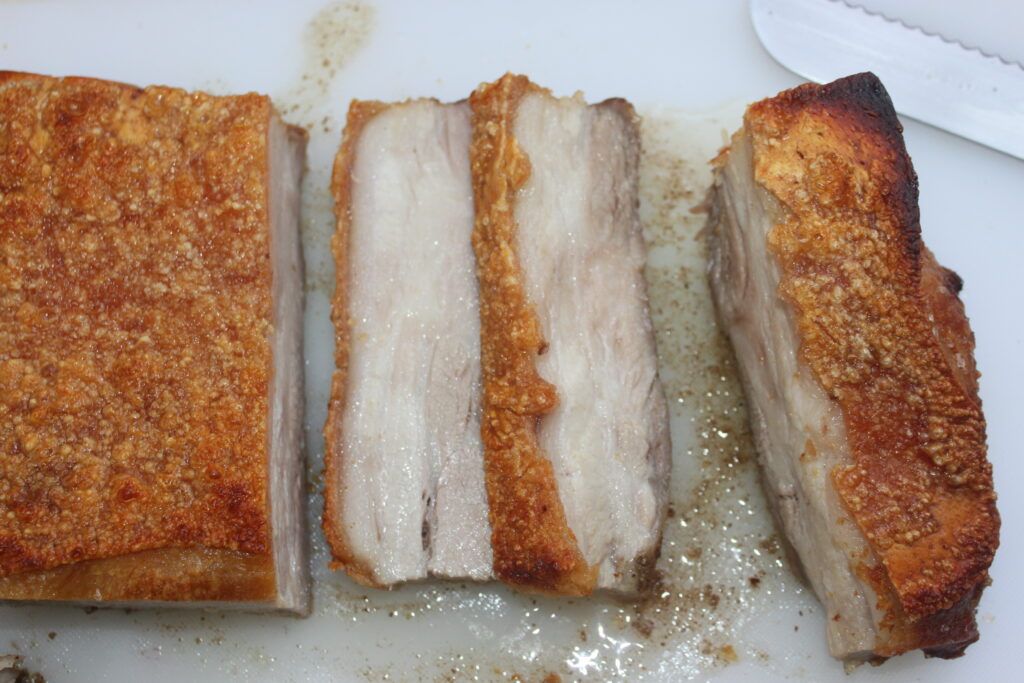
Enjoy it straight away with plain rice and a few green vegetables!
Poitrine de porc extra-croustillante
Ingredients
Instructions
- Pour cette recette, choisissez le morceau de viande de la taille de votre choix. Il faut silmplement demander la poitrine de porc, avec la peau.
- Retournez la poitrine côté chair sur une planche. Arrosez de vin chinois sur toute la surface (pas sur la peau donc). Saupoudrez ensuite d’épices « 5 parfums » , de sel et de poivre blanc. Encore une fois, uniquement côté chair.
- Retournez la viande sur un morceau de papier d’aluminium (ou 2 qui se chevauchent si le morceau de viande est trop grand).
- Refermez le papier d’aluminium autour de la viande, pour ne laisser apparent que la peau. Piquez la peau avec la pointe d’un couteau, ou un pic à brochette en métal. Il ne faut piquer que la peau sans enfoncer dans la chair. Sinon la viande relâchera du jus et empêchera la peau de devenir croustillante par la suite. Il faut piquer partout, ce qui est un peu fatigant. J’ai fait des trous tous les 5mm environ
- Essuyez la peau avec un papier absorbant.
- Passez ensuite au pinceau du vinaigre blanc cristal sur toute la surface de la peau.
- Versez ensuite du gros sel sur toute la surface de la peau, en mettant une bonne épaisseur. J’ai mis environ 250g de gros sel pour le morceau que j’avais.
- Il faut donc une belle croûte géénreuse de sel.
- Mettez ensuite à cuire 1 heure sur chaleur tournante à 180°C.
- Laissez tiédir la viande, puis enlevez tout le sel, sans le rincer ! Il faut gratter au couteau au maximum. Remettez la viande, peau apparente vers le haut, dans le plat, sans le papier d’aluminium.
- Mettez le four sur fonction « grill » uniquement. Ne mettez pas le plat trop près des résistances, mais environ dans le premier tiers du bas du four. Laissez griller environ 30 minutes, tout en adaptant à votre four et à la viande qui ne doit bien sûr pas brûler. La peau va « souffler » et devenir extra-croustillante.
- Sortant la viande et coupez la peau avec une scie, puis la chair en dessous avec un couteau.
- Il faudra la déguster sans attendre avec un riz nature et quelques légumes verts !
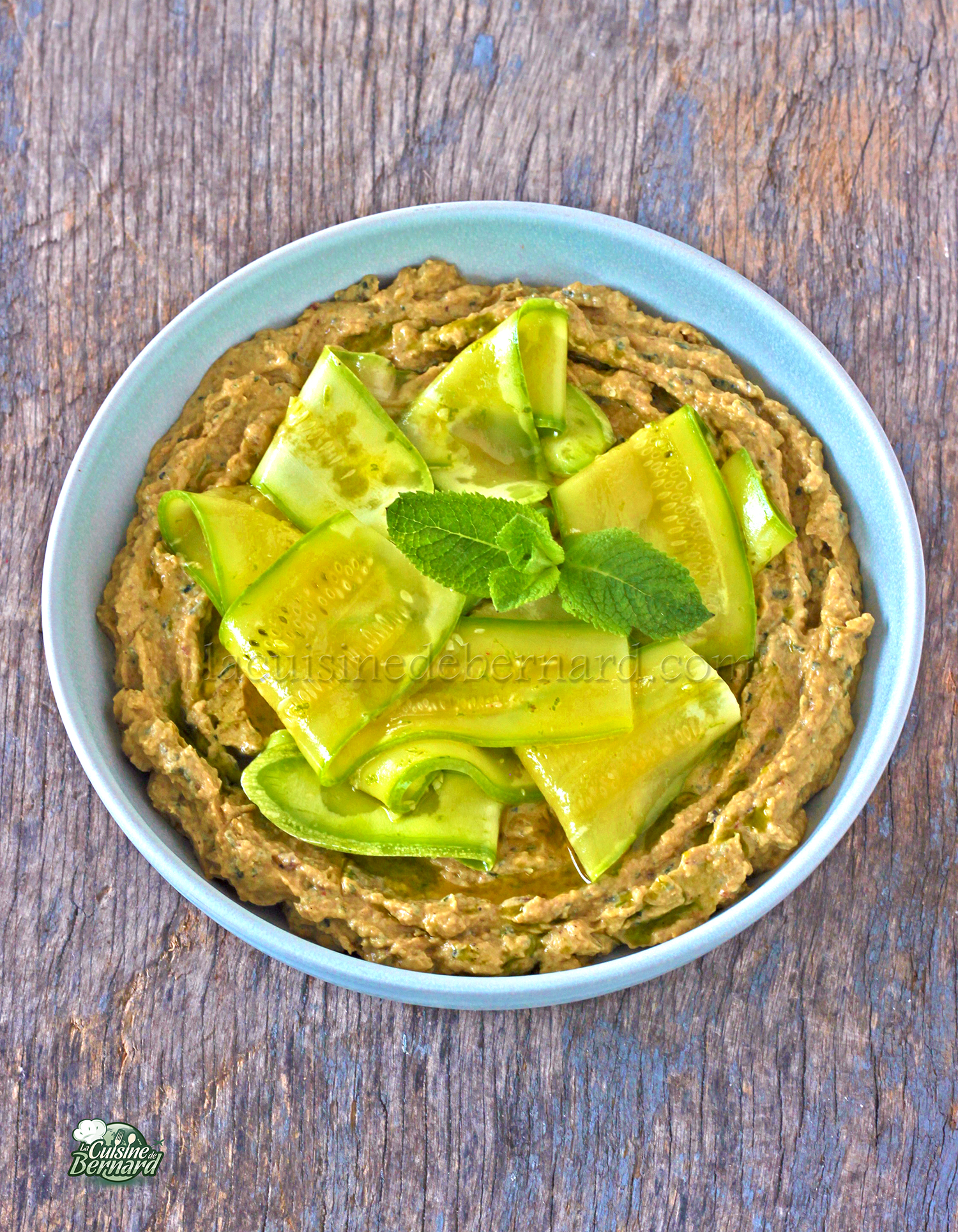
For a change from babaganoush (which is also on my site), I suggest a zucchini, mint and lime caviar. Very easy to make, this dish will be luminously fresh, bringing color and flavor to an aperitif or appetizer! Delicious with warm, crusty bread.
Recipe for 6 people:
- 5 medium-sized white or green zucchinis
- 1 head of garlic
- 10% of the weight of the cooked zucchinis, of tahini (roughly 50g)
- a dozen sprigs of mint
- olive oil, salt, pepper
For the marinated zucchini strips:
- 1 zucchini
- 1 untreated lime
- olive oil, salt
Start by washing the zucchinis and cutting off the ends. Cut them in half lengthwise.
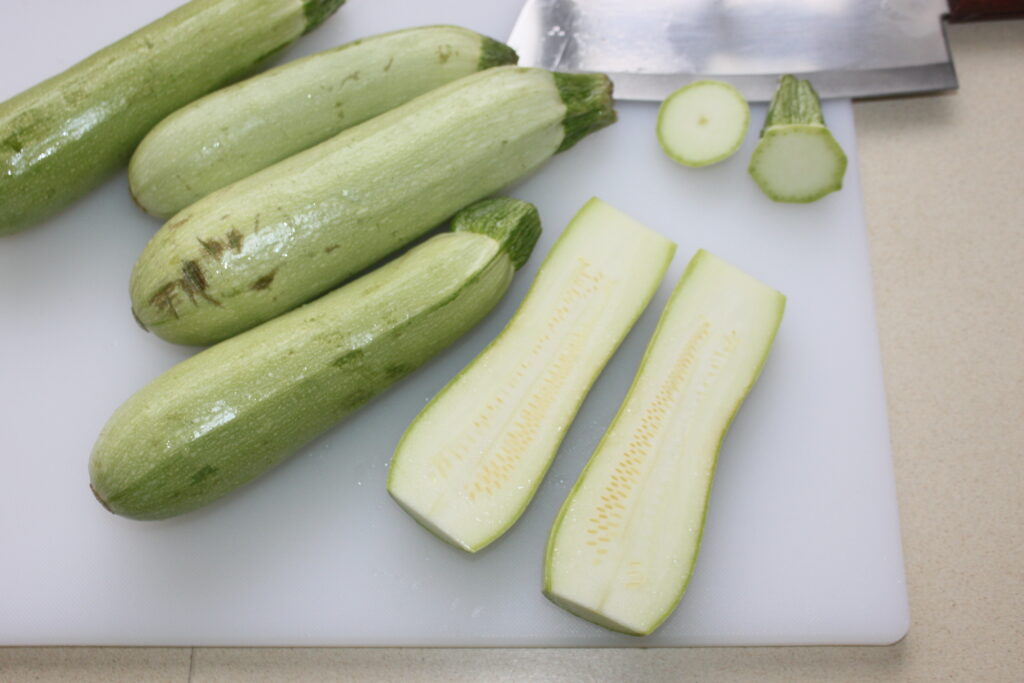
Place in an ovenproof dish. Add the whole head of garlic. Drizzle generously with oil and season with salt and pepper.
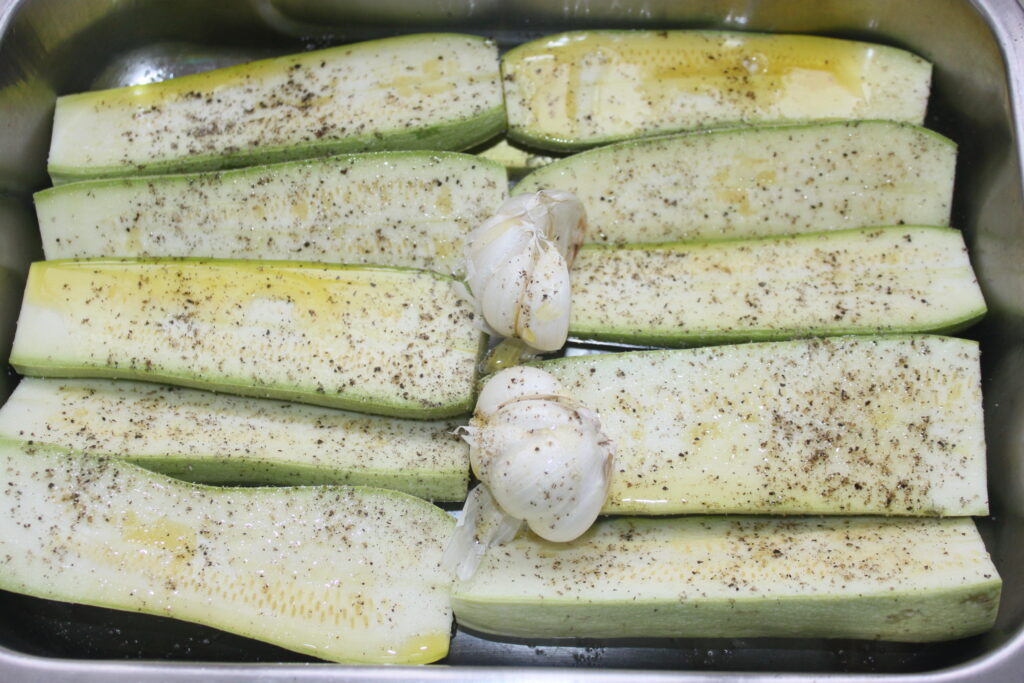
Bake in the oven at 220°C for 1h10.
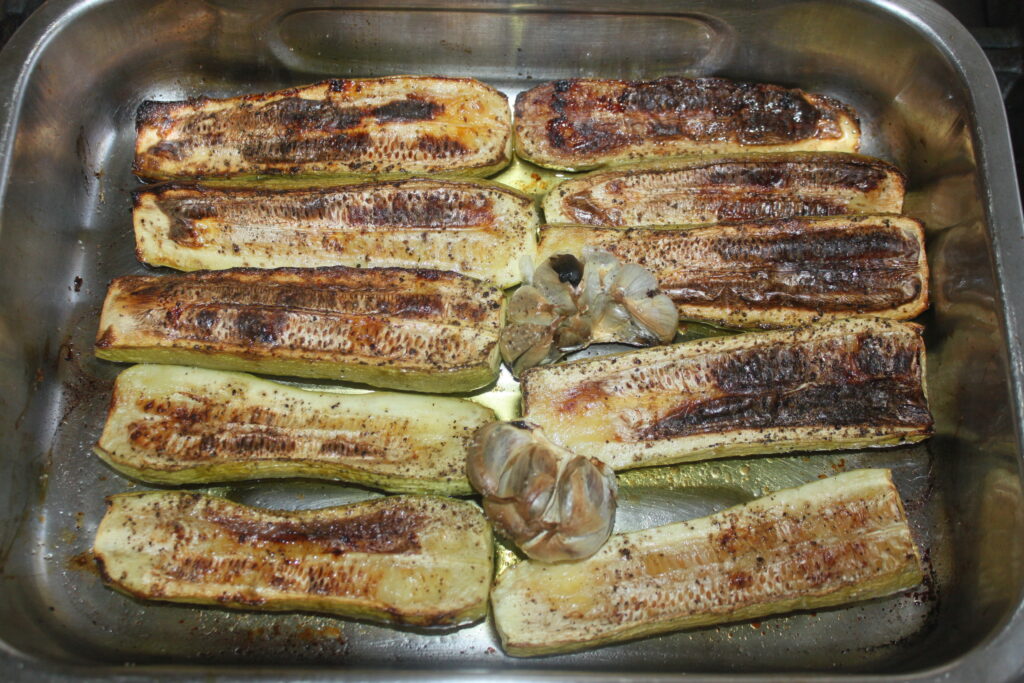
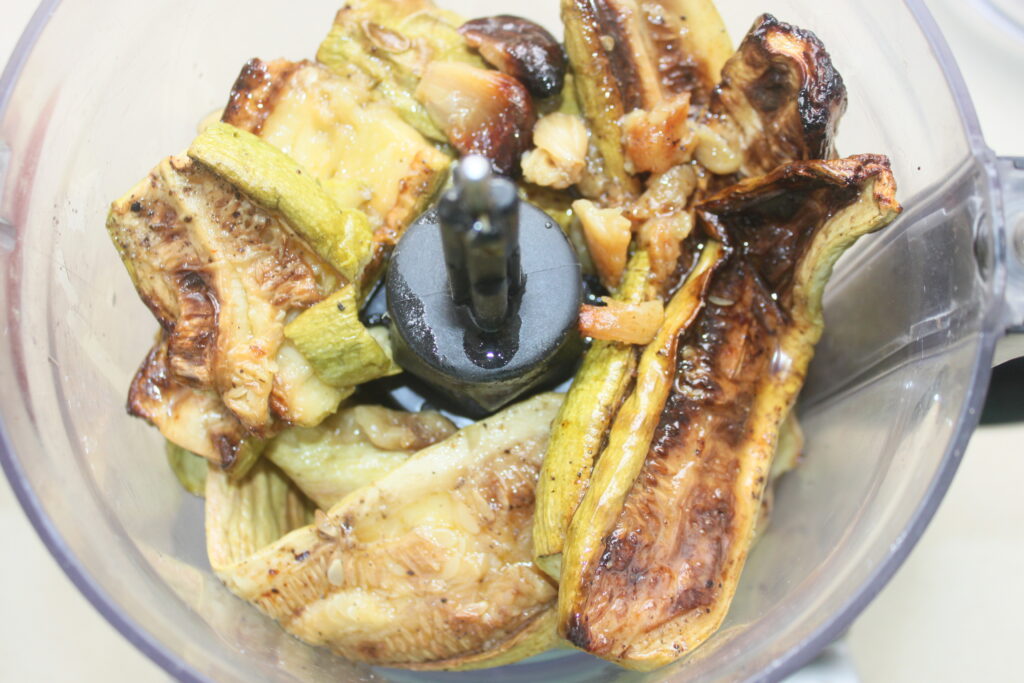
Leave to cool, weigh the cooked zucchini, then place the cooked zucchini, with any juices it may have given off, in a small blender with the roasted garlic cloves.
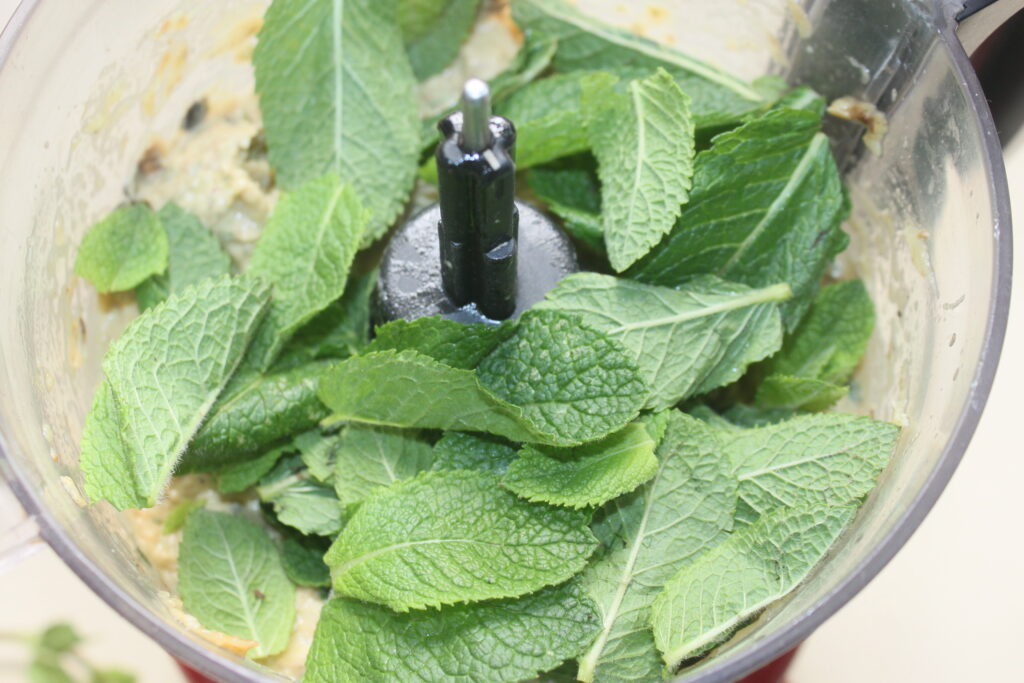
Weigh out 10% of the weight of the tahini zucchini, the sesame cream. Season with salt and pepper, a little olive oil (1 tablespoon) and the leaves of a dozen sprigs of mint.
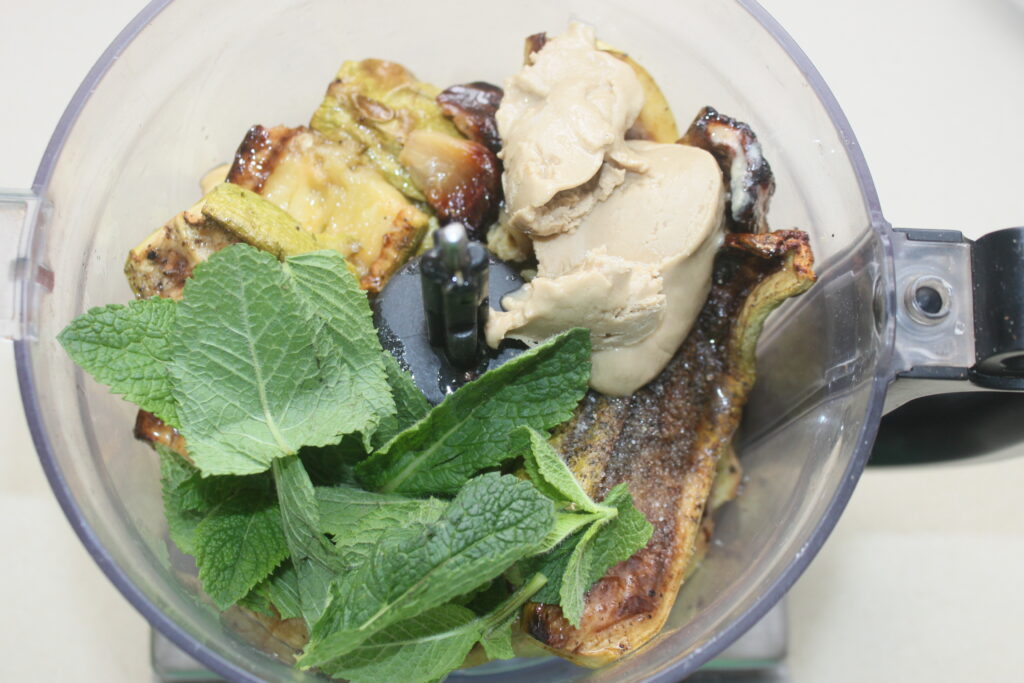
It’ll be a lot, but it’ll be fresh and delicious!
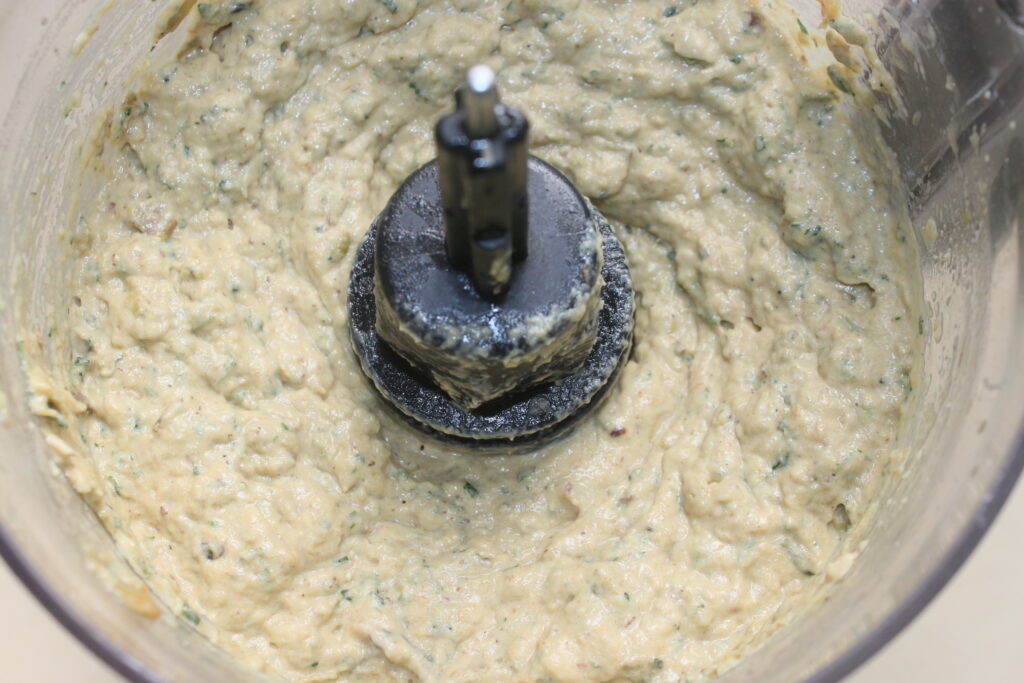
Blend until smooth and homogeneous.
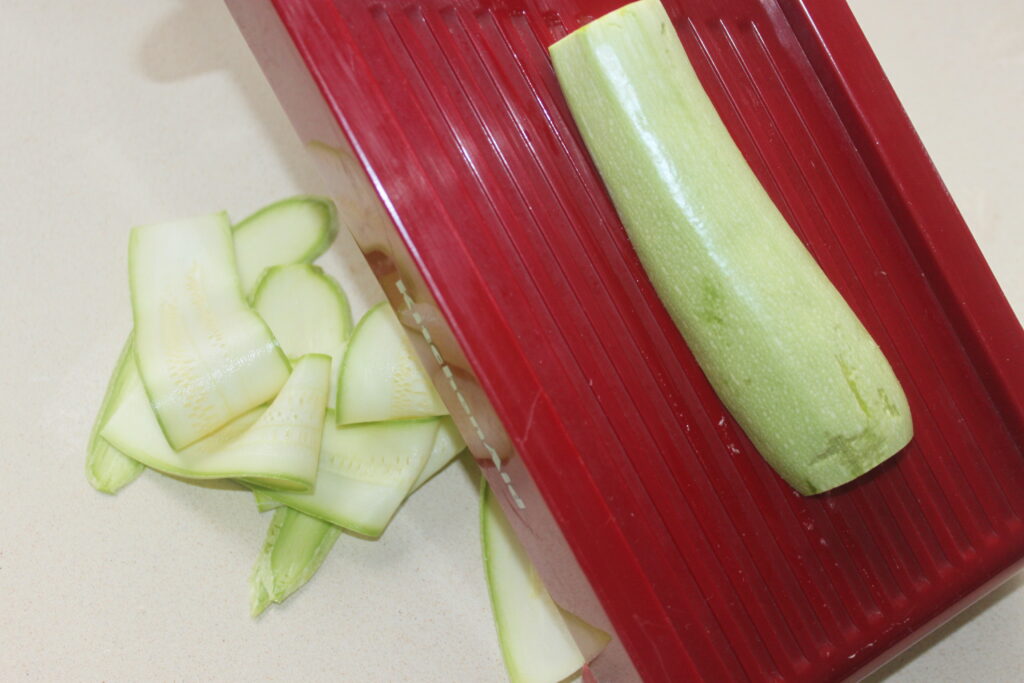
For the last zucchini, cut lengthwise into thin strips, best done with a mandolin.
Pour into a bowl and add the zest of half to one whole lime.
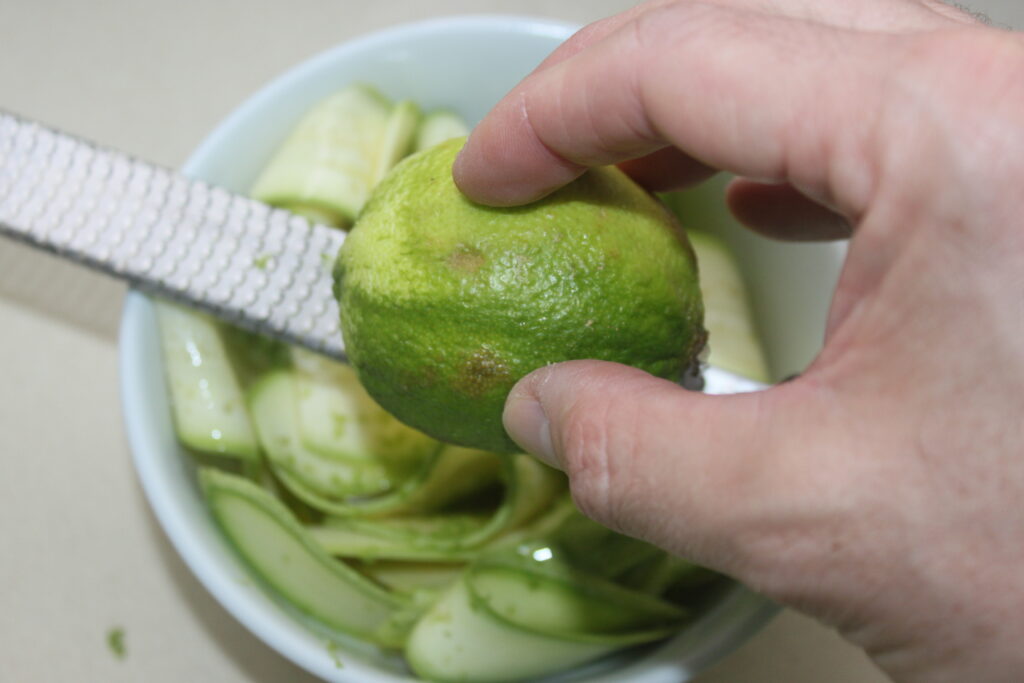
Season with salt and olive oil.

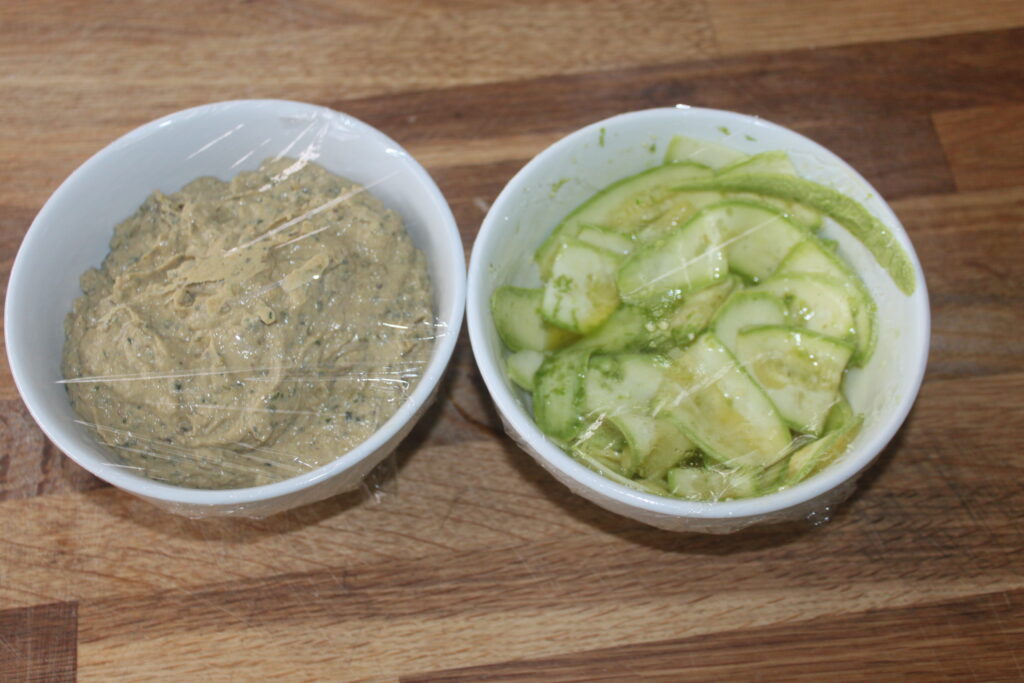
Leave to marinate in a cool place for at least an hour. You can put everything in cling film in a cool place.
Just before serving, place the zucchini caviar in a dish, add the marinated zucchini strips and drizzle with olive oil. For a mint-flavored chlorophyll oil, go HERE!
Serve with warm, crusty bread.

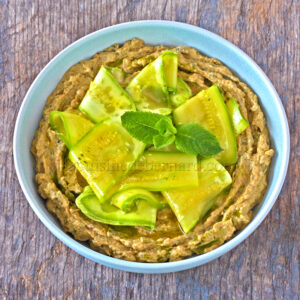
Zucchini caviar with mint and lime
Ingredients
- 5 zucchini white or green
- 1 head of garlic
- 50 g tahini
- olive oil, salt, pepper
For the marinated zucchini strips:
- 1 zucchini
- 1 zest lime bio
- olive oil, salt
Instructions
- Start by washing the zucchinis and cutting off the ends. Cut them in half lengthwise.
- Place in an ovenproof dish. Add the whole head of garlic. Drizzle generously with oil and season with salt and pepper.
- Bake in the oven at 220°C for 1h10.
- Leave to cool, weigh the cooked zucchini, then place the cooked zucchini, with any juices it may have given off, in a small blender with the roasted garlic cloves.
- Weigh out 10% of the weight of the tahini zucchini, the sesame cream. Season with salt and pepper, a little olive oil (1 tablespoon) and the leaves of a dozen sprigs of mint.
- It’ll be a lot, but it’ll be fresh and delicious!
- Blend until smooth and homogeneous.
- For the last zucchini, cut lengthwise into thin strips, best done with a mandolin.
- Pour into a bowl and add the zest of half to one whole lime. Season with salt and olive oil.
- Leave to marinate in a cool place for at least an hour. You can put everything in cling film in a cool place.
- Just before serving, place the zucchini caviar in a dish, add the marinated zucchini strips and drizzle with olive oil. For a mint-flavored chlorophyll oil, go HERE!
- Serve with warm, crusty bread.
Nutrition
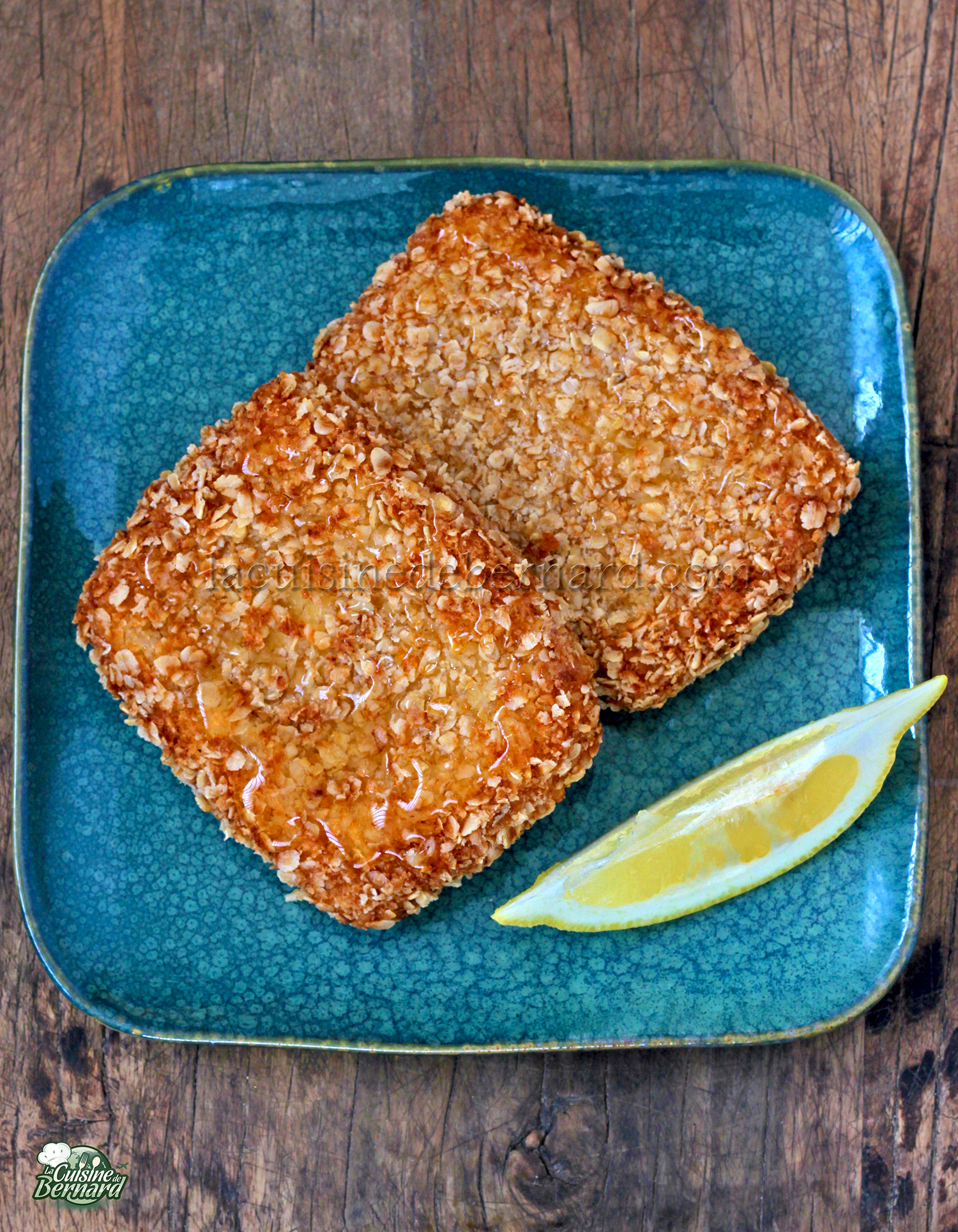
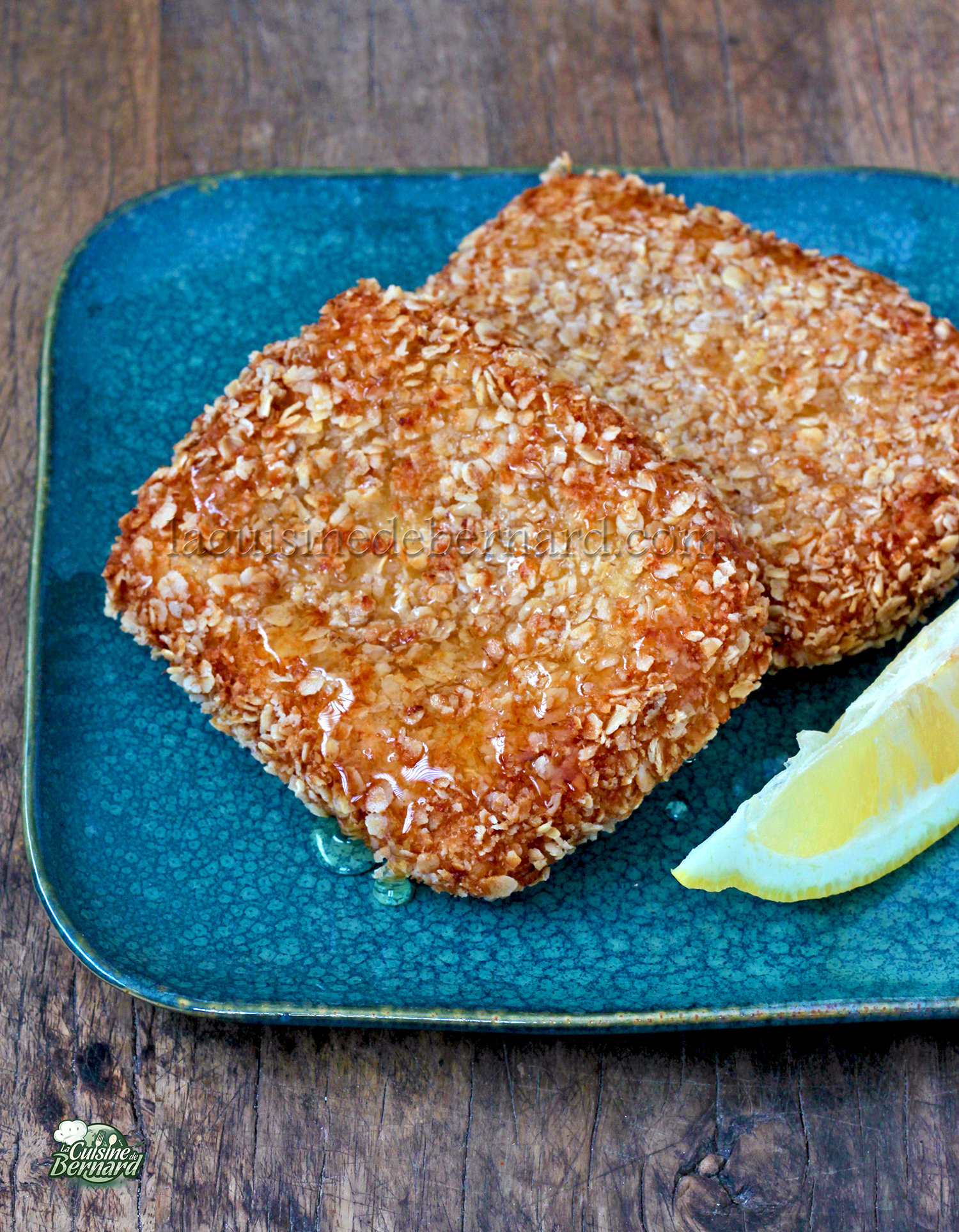
During a trip to the Cyclades, I was lucky enough to taste saganáki, a delicious fried cheese, several times. One of the versions was made with rolled oats, and the result was unexpected and, frankly, delicious. As the cheese used, kefalograviéra, is rather hard to find in our country, I propose an alternative with halloumi, which is much easier to find. Served with honey and a few slices of lemon, this simple dish will be the star of your aperitif or starter!
For 3-4 people :
- One halloumi or 200-250g of Greek cheese: kefalograviéra, kefalotýri, kasséri
- A bowl of flour
- A large bowl of fermented milk
- 200g rolled oats
- Oil for frying
- Salt and pepper
- Honey and lemon to serve
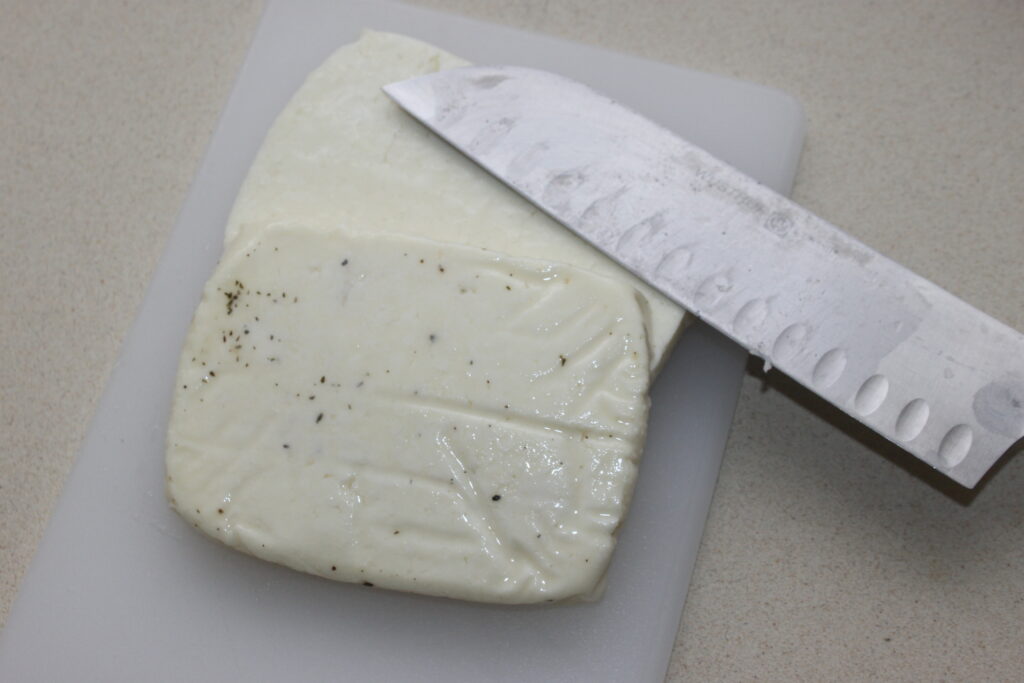
Unwrap the halloumi and cut it into 2 or 3 thick slices.
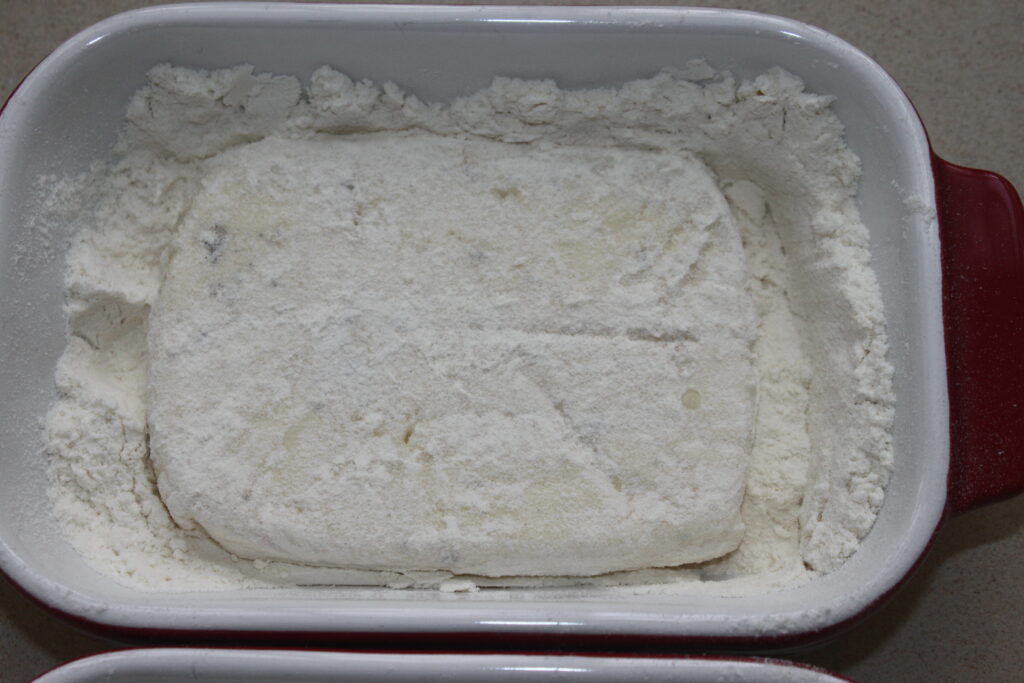
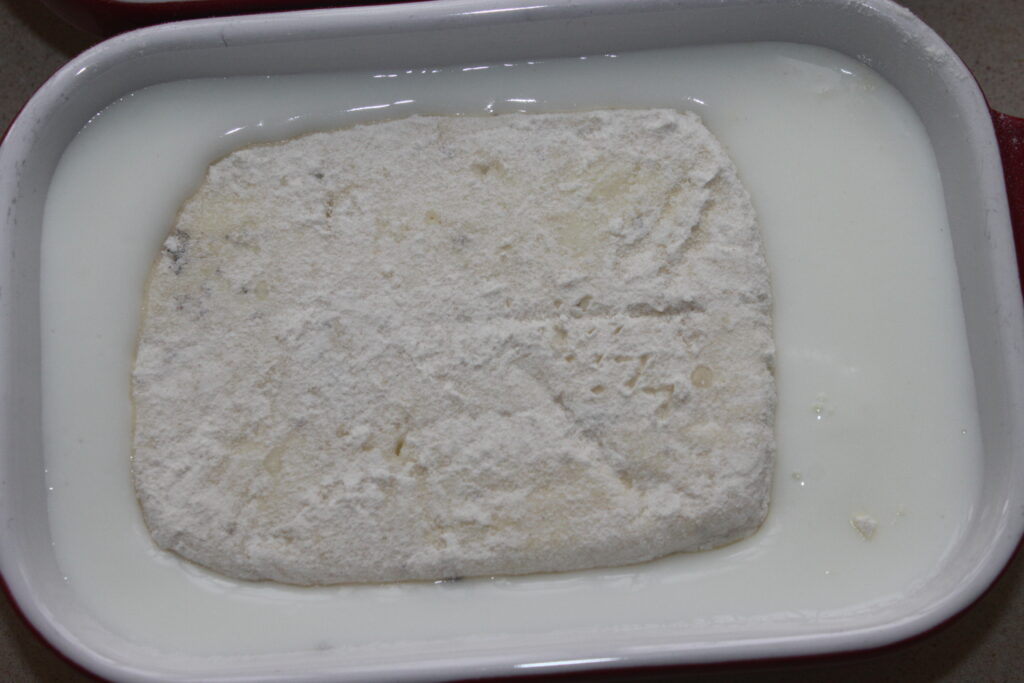
Dredge each slice in flour on both sides.
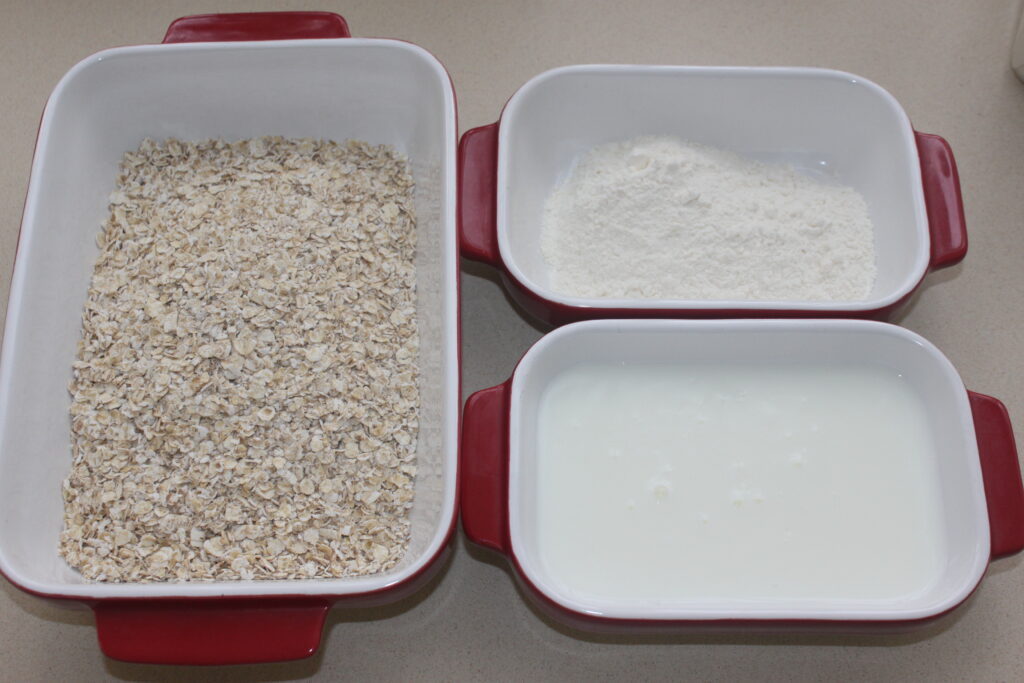
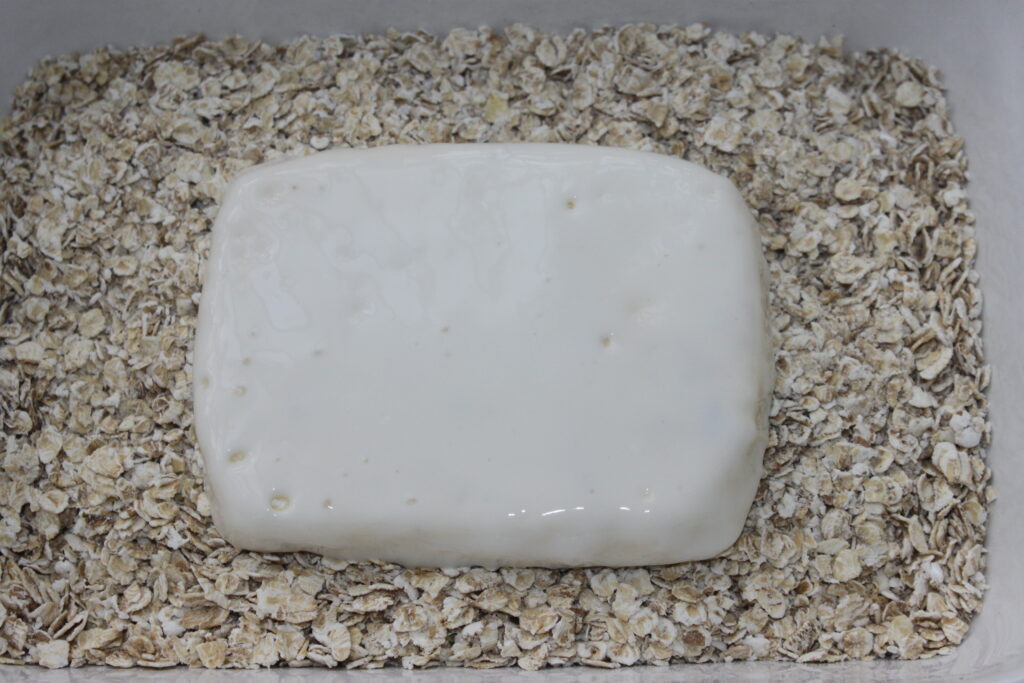
Remove the excess and dip them in the fermented milk. Remove the excess and place in a container with the oatmeal.
Sprinkle with flakes to cover the entire surface of the cheese slices.
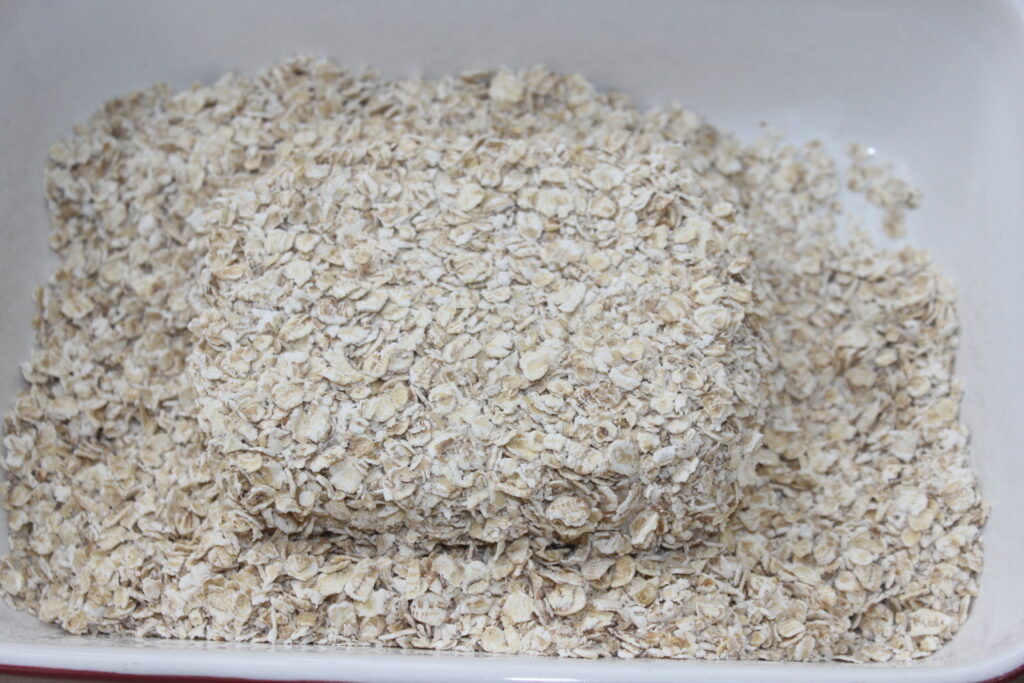
Leave to rest in the flakes for 5 minutes, while you heat the oil in a small saucepan.
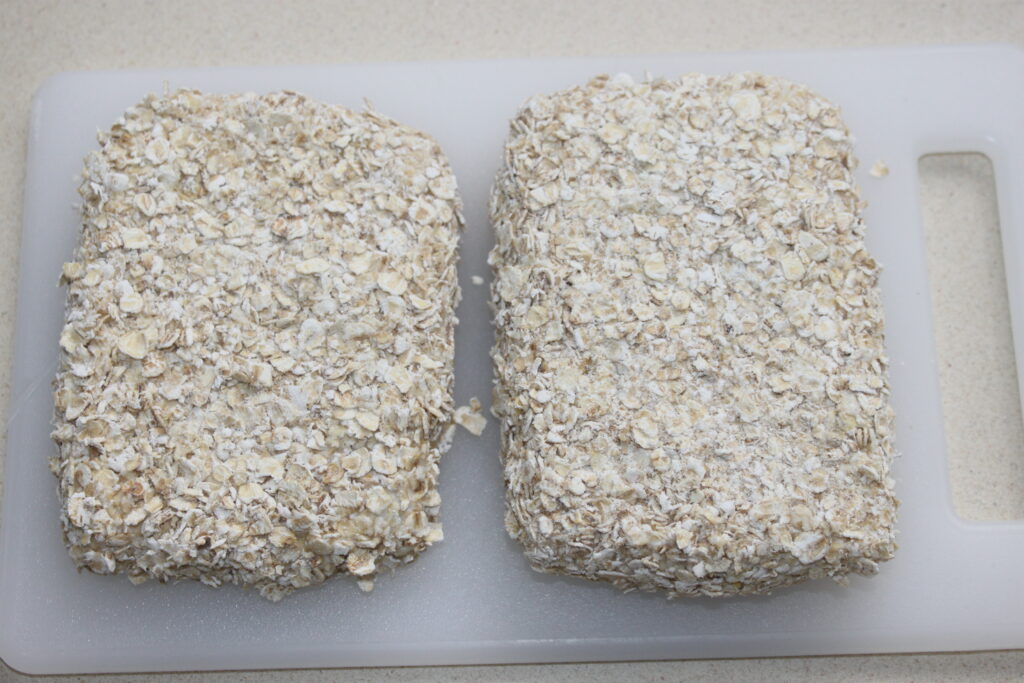
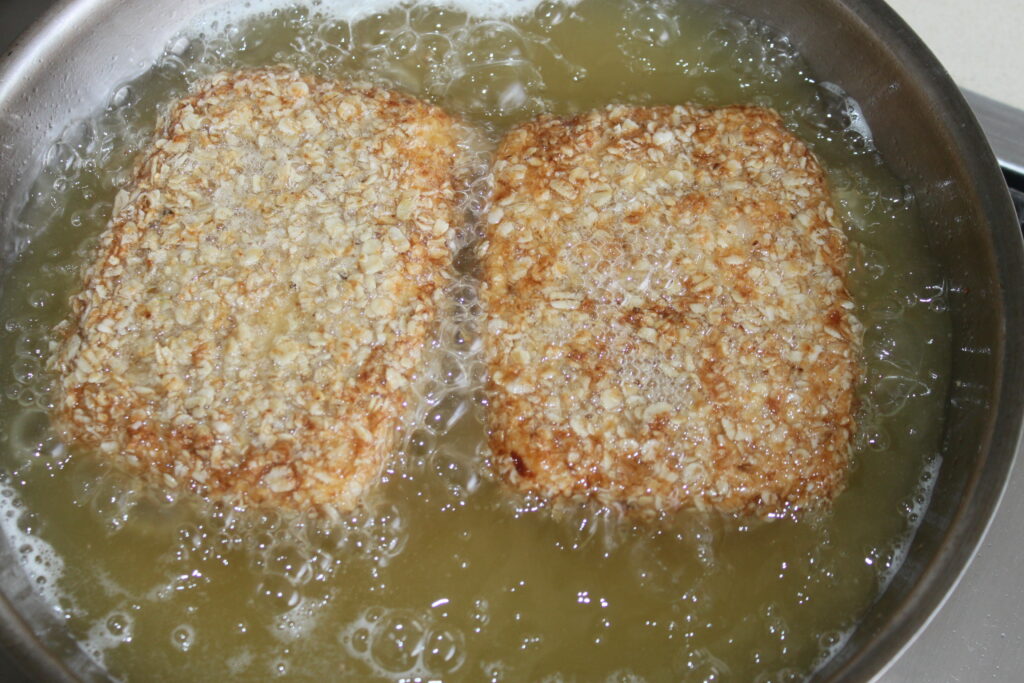
When the oil is hot, around 180°C, dip the slices in one at a time until they are golden brown.

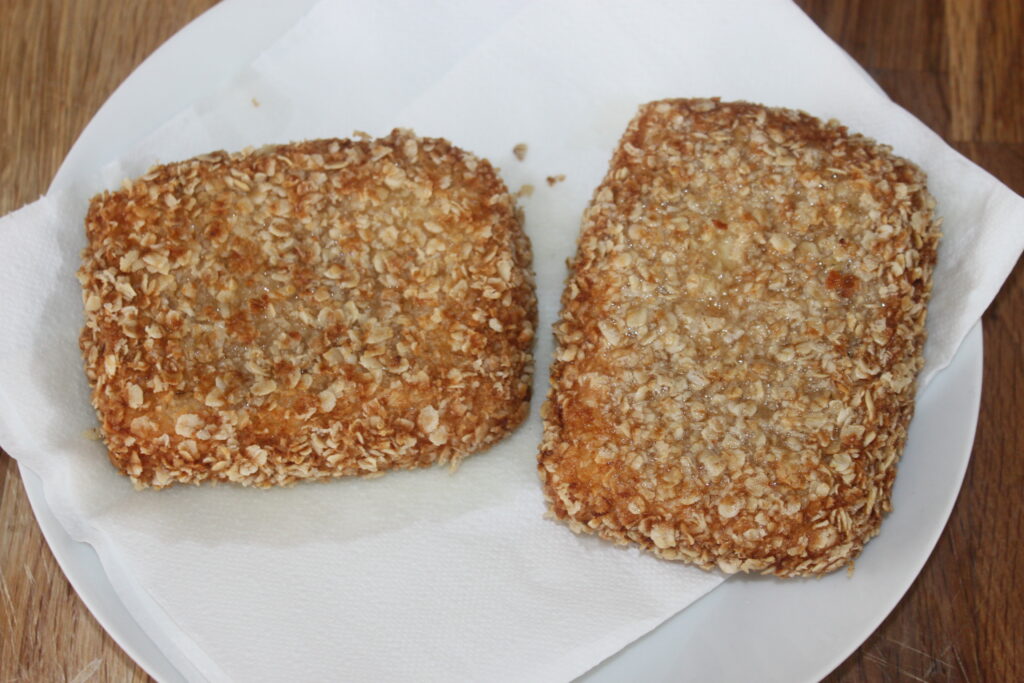
Drain on paper towels.
Add salt and pepper to taste, then serve with honey and lemon slices to taste.
Halloumi frit aux flocons d’avoine
Ingredients
- 1 halloumi
- 1 bol de farine
- 1 bol de lait fermenté
- 200 g flocons d'avoine
- huile pour friture
- sel, poivre
- mile, citron pour servir
Instructions
- Déballez l’halloumi et coupez-le en 3 dans l’épaisseur.
- Passez chaque tranche dans la farine, de chaque côté. Enlevez l’excédent puisplongez-les dans le lait fermenté. Enlevez à nouveau l’excédent puis placez-les dans un récipient contenant les flocons d’avoine.
- Parsemez de flocons pour bien couvrir toute la surface des tranches de fromage. Laissez reposer dans les flocons pendant 5 minutes, le temps de faire chauffer l’huile dans une petite casserole.
- Quand l’huile est chaude, environ à 180°C, plongez les tranches une à une jusqu’à avoir une belle coloration dorée. Égouttez-les sur du papier absorbant.
- Salez et poivrez à votre goût, puis servez avec du miel et des tranches de citron à disposition.
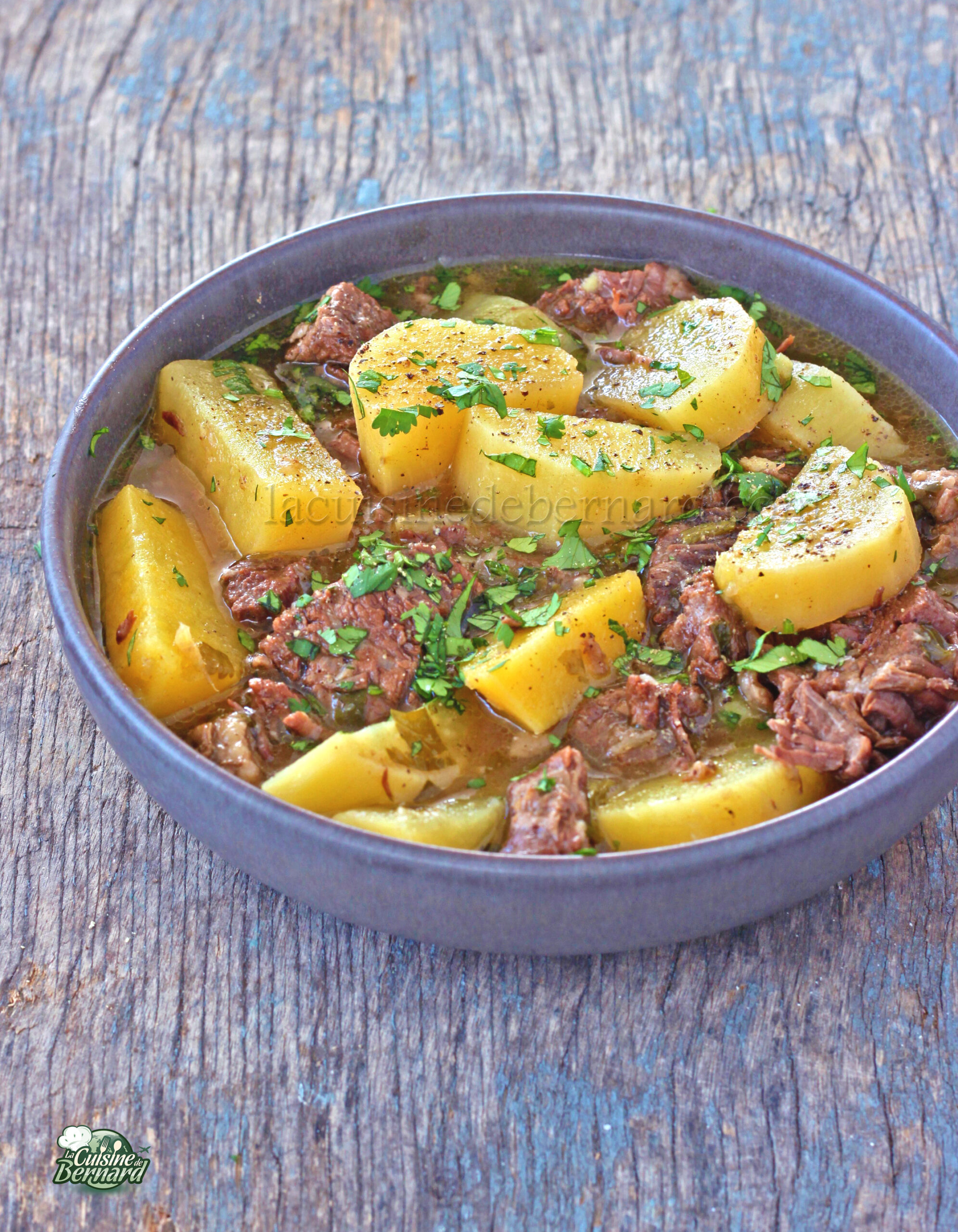
I’m lucky enough to have a market gardener who offers quite a few exotic vegetables, including the classic orange sweet potatoes, but also the firmer-textured white ones that I’m particularly fond of. I’d bought some, and they’d been lying around in my kitchen for a while. They keep very well. But I went into a recipe a bit on the spur of the moment, not knowing how it would turn out. The result was delicious, with a very tasty sauce. The meat is tender and juicy to perfection, and the white sweet potato is both firm and melt-in-the-mouth. A little feast!
Recipe for 6 to 8 people:
- 1.5 kg of meat (I used rib-eye steak)
- 1 or 2 marrow bones
- 2 onions
- 8 garlic cloves
- 5cm fresh ginger
- 1 or 2 bird peppers
- 2 liters chicken or vegetable stock
- 3 tablespoons wine vinegar
- 3 tablespoons Worcestershire sauce
- 3 large white sweet potatoes (or more, depending on size!)
- 1 small bunch of coriander
- 3-4 teaspoons rice flour or potato starch
- salt pepper
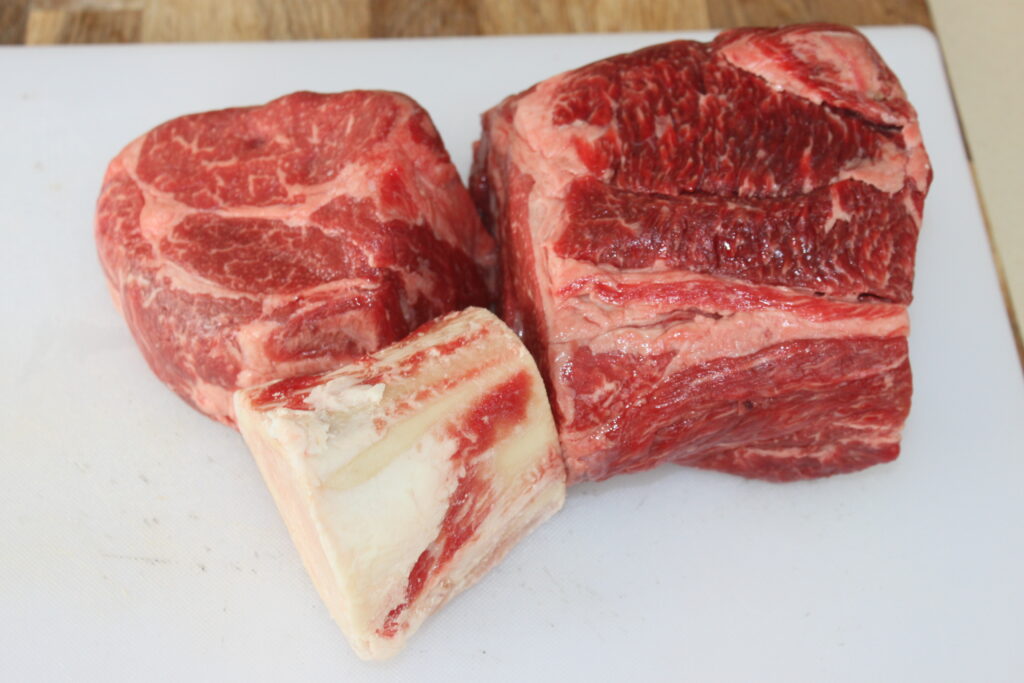
For this recipe, I used low ribs, ideal for this type of recipe. I also have a marrow bone, but you could use more.
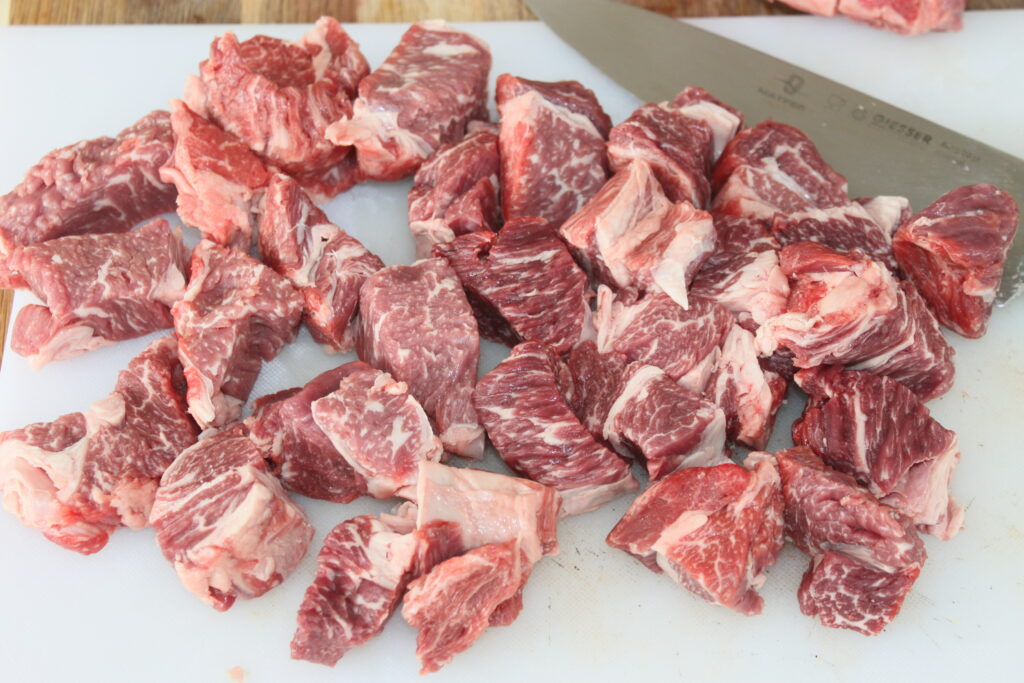
Cut the meat into 3-4cm cubes.
Place in a casserole dish with a tablespoon of oil over high heat.
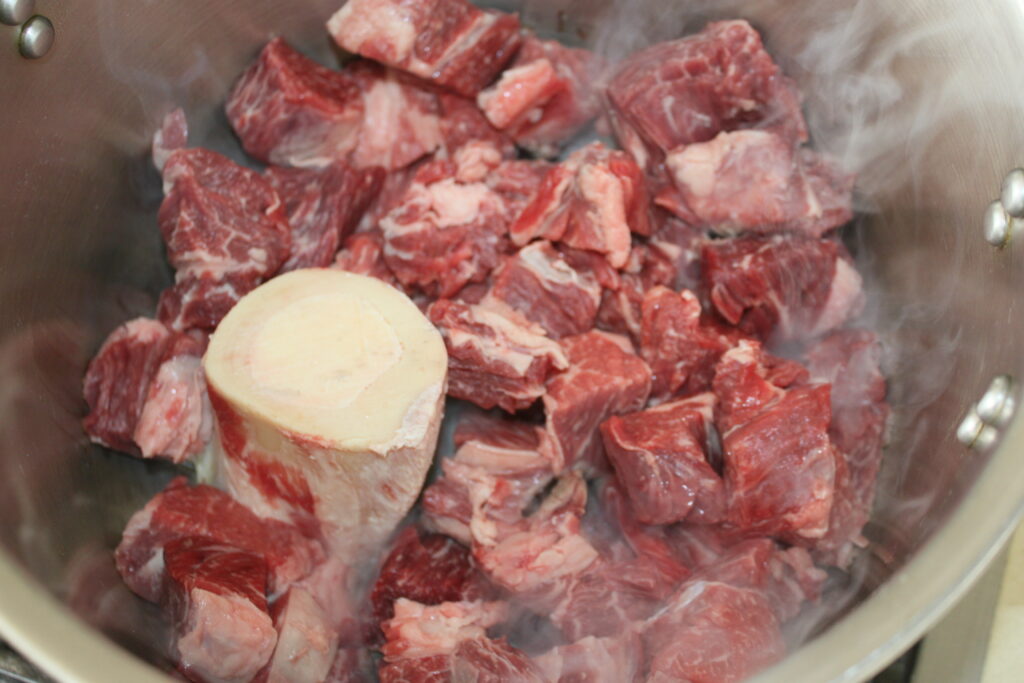
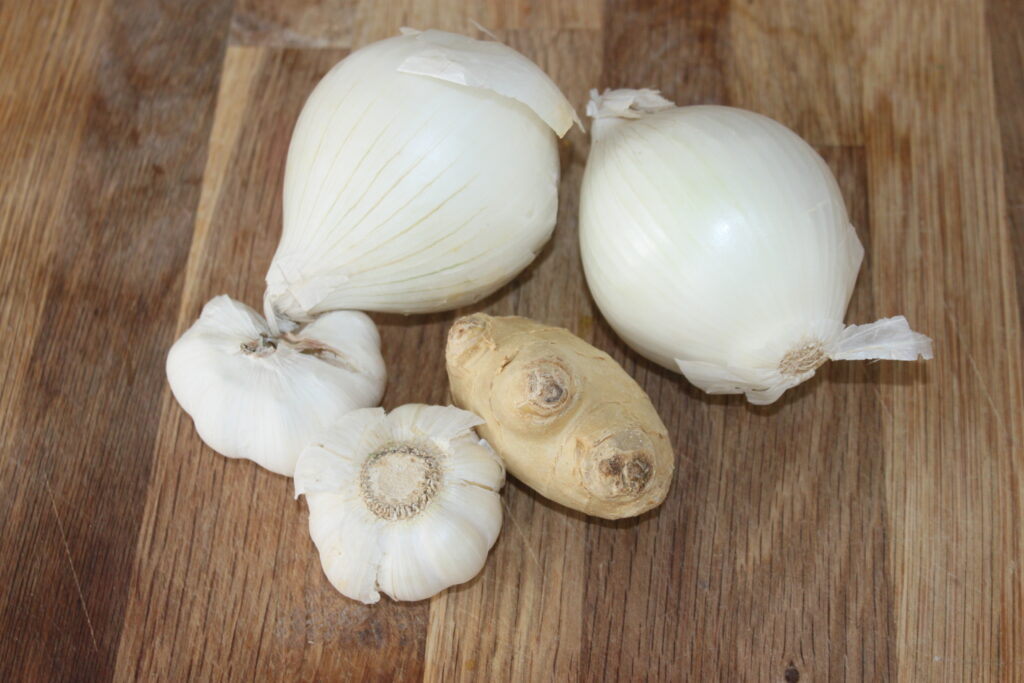
Simmer for 10-15 minutes, stirring occasionally. Meanwhile, peel and chop the onions, garlic cloves and ginger,
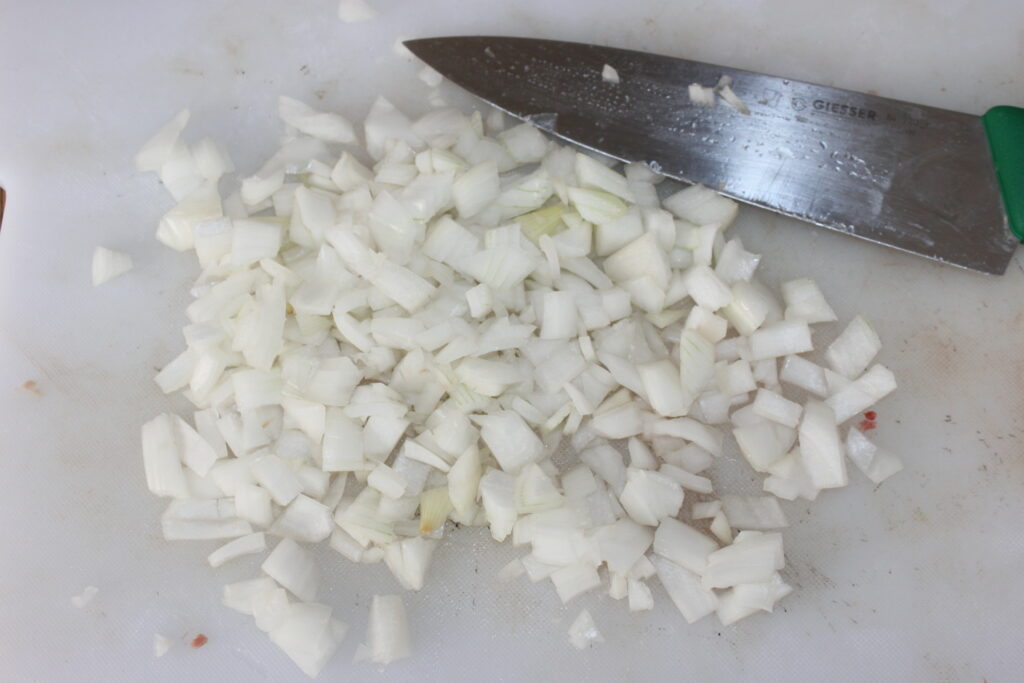
For the onion, in classic chunks.
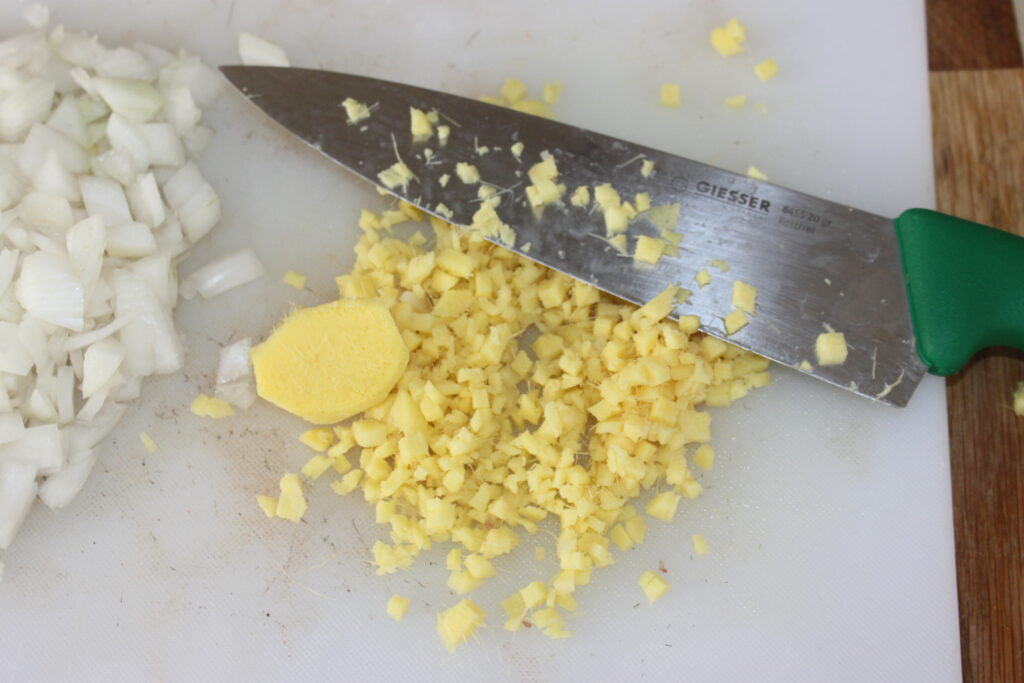
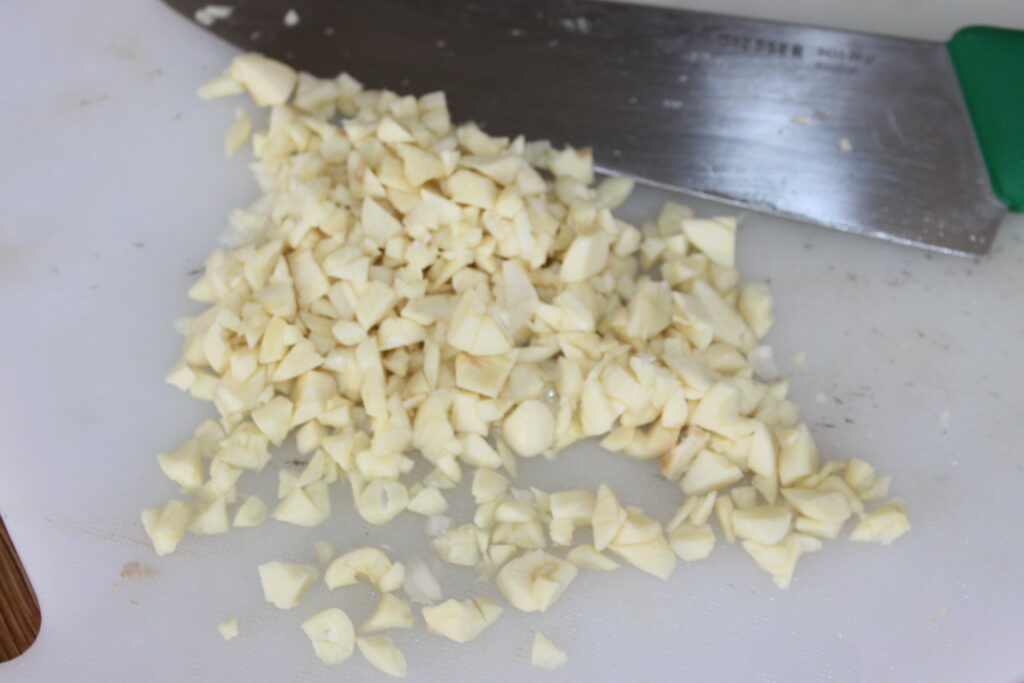
Garlic and ginger require finer chopping.
Pour into the casserole dish.
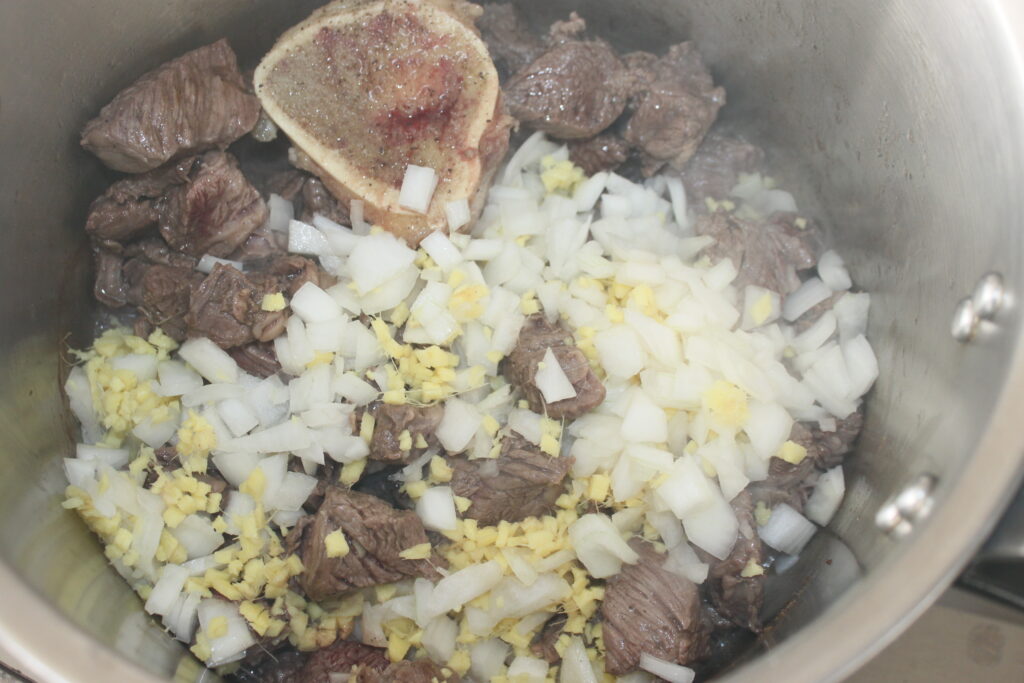
Cook and stir for 5 minutes.
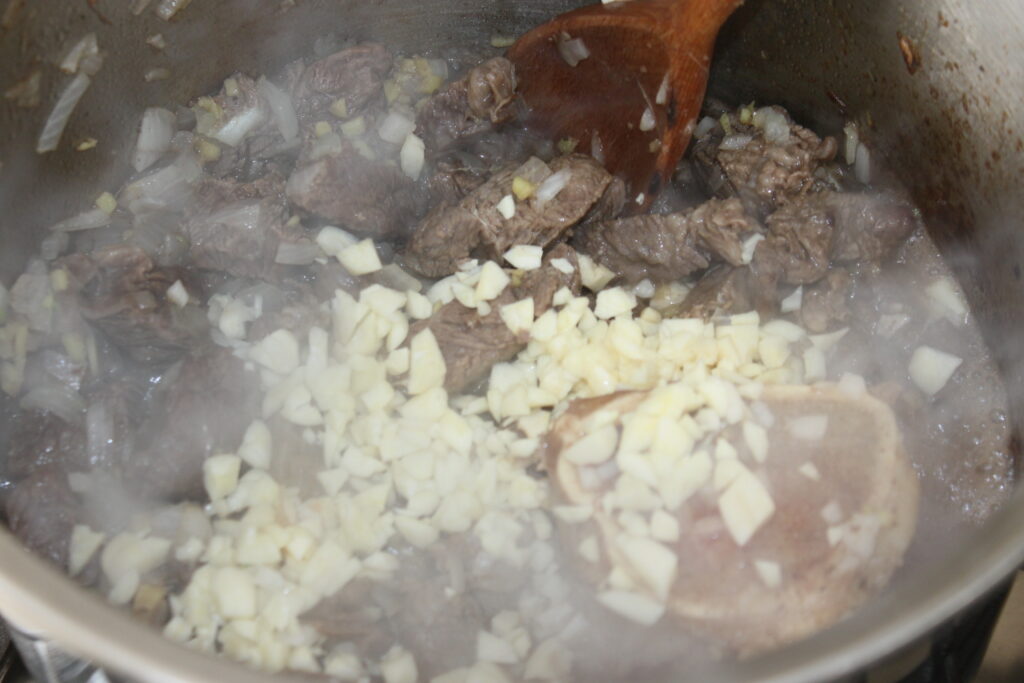
Finely chop the bird pepper(s). You can leave the seeds in or remove them for less pungency.
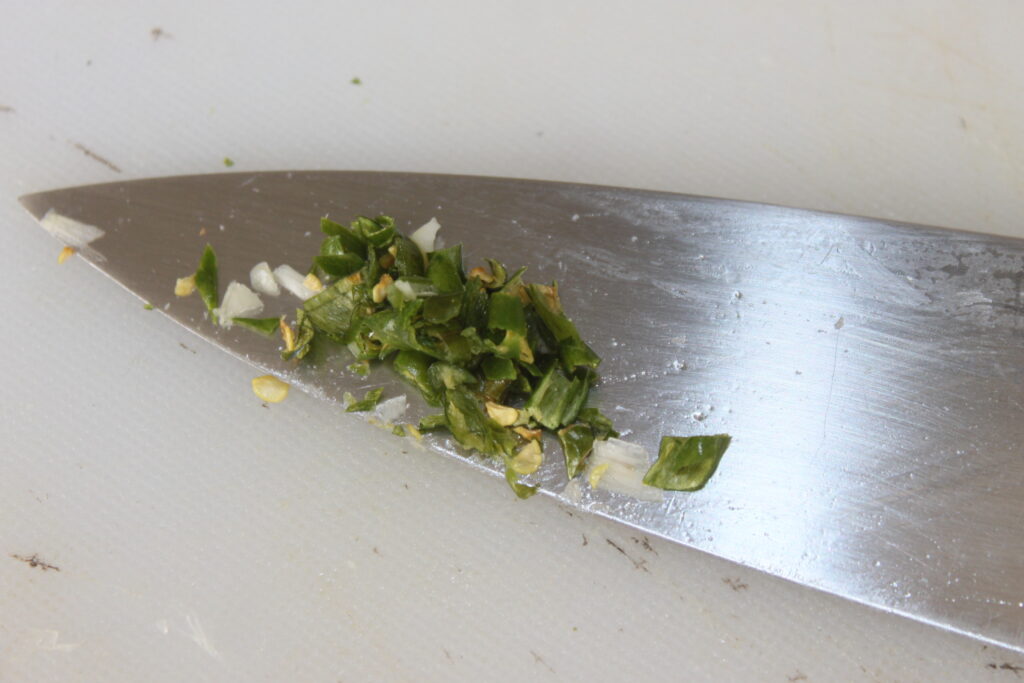
Pour into the casserole dish, then add chicken (or vegetable) stock up to the level of the meat.

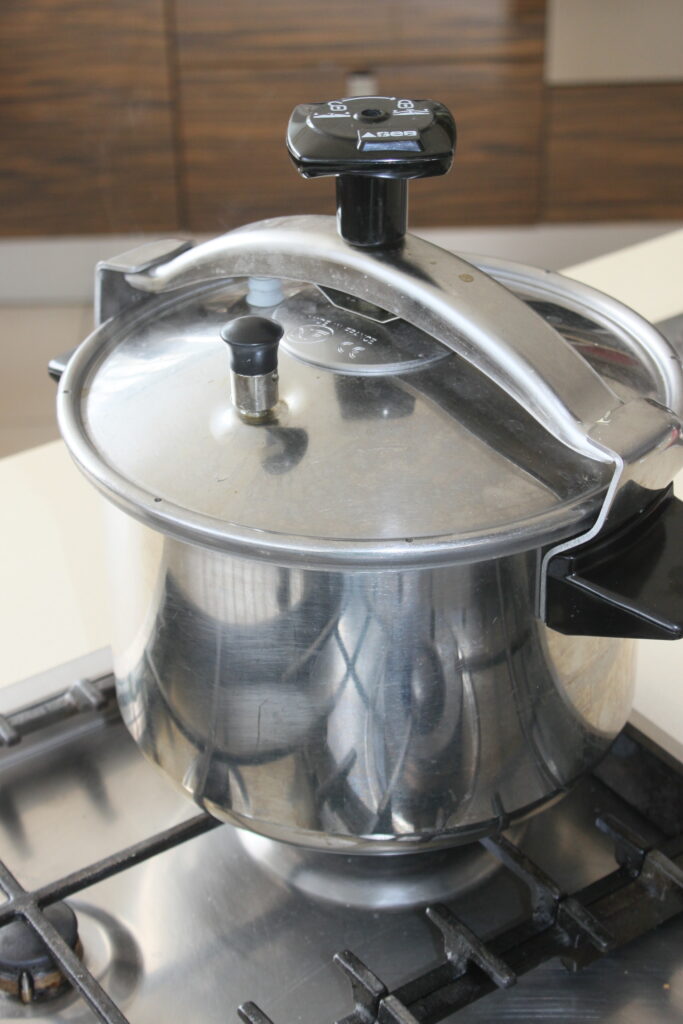
I put the pressure on here and let it cook with the steam hissing for 1h30. Without a pressure cooker, cooking time is doubled.
After this cooking time, pour in the Worcestershire sauce and wine vinegar.
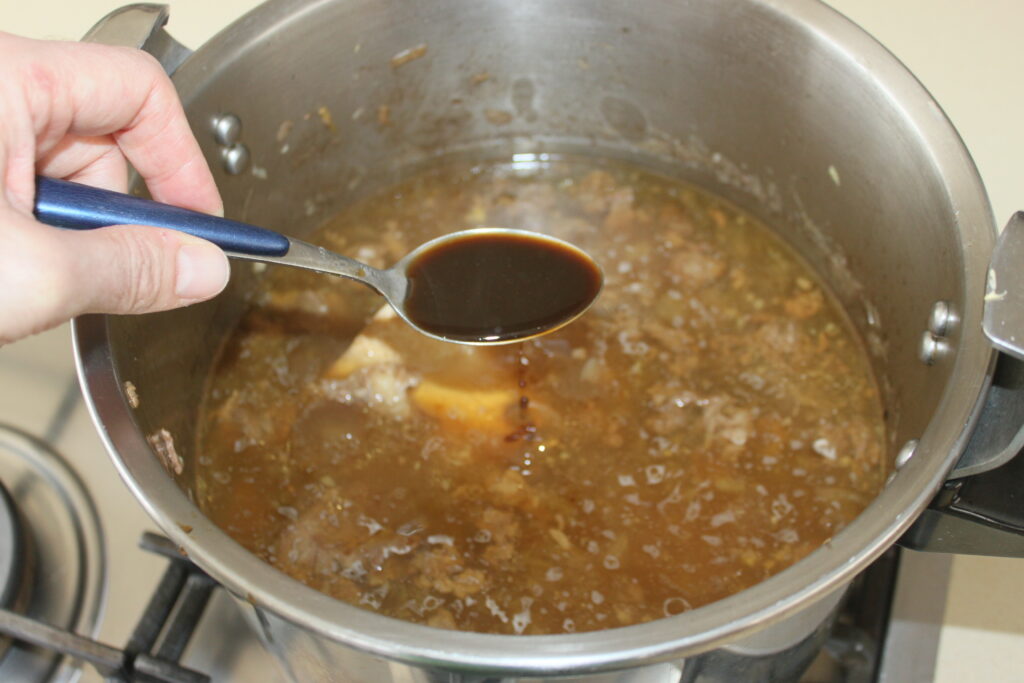
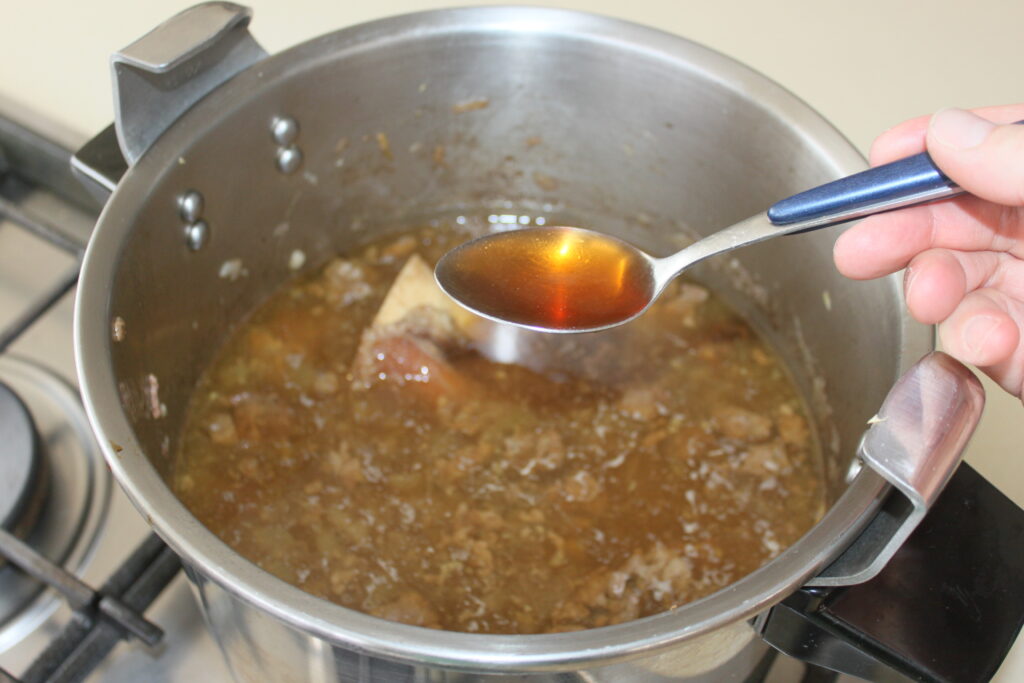
Check that the meat is cooked through, as it should be very soft at this stage.
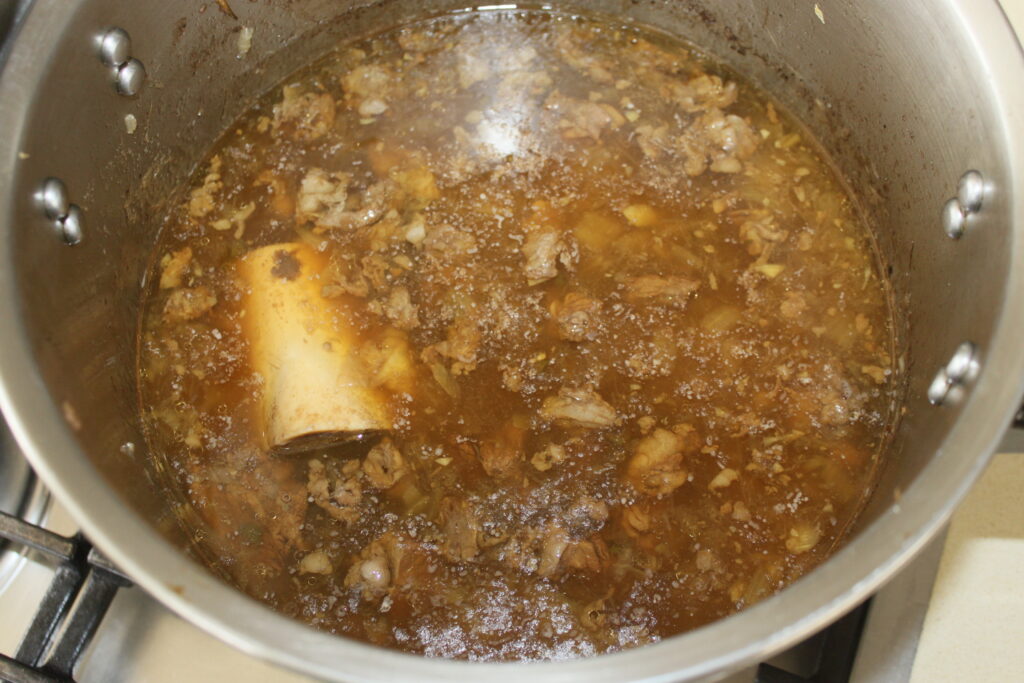
If it’s good, leave to cool completely before chilling to set the fat and get rid of some of it. I therefore advise you to do this first cooking the day before your meal.
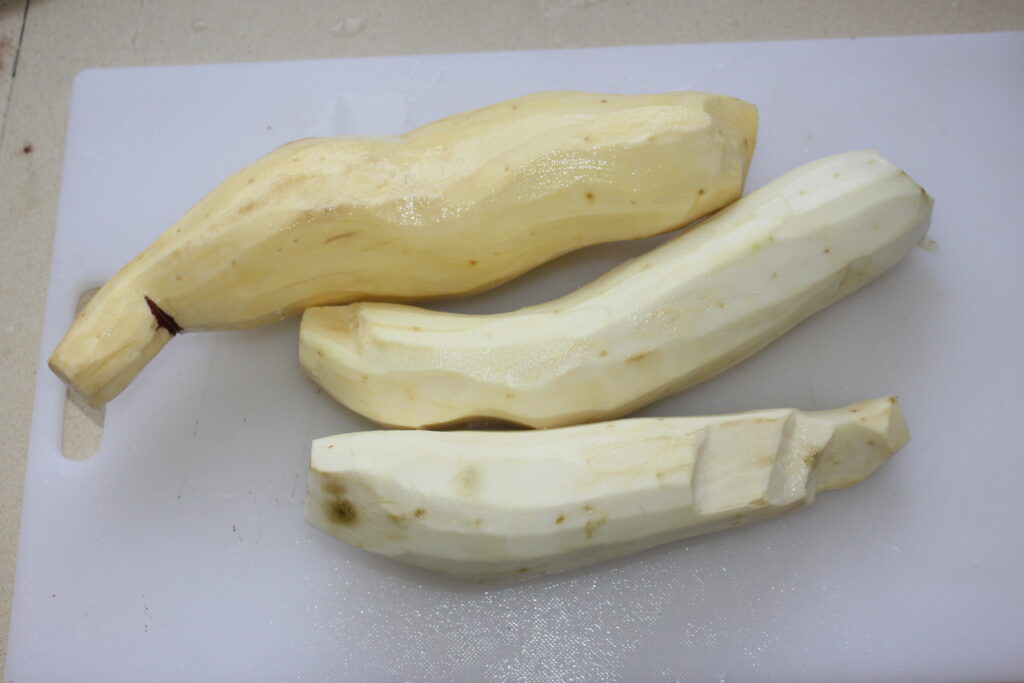
For the next day. Here are the white sweet potatoes. I’m lucky enough to have a market gardener who sells them. The texture is very different from that of orange sweet potatoes. It is firmer, less sweet and almost chestnut-like. Of course, you can also use the classic sweet potato and adapt the cooking to it.
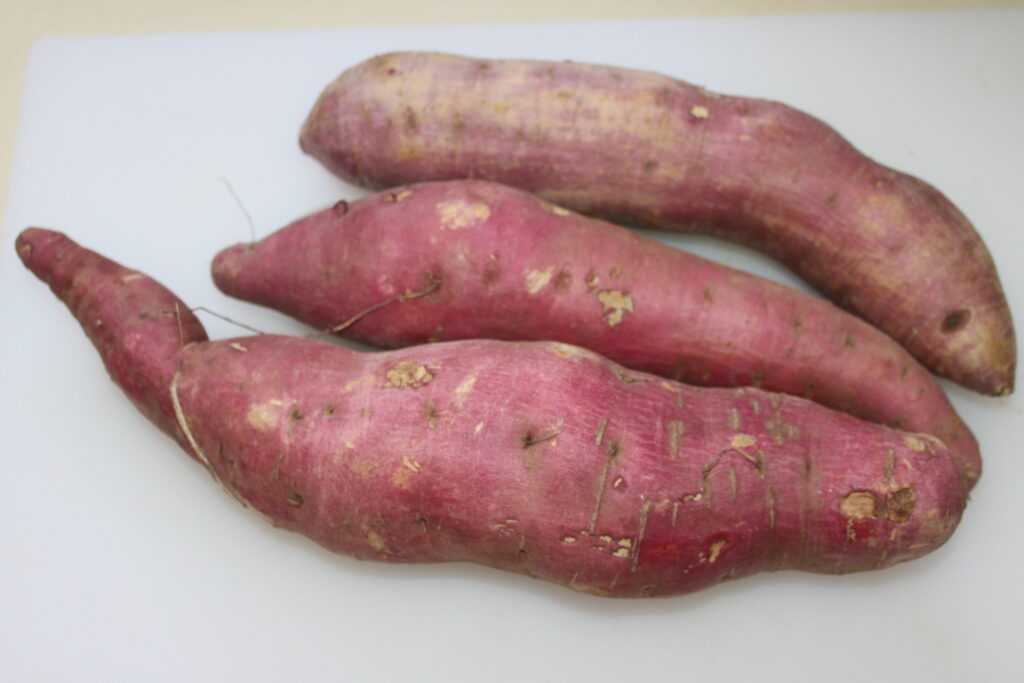
They need to be peeled, then cut into pieces.

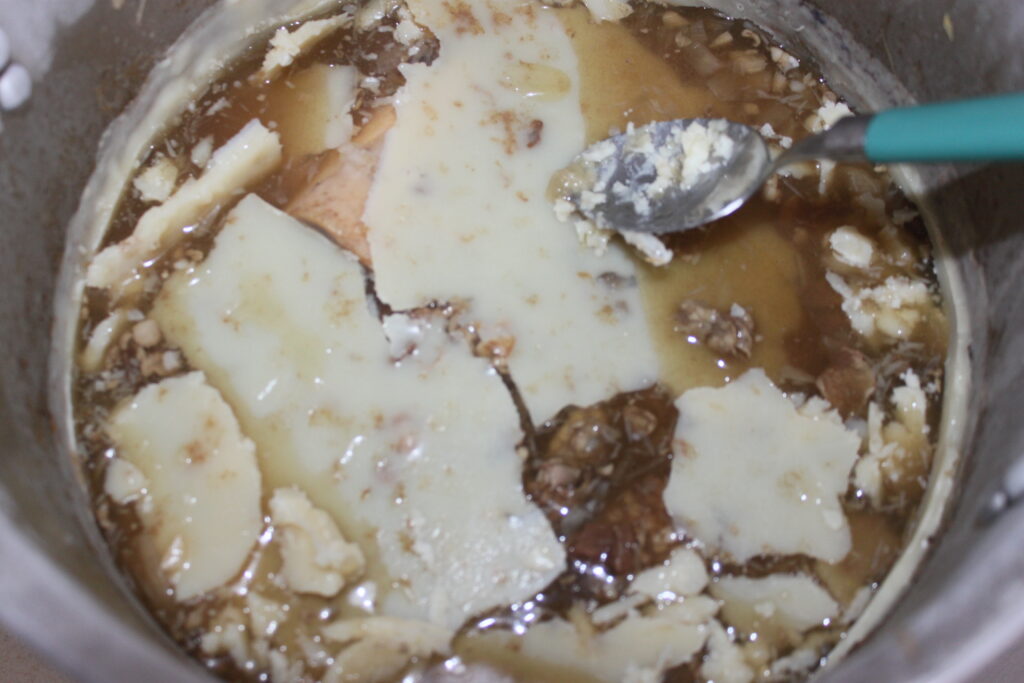
Remove the casserole from the fridge and remove any fat that has congealed. This way, it’s up to you to decide how much fat to leave.
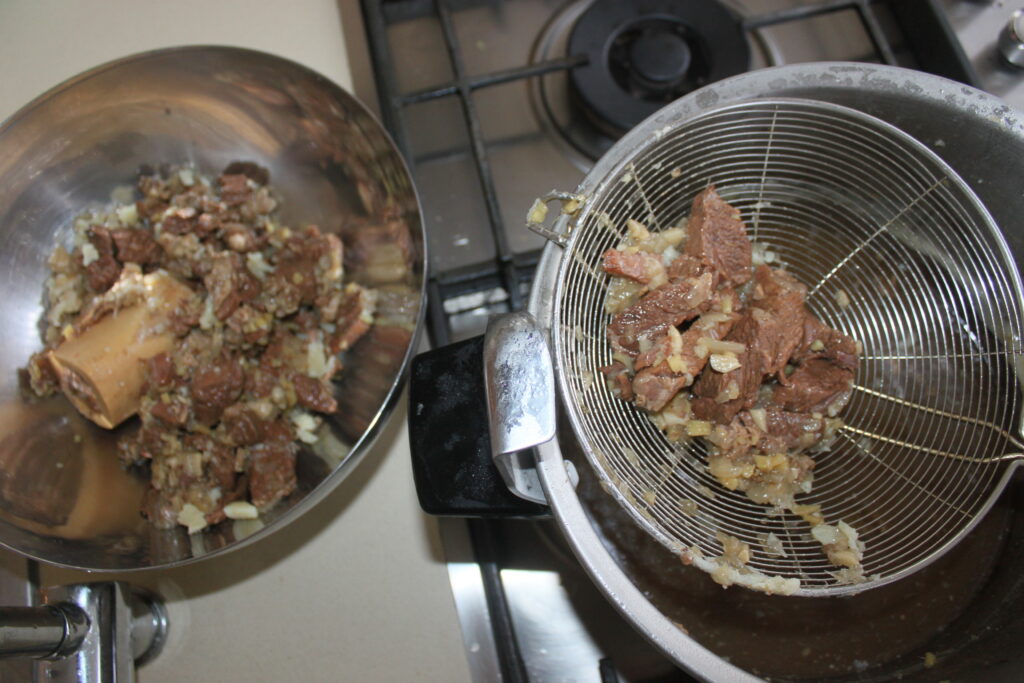
Remove the meat and bone from the stock and set aside.
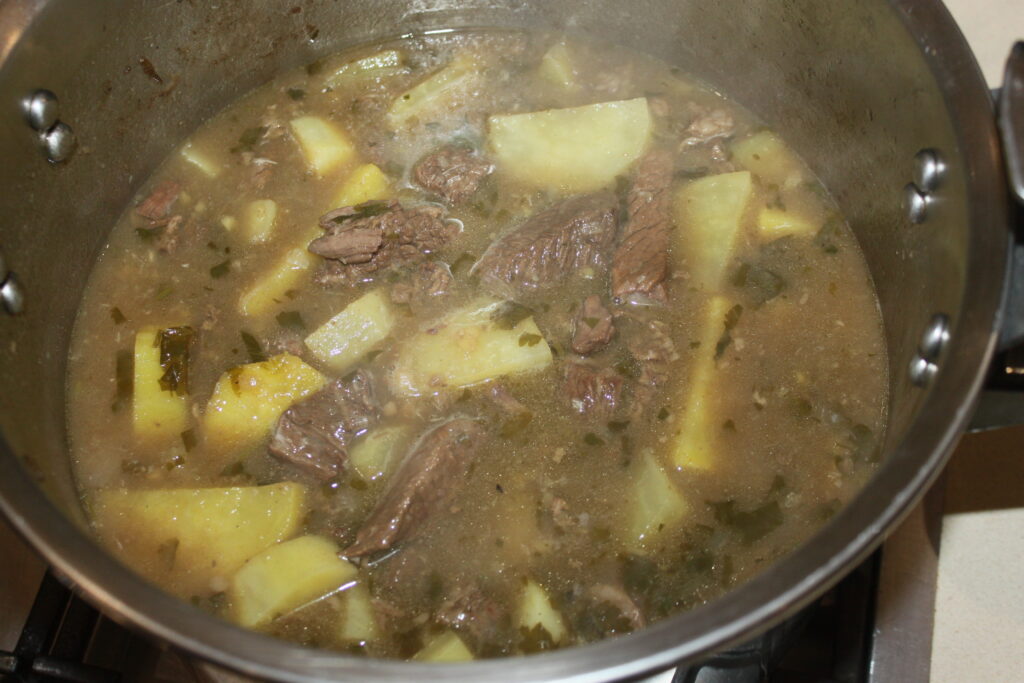
Add the sweet potatoes and bring to the boil, uncovered. Chop the small bunch of coriander, washed and squeezed dry, and add to the sweet potatoes. Put salt and pepper at your taste.

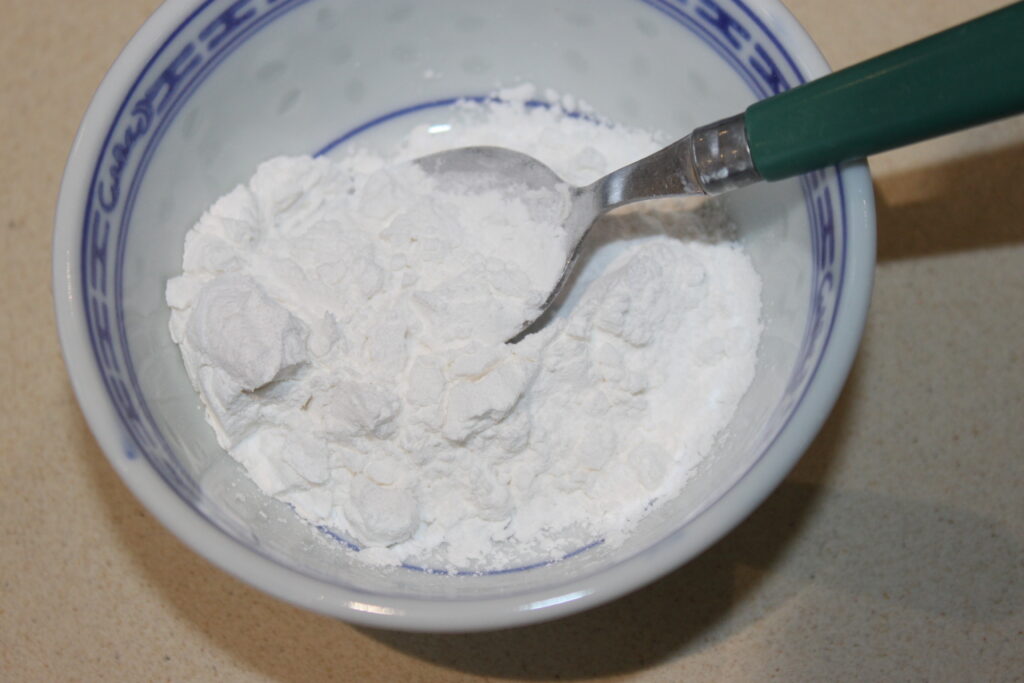
Leave to cook for 20-25 minutes and check with a fork. Pour the rice flour into a small bowl and add about 50g of water. Pour this mixture into the boiling liquid, stirring gently to thicken the sauce to your liking. So you don’t necessarily have to pour it all in, or on the contrary, add more, to adapt to the desired consistency. I wanted a sauce with just a touch of glaze.
When ready, add the meat and cook for 10 minutes until heated through.
Serve the stew well chutneyed, with a sprinkling of freshly chopped coriander.
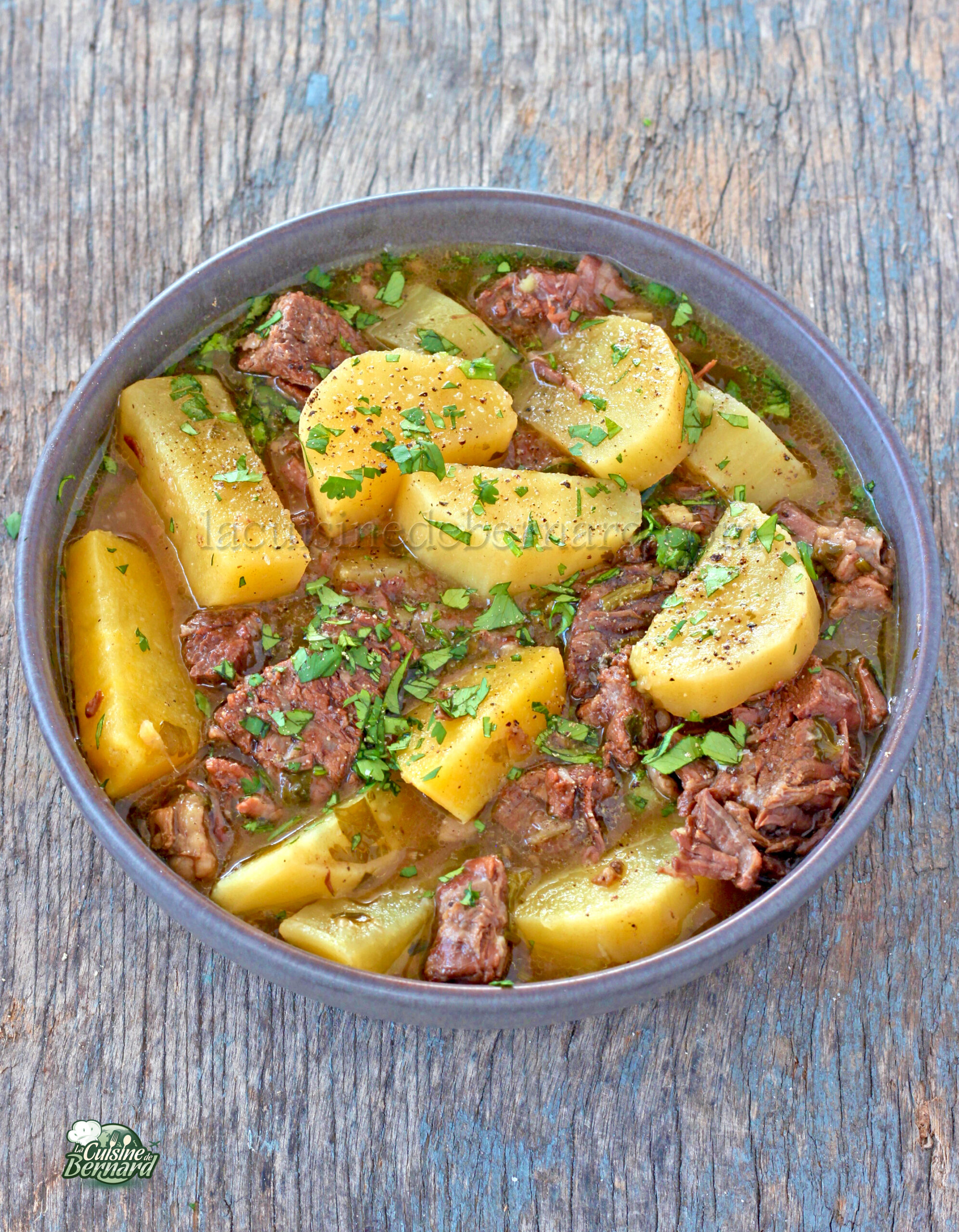

Daube de bœuf, ail gigembre et patates douces blanches
Ingredients
- 1,5 kg viande de bœuf ici basse côte
- 2 os à moelle
- 2 oignons
- 8 gousses d'ail
- 5 cm gingembre frais
- 2 piments oiseaux
- 2 litres bouillon de volaille ou de légume
- 3 c. à soupe vinaigre de vin
- 3 c. à soupe sauce Worcestershire
- 3 patates douces blanches
- 1 petit bouquet de coriandre
- 4 c. à café farine de riz ou fécule de pomme de terre
- sel, poivre
Instructions
- Pour cette recette, j’ai pris de la basse côte, idéale pour ce genre de recette. J’ai aussi un os à moelle, mais on peut mettre davantage. Coupez la viande en morceaux cubiques de 3-4cm.
- Placez dans une cocotte avec une cuillerée à soupe d’huile sur feu fort.
- Laissez mijoter 10-15 minutes en remuant de temps en temps. Pendant ce temps, épluchez et coupez en petits morceaux les oignons, les gousses d’ail et le gingembre.,
- Pour l’oignon, en morceaux classiques. Pour l’ail et le gingembre, il faudra hacher plus finement. Versez le tout dans la cocotte.
- Laissez cuire en mélangeant pendant 5 minutes.
- Hachez finement le ou les piments oiseaux. Vous pouvez laisser les graines ou les ôter pour moins de piquant.
- Versez dans la cocotte puis versez du bouillon de volaille (ou de légume) jusqu’au niveau de la viande.
- J’ai mis ici la pression et j’ai laissé cuire avec le sifflement de la vapeur pendant 1h30. Sans cocotte minute sans pression, le temps de cuisson est doublé.
- Après ce temps de cuisson, versez la sauce Worcestershire et le vinaigre de vin.
- Vérifiez la cuisson de la viande qui doit être très fondante à ce stade.
- Si c’est bon, laissez refroidir totalement avant de mettre au frais pour figer le gras et s’en débarrasser en partie. Je conseille donc de faire cette première cuisson la veille de votre repas.Pour le lendemain. Voici les patates douces blanches. J’ai la chance d’avoir un maraicher qui en vend. La texture est très différente de la patate douce orangée. Elle est plus ferme, moins sucrée, ressemble presque à de la châtaigne. Bien sûr, vous pouvez mettre la patate douce classique et adaptez la cuisson à cette dernière.
- Il faut les éplucher, puis les couper en morceaux.
- Sortez la cocotte du frais et enlevez la partie grasse qui a figé. De cette façon, c’est à vous de décider la quantité de gras laissée.
- Enlevez la viande et l’os du bouillon, réservez.
- Placez les patates douces puis portez à ébullition, sans couvercle. Hachez le petit bouquet de coriandre, lavé et essoré, ajoutez le tout avec les patates douces. Salez et poivrez à votre goût.
- Laissez cuire 20-25 minutes et vérifiez la cuisson en y plantant une fourchette. Versez la farine de riz dans un petit bol et ajoutez environ 50g d’eau. Versez cette préparation dans le liquide bouillant tout en remuant délicatement pour épaissir la sauce à votre goût. Il ne faut donc pas forcément tout verser, ou au contraire en ajouter davantage, pour adapter à la consistance voulue. J’ai voulu une sauce juste nappante.
- Quand c’est prêt, ajoutez la viande et laissez cuire 10 minutes pour que le tout soit bien chaud.
- Servez la daube bien chuade, avec un peu de coriandre fraichement hachée.
Nutrition
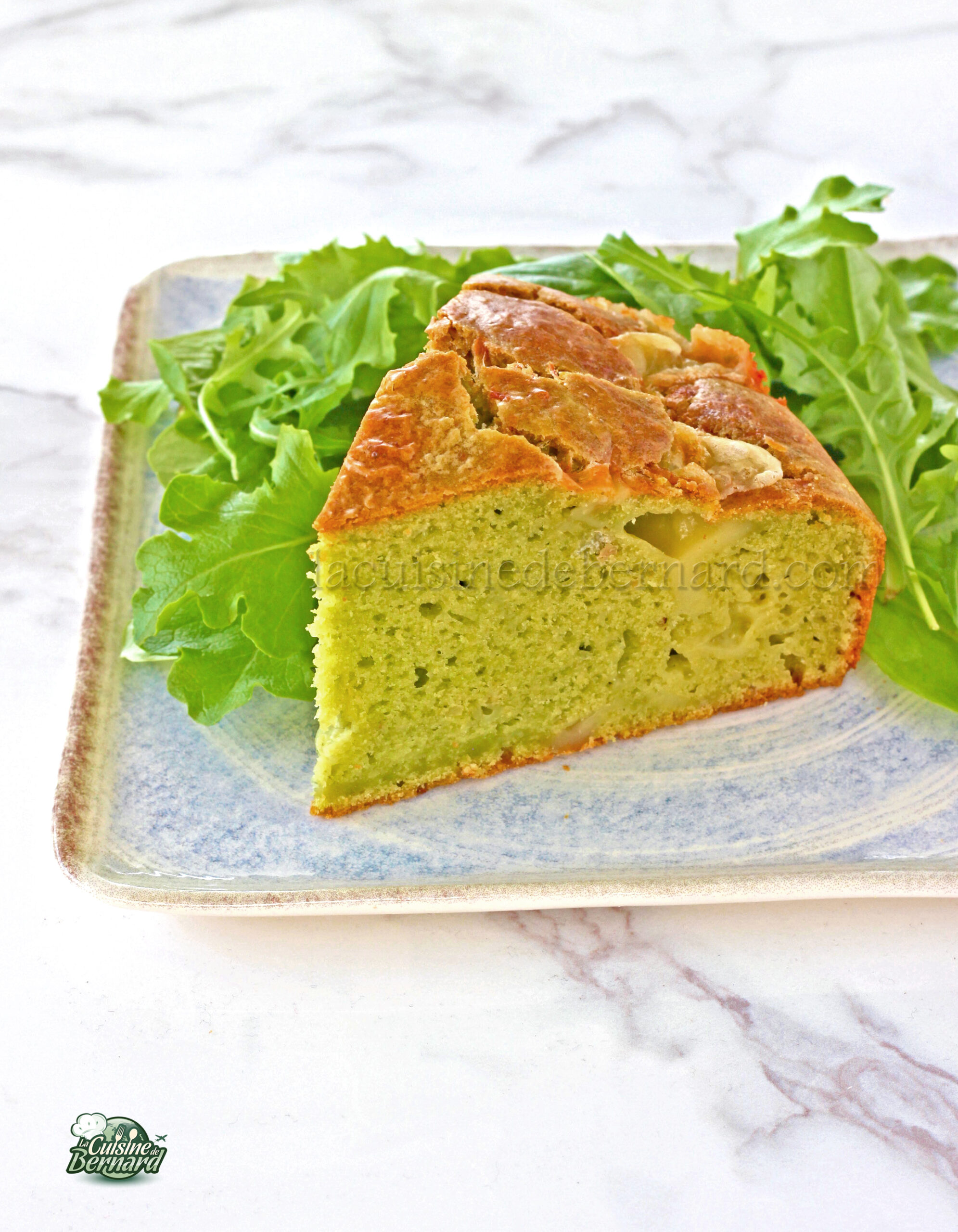
Perfect as an original starter or aperitif! I tasted the equivalent of this salted Morbier, parsley and hazelnut cake in a restaurant in Joigny where I was lucky enough to be invited. I wanted to do it again at home, always on instinct. The result is delicious, with an unexpectedly pretty green color when cut. Very easy to make, it’s best served hot or warm, so just warm it up before devouring!
Recipe for a 23-24 cm diameter mould:
- 130g olive or rapeseed oil for cooking
- 200g egg
- 40g parsley (or wild garlic)
- 4 garlic cloves, peeled (not necessary if wild garlic)
- 230g semi-skimmed milk
- 7g salt
- 15g of sugar
- 300g of flour T55
- 10g of baking powder
- 100g of hazelnut powder
- 70g grated Comté or Emmental cheese
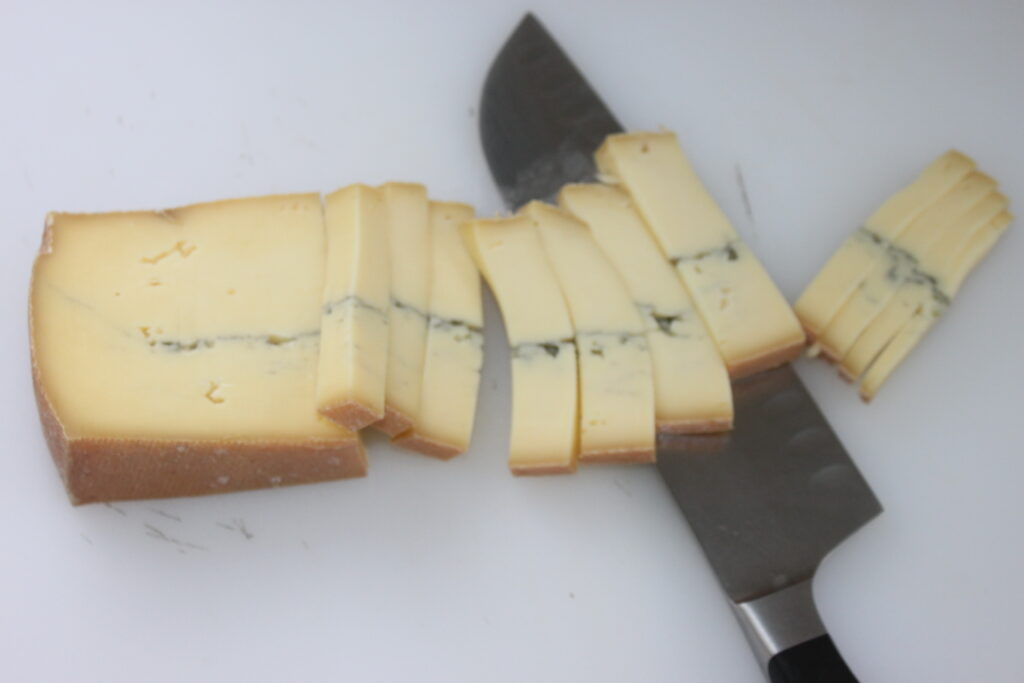
- 230g morbier cheese, cut into pieces
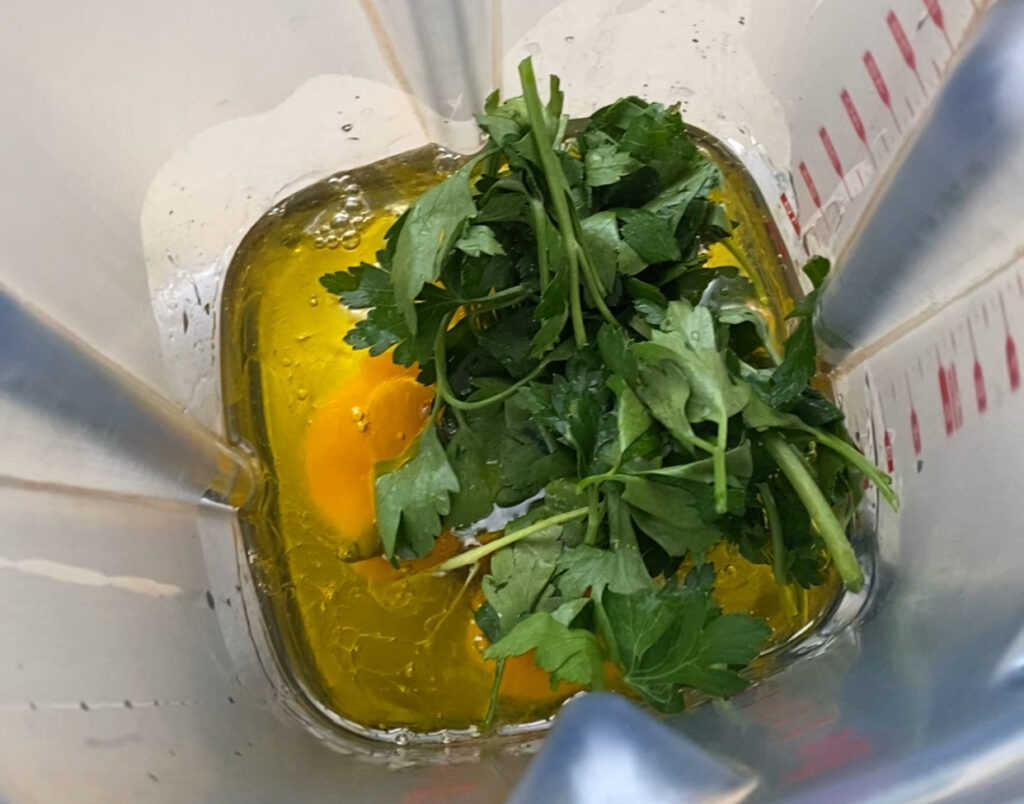
Put the chosen oil, the 200g of egg (about 4 medium eggs), the washed and chopped parsley and the peeled garlic into a blender and blend until you have a kind of homogeneous cream.
Pour into a bowl and add the milk, salt and sugar.
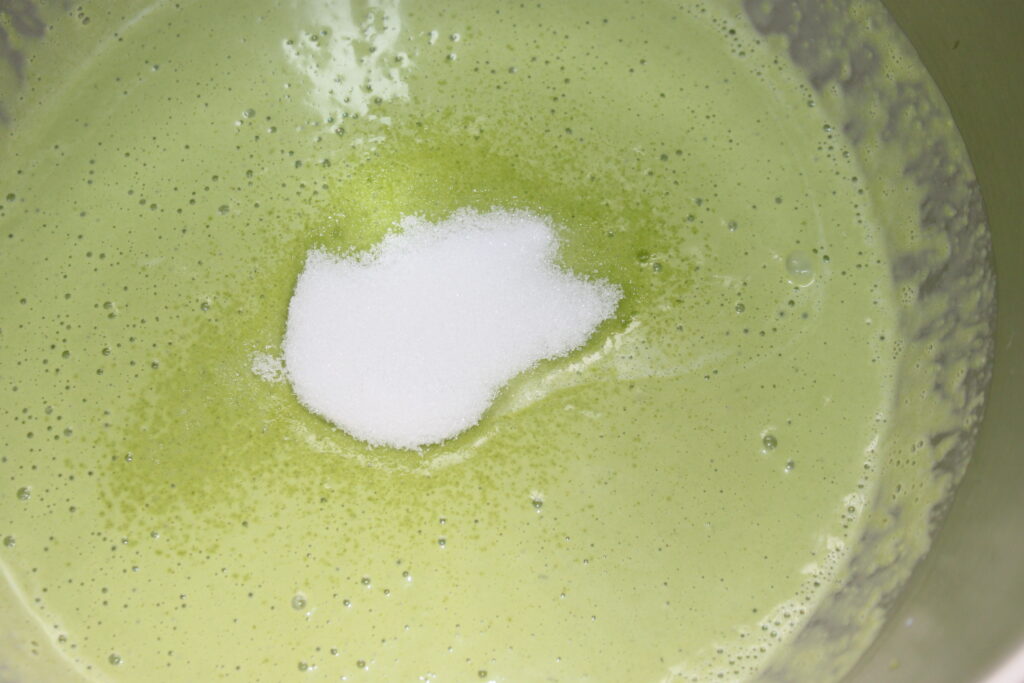
Mix, then add the flour, baking powder and hazelnut powder.
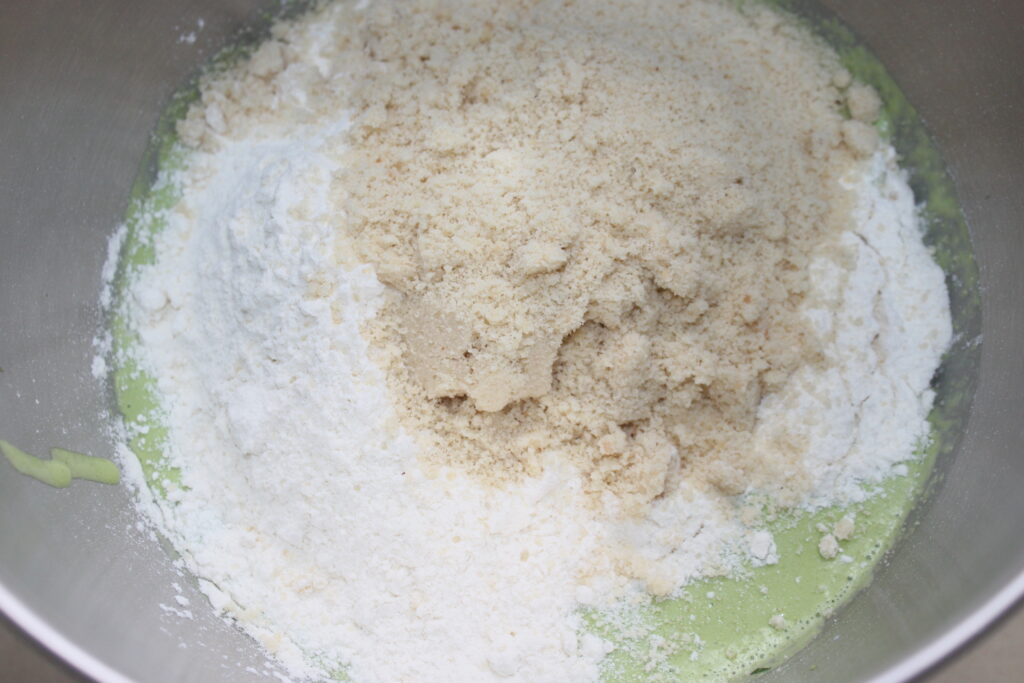
Then add the cheeses: grated Emmental or Comté, and morbier cut into pieces (with the rind!).
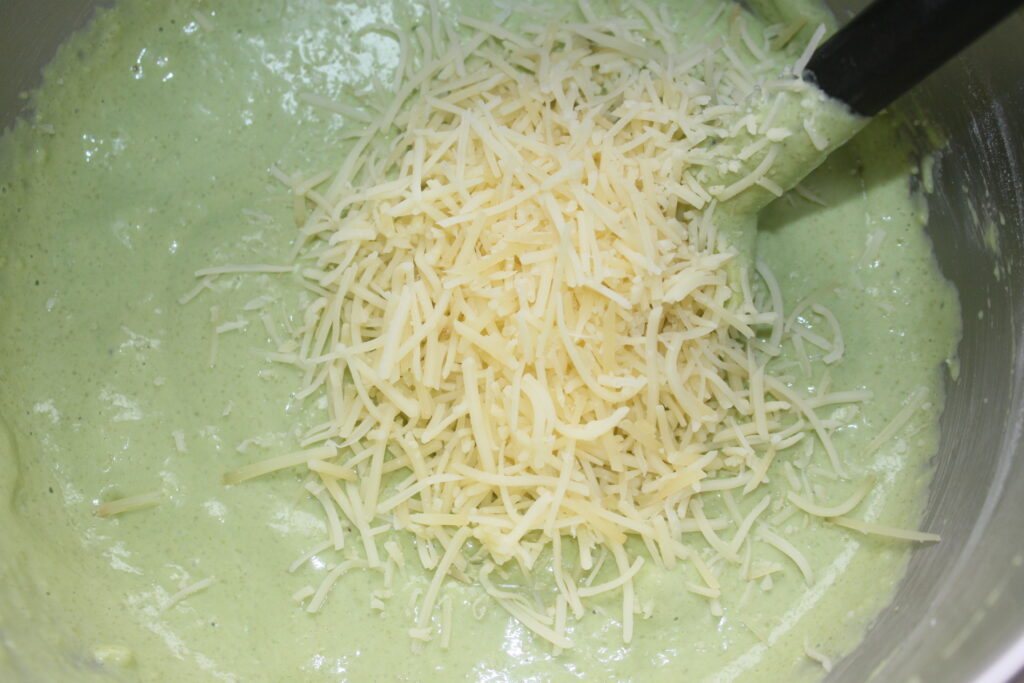
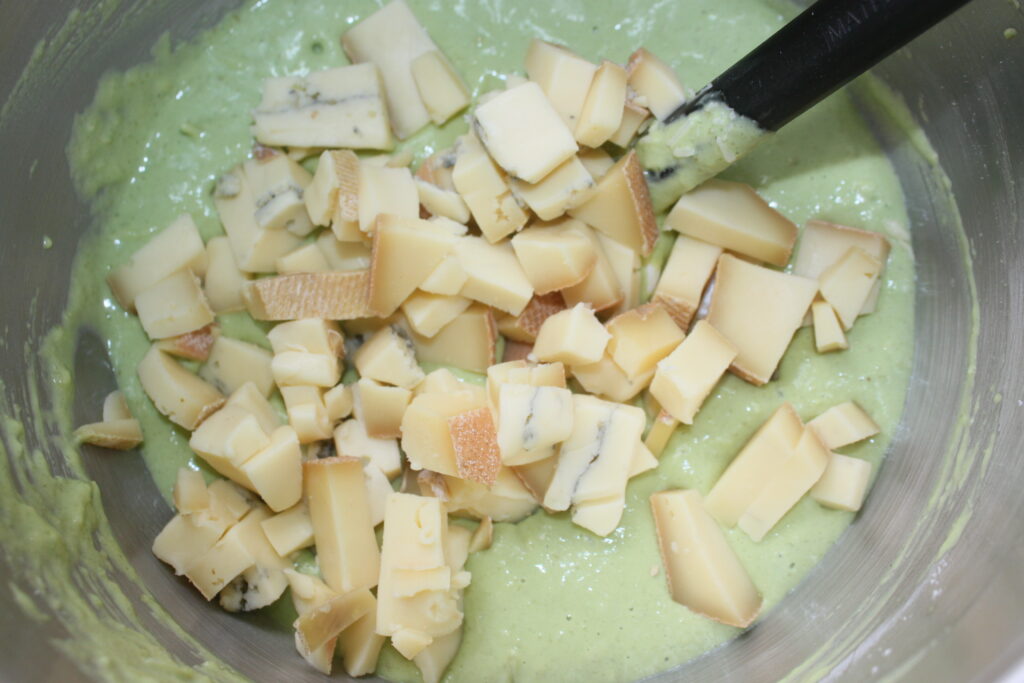
Mix well, then pour into the baking tin lined with baking parchment. Drizzle a little oil over the inside edge to facilitate removal from the mold.
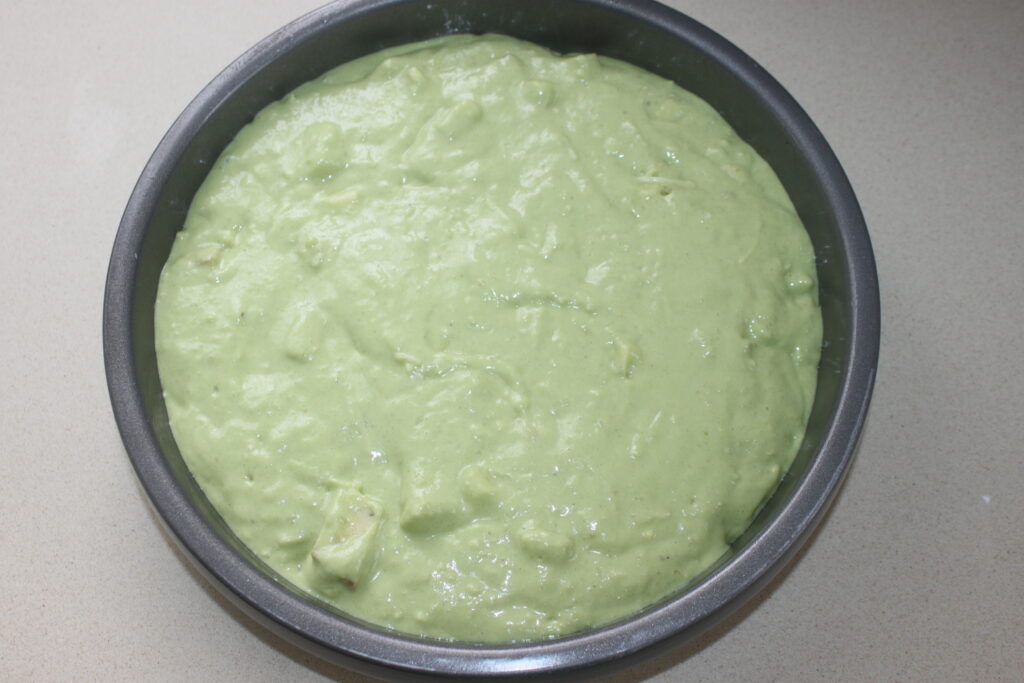
Bake for 50 minutes at 175°C over static heat (not convection heat).
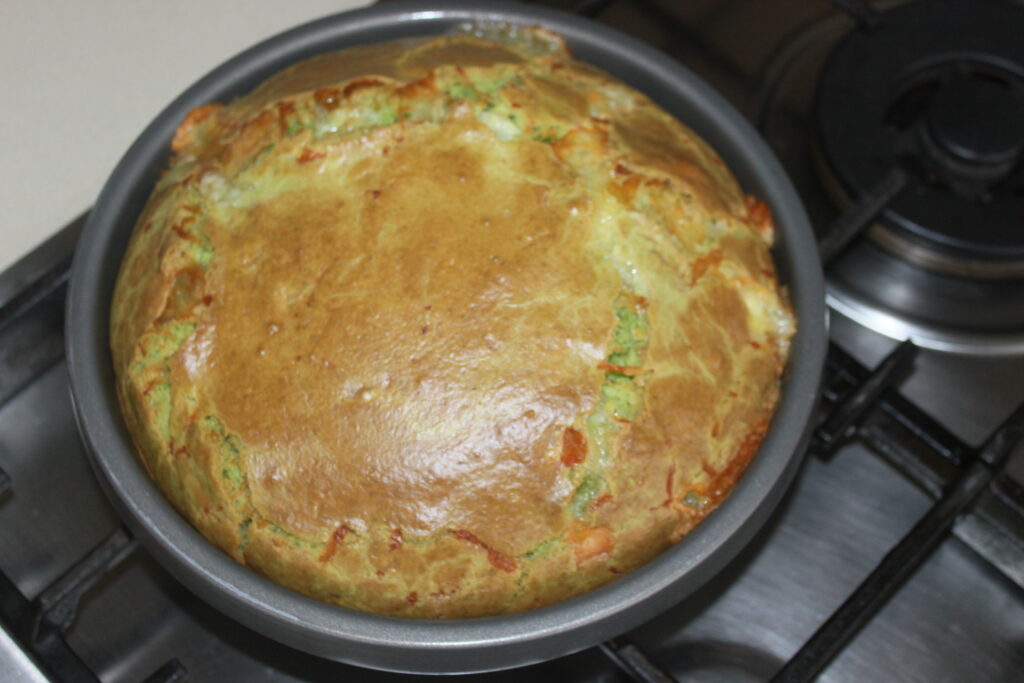
Turn out and leave to cool on a wire rack.
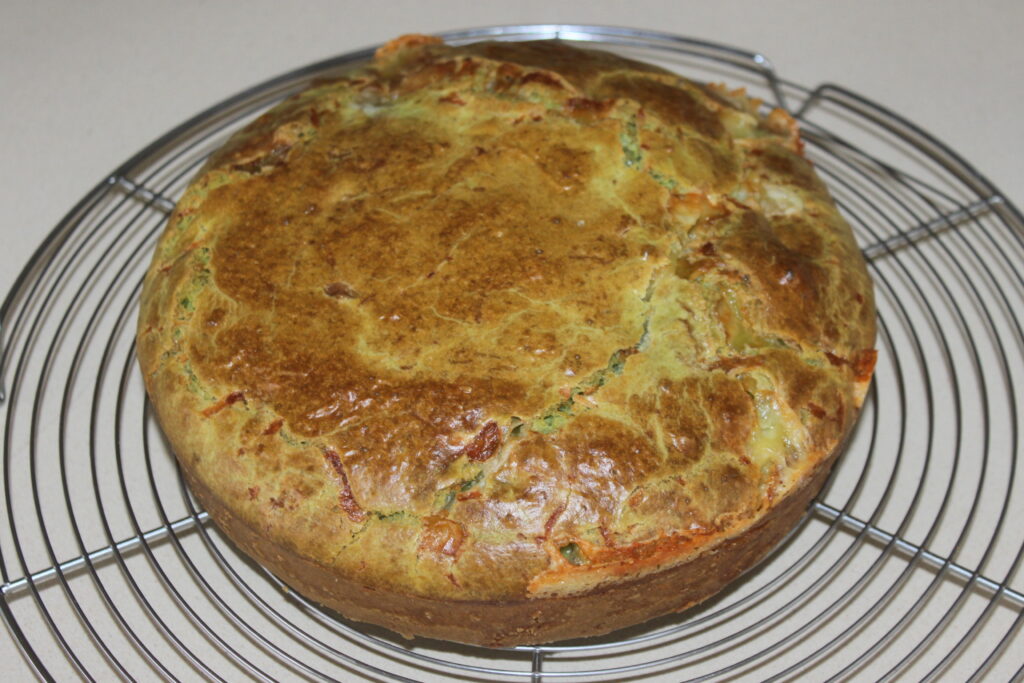
Enjoy as an aperitif or starter with a salad. Morbier cake tastes best warm, so just heat it up!
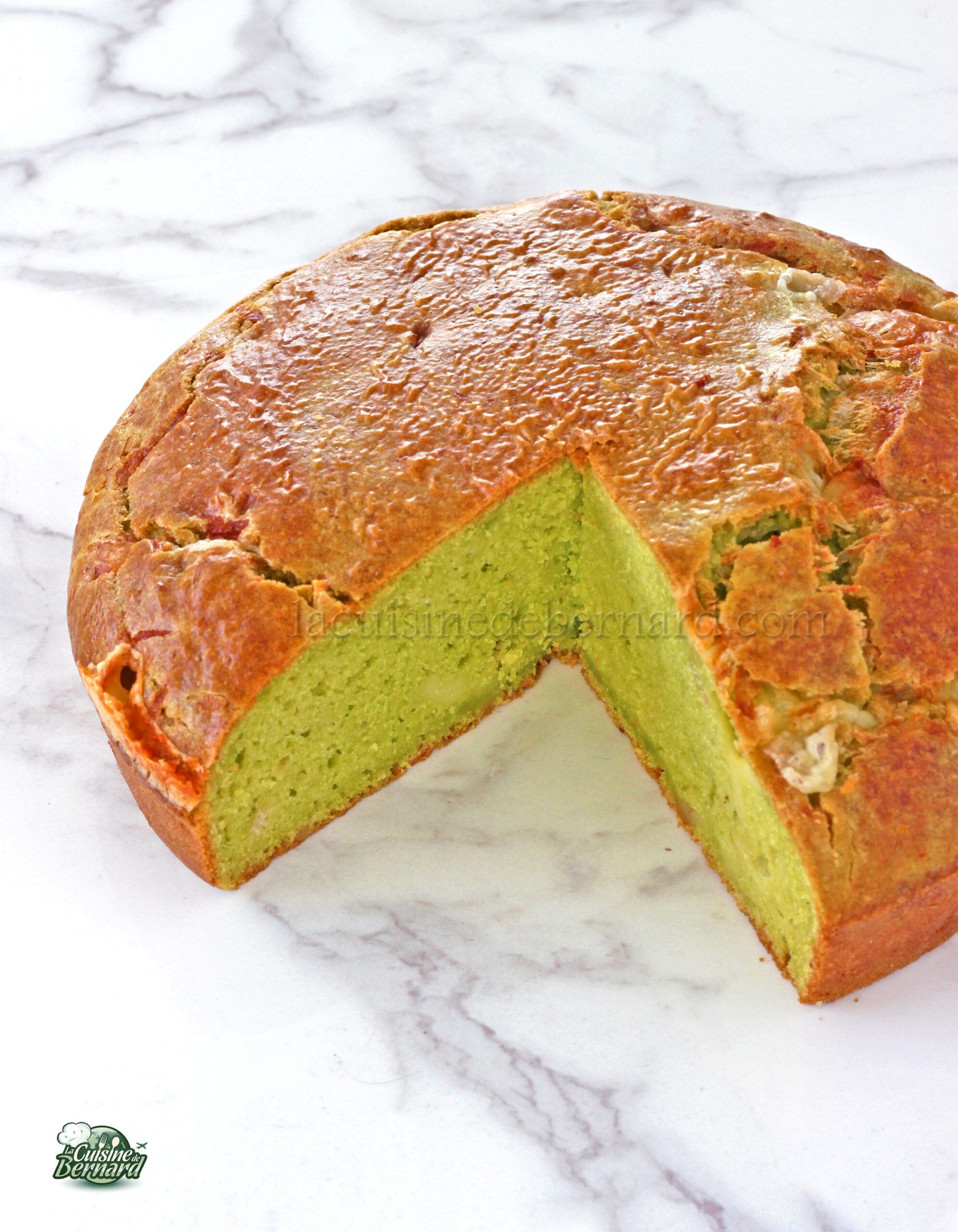
Savoury cake with morbier cheese, parsley and hazelnuts
Ingredients
- 130 g olive oil
- 200 g egg
- 40 g parsley
- 4 garlic cloves
- 230 g semi-skimmed milk
- 7 g salt
- 15 g sugar
- 300 g flour T55
- 10 g baking powder
- 100 g hazelnut powder
- 70 g county
- 230 g morbier
Instructions
- Put the chosen oil, the 200g of egg (about 4 medium eggs), the washed and chopped parsley and the peeled garlic into a blender and blend until you have a kind of homogeneous cream.
- Pour into a bowl and add the milk, salt and sugar.
- Mix, then add the flour, baking powder and hazelnut powder.
- Then add the cheeses: grated Emmental or Comté, and morbier cut into pieces (with the rind!).
- Mix well, then pour into the baking tin lined with baking parchment. Drizzle a little oil over the inside edge to facilitate removal from the mold.
- Bake for 50 minutes at 175°C over static heat (not convection heat).
- Turn out and leave to cool on a wire rack.
- Enjoy as an aperitif or starter with a salad. Morbier cake tastes best warm or lukewarm, so all you have to do is heat it up!